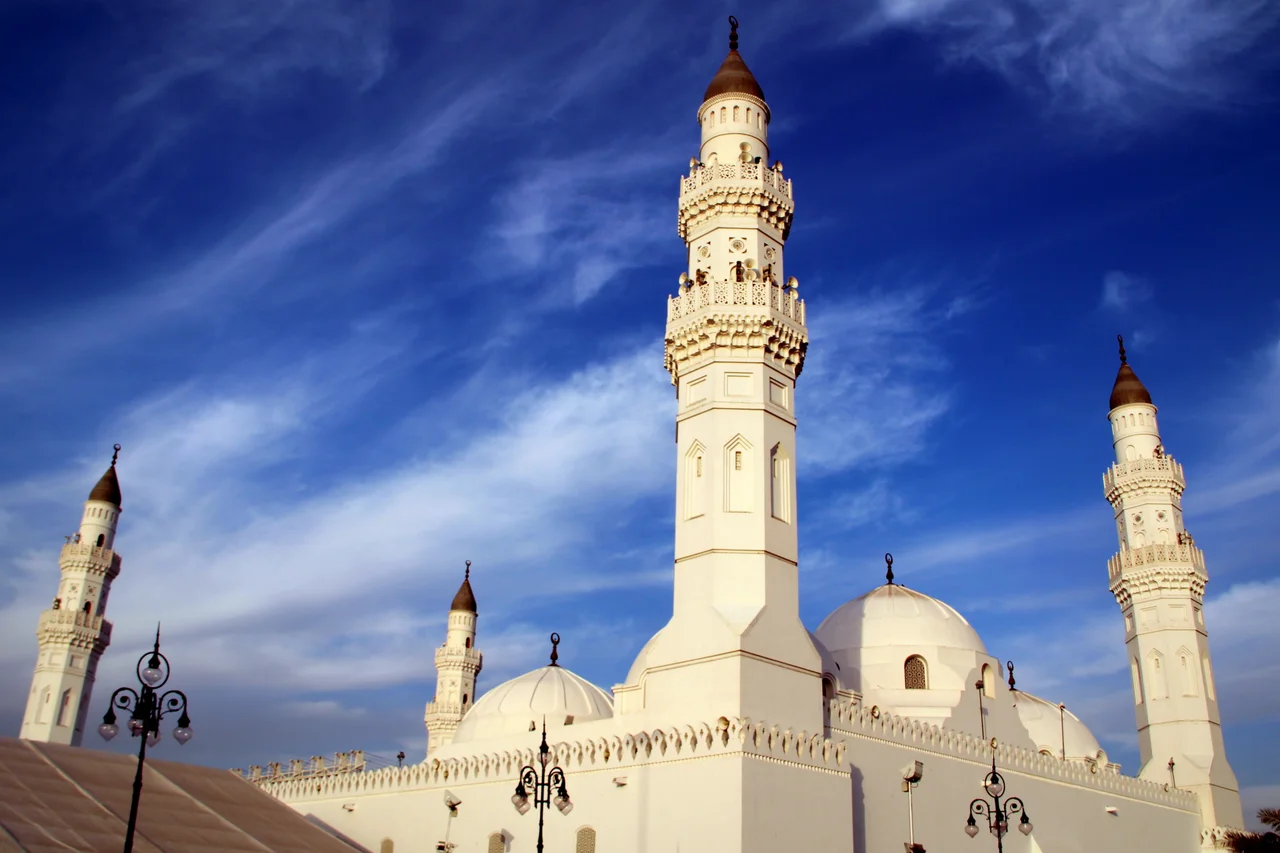

Quba Mosque
Before Medina was Medina, before the great mosque at its center, there was Quba. When the Prophet Muhammad completed his migration from Mecca in 622, the very first thing he is said to have done on arriving was to lay the foundation stone of a mosque in this village on the city's southern edge. By tradition that makes Masjid Quba the oldest mosque in the world, the place where the practice of building houses of prayer in Islam began. Muhammad set the first stone; his companions, the future caliphs Abu Bakr, Umar, and Uthman among them, laid the next.
The First Stone
The stories of how the site was chosen carry the texture of a real moment remembered many ways. Some accounts say the spot was a yard where Muhammad's host in Quba dried his dates; another holds it was where a woman named Labba had tethered her donkey; a later tradition, echoing the founding of the Prophet's Mosque, says Muhammad let his camel wander and built where it stopped. Whatever the detail, the meaning is constant: here the community that had just fled persecution in Mecca built its first place to pray together. Like the early Prophet's Mosque, it would at first have faced Jerusalem, and Muhammad most likely rebuilt it when the direction of prayer turned toward the Kaaba. He returned to Quba often, riding or walking out every Saturday to pray within its walls.
The Reward of a Pilgrimage
Quba's special standing comes from the Prophet's own devotion to it, preserved in his sayings. He told his followers that whoever performs ablution at home and then comes to pray in the Mosque of Quba earns a reward like that of an Umrah, the lesser pilgrimage to Mecca. That promise has drawn worshippers ever since, and the merits of Quba are mentioned across the great collections of hadith. Many Muslims also identify Quba with the mosque the Quran describes as "founded on piety from the first day," the Masjid al-Taqwa. For pilgrims who come to Medina for the Prophet's Mosque, a visit out to Quba is a cherished part of the journey, a chance to pray where the very first congregation gathered.
Rebuilt for the Modern Age
The mosque that stands today is not the humble walled enclosure of the seventh century. The original was a simple square court with a roofed prayer area on the qibla side, expanded by later rulers over the centuries. Then, in the 1980s, it was rebuilt almost entirely. King Fahd laid the foundation stone for a sweeping reconstruction in November 1984, and the new mosque was inaugurated in November 1986, enlarged nearly ninefold to hold some twenty thousand worshippers. The architects, including the Egyptian master Abdel-Wahed El-Wakil, deliberately kept the spirit of Medinan building: ribbed white domes, basalt facing, latticework that filters the light of the surrounding palm groves, and a modest exterior recalling the city's old simplicity. The result rests on traditional clay-block construction rather than poured concrete, fifty-six domes and four minarets rising over a courtyard floored in black, red, and white marble.
Still Growing
Quba's story is not finished. In April 2022 the Saudi crown prince announced the largest expansion the mosque has ever seen, a project named for King Salman that aims to multiply its area roughly tenfold and lift its capacity toward sixty-six thousand. Rather than enlarge the historic building itself, the plan wraps it in covered plazas on all four sides and revitalizes the surrounding district, easing the flow of the crowds who pour out from central Medina. There is a quiet continuity in all this construction. The Prophet once walked the road from his mosque to Quba every week, and the city has even worked to restore that path for pilgrims on foot. Fourteen centuries on, people are still making the same short, meaningful journey to the place where it all began.
From the Air
Masjid Quba sits on the southern outskirts of Medina at roughly 24.439 degrees north, 39.617 degrees east, a few kilometers south of the Prophet's Mosque. From the air it is recognizable as a bright white mosque complex with four slender minarets and a cluster of ribbed white domes, set amid the date-palm groves and dense low-rise neighborhoods of southern Medina. Like the rest of the city's sacred core, the area is closed to non-Muslims, so it is best viewed from altitude or a respectful distance. The historic Quba Road runs north from the mosque toward the city center, a useful visual line of reference. Nearest airport: Prince Mohammad bin Abdulaziz International (ICAO OEMA), about 18 km to the north-northeast; the regional gateway is Jeddah's King Abdulaziz International (OEJN), some 350 km southwest. Dry, clear Hejaz skies give strong visibility through most of the year.
Nearby Stories
- Battle of Badr 64 km away
- Khaybar 105 km away
- Hejaz 116 km away
- Mahd Al-Dhahab 138 km away
- Ghadir Khumm 167 km away
- Al-Ula 231 km away
- Hegra 277 km away
- Rock Art of Hail Province 367 km away