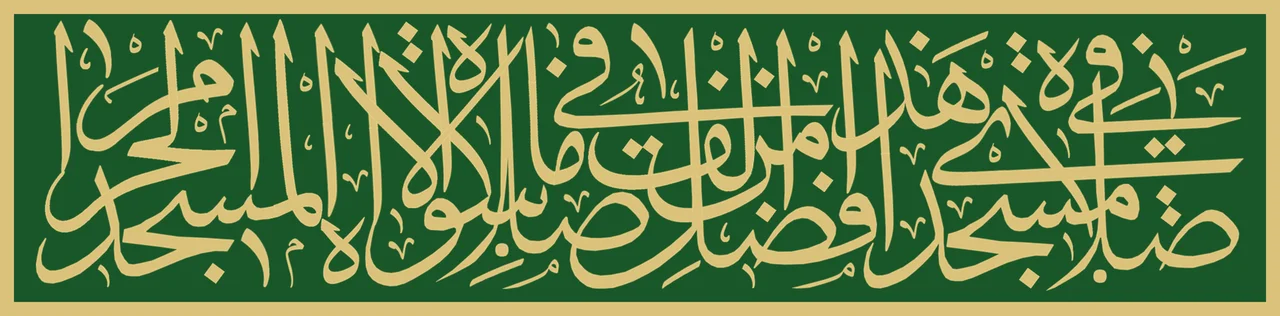

Prophet's Mosque
When the Prophet Muhammad reached Medina in 622, the camel he rode, Qaswa, knelt on a plot of open ground, and there he resolved to build. The land belonged to two orphaned brothers, Sahl and Suhayl, who offered it as a gift; Muhammad refused to take it for free and insisted the price be paid, because they were children. What rose on that spot became al-Masjid an-Nabawi, the Prophet's Mosque, the second-holiest site in Islam after the sanctuary in Mecca. It is also the place where, beneath a dome painted a deep, unmistakable green, Muhammad himself is buried.
A Mosque Built by Hand
The first mosque was a modest thing, and the Prophet helped build it. An open-air rectangle of mud-brick walls, its roof of palm trunks and beaten clay rose barely over head height, and palm-leaf thatch gave the only shade. It took about seven months to finish. This was far more than a place to pray. The mosque served as the community's town hall, its courthouse, and its school, with a raised pulpit, the minbar, from which Muhammad taught and delivered the Friday sermon. In those first years the worshippers faced north toward Jerusalem, until the direction of prayer, the qibla, was turned toward the Kaaba in Mecca. A platform along one wall, the Suffah, sheltered the poorest of his followers, who had nowhere else to live.
Layers of Empire
Every dynasty that ruled the Islamic world left its mark here, expanding and adorning the mosque in turn. The caliph Umar enlarged it; Uthman rebuilt it in stone. The great transformation came under the Umayyad caliph al-Walid I around 706, who brought in mosaicists and craftsmen and, controversially, demolished the living quarters of the Prophet's wives to expand the building, drawing the graves of Muhammad and the first two caliphs into the structure itself. His renovation introduced the first concave prayer niche, the mihrab, in Islamic architecture, and possibly the first minarets. Abbasids, Mamluks, and Ottomans each added their own walls, gates, and towers, so that the mosque became a living record of Islamic art across the centuries, every ruler inscribing his name into its stone.
The Green Dome
The single most recognizable feature of the mosque was a comparatively late addition. The dome over the Prophet's tomb was built in 1818 during the reign of the Ottoman sultan Mahmud II, and in 1837 it was painted the green that gave it its name, the Kubbat al-Khadra. Beneath it lies the chamber that was once the room of Aisha, the Prophet's wife, holding the graves of Muhammad and his two companions and fathers-in-law, Abu Bakr and Umar. A fourth space is left empty, reserved by Islamic belief for Jesus, who Muslims hold will return. Adjacent stands the Rawdah, the strip of ground between the Prophet's pulpit and his tomb that a famous saying calls a garden of Paradise, the most sought-after few square meters in the whole sanctuary.
An Ocean of Pilgrims
The mosque of today would astonish its founders. Successive Saudi kings have expanded it on a colossal scale, and a project completed under King Fahd in the 1990s, with escalators and dozens of courtyards, was followed by still grander plans, until the structure is built to hold well over a million worshippers at once. Engineering serves devotion in striking ways: the oldest Ottoman prayer hall is roofed with great sliding domes that glide apart on metal tracks, and the surrounding plazas bristle with giant retractable umbrellas, designed by the German Muslim architect Mahmoud Bodo Rasch, that bloom open to shade the faithful from the desert sun. Almost always open, day and night, the mosque has closed to visitors only once in modern times, as Ramadan arrived during the pandemic of 2020. The rest of the time, a tide of pilgrims flows endlessly around the Green Dome.
From the Air
Al-Masjid an-Nabawi stands at the heart of Medina, near 24.468 degrees north, 39.611 degrees east. It is the single most prominent landmark in the city and is easily identified from altitude: an immense complex of marble plazas studded with minarets, with the green-painted dome over the Prophet's tomb at its southeastern corner. The sacred central district may not be entered by non-Muslims, so this is best appreciated from the air or from a respectful distance. By day the white marble courtyards and the ranks of folded sunshade umbrellas reflect brilliantly against the surrounding city. Nearest airport: Prince Mohammad bin Abdulaziz International (ICAO OEMA), about 15 km northeast; the regional gateway is Jeddah's King Abdulaziz International (OEJN), roughly 350 km southwest. Clear, dry Hejaz skies offer excellent visibility for most of the year.
Nearby Stories
- Battle of Badr 64 km away
- Khaybar 105 km away
- Hejaz 116 km away
- Mahd Al-Dhahab 138 km away
- Ghadir Khumm 167 km away
- Al-Ula 231 km away
- Hegra 277 km away
- Rock Art of Hail Province 367 km away