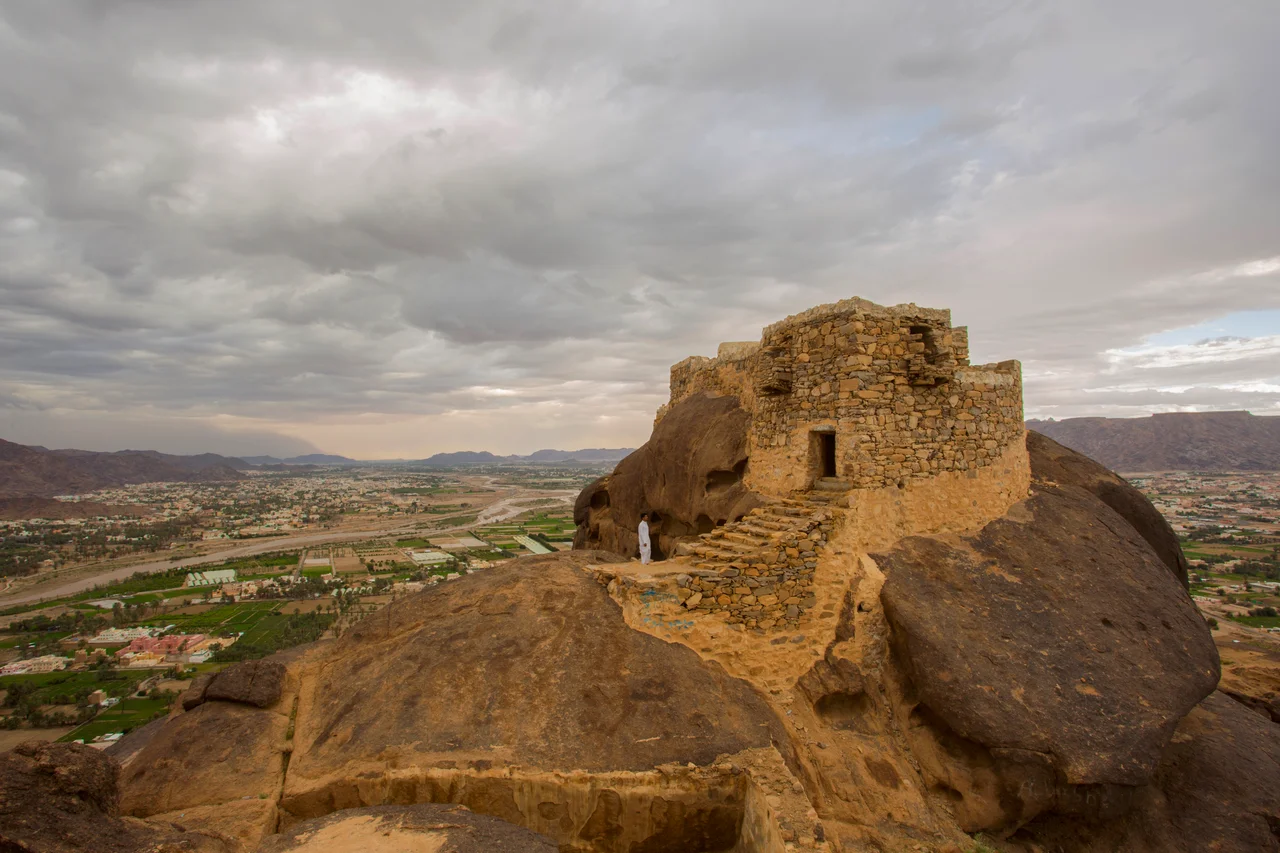

Najran Province
In February 523 AD, a Jewish king named Dhu Nuwas, ruler of the Himyarite kingdom in what is now Yemen, arrived at the gates of Najran. The city had already surrendered. He accepted the capitulation and then, according to a letter preserved by Simeon, the bishop of Beth Arsham, he demanded that the Christian inhabitants renounce their faith. Those who refused were massacred. Some sources place the death toll as high as 20,000. The site of that massacre, Al-Ukhdud, still lies in ruins at the edge of modern Najran, and the Quran itself, in Surah Al-Buruj, remembers those who were thrown into a flaming trench. Christian, Jewish, Ismaili Muslim, Sunni Muslim; Najran has been all of these, and it has paid for each transition.
The Incense Crossroads
According to Greek and Roman sources, Najran was a focal point of the ancient Incense Route. All caravans leaving Yemen for the north or west had to pass through here, where the route split: one branch ran north through the Hijaz to Egypt and the Levant, another ran northeast toward Gerrha on the Persian Gulf. In 25 BC, the Roman prefect of Egypt Aelius Gallus led a costly and ultimately disastrous expedition to conquer Arabia Felix; he won a battle near Najran and occupied the city briefly, using it as a base to attack the Sabaean capital at Ma'rib. Strabo, who is one of our principal sources for the campaign, called the city Negrana. By the time of Muhammad in the early 7th century, Najran was a center of arms manufacture, though it was more famous for its leather than for its iron.
The Christians of Najran
Christianity arrived in Najran in the 5th century, perhaps earlier. According to the early Muslim historian Ibn Ishaq, it was the first place in South Arabia where Christianity took root. The community flourished. When the Jewish king Dhu Nuwas came in 523, they were a wealthy and visible minority; when he massacred them for refusing conversion, the event reverberated through the Christian world. A triumphal inscription called Ja 1028, commissioned by one of Dhu Nuwas's commanders, celebrated the killings. The Christian community was eventually restored, and after the rise of Islam the Christians of Najran negotiated a treaty with Muhammad: an annual tribute of 2,000 pieces of clothing, in exchange for protection. The agreement was renewed under the first two caliphs. Then in 641 CE, under Caliph Umar, the Christians of Najran were accused of usury and ordered to leave. They were resettled in Mesopotamia, where they founded a community near Kufa they called Najraniya. Najran's Christian chapter ended there.
The Jews of Najran
Najran also had a Jewish community dating to pre-Islamic times, historically associated with the Banu al-Harith tribe, originally Yemenite Jews who had conquered the city and ruled it before the Christian arrival. With the Saudi conquest of Najran in 1934, pressure on the community grew. In September and October 1949, some 200 Najrani Jews fled south to Aden following the creation of the state of Israel. Saudi King Ibn Saud demanded their return; Yemeni King Ahmad bin Yahya refused, citing the fact that these were Yemenite Jews. They settled at Hashid Camp (Mahane Geula) and were airlifted to Israel as part of Operation Magic Carpet. Other groups of Najrani Jews escaped to Cochin in India, where they had long-established trade ties with the Paradesi Jewish community.
The Ismaili Majority
Today Najran is inhabited primarily by the Yam tribe, a significant portion of whom are Sulaymani Ismaili Muslims, followers of one of the two main branches of contemporary Ismailism, with co-religionists in India, Pakistan, and Yemen. In Najran city, the Khushaywah compound and its Mansura Mosque complex form the spiritual capital of Sulaymani Ismailism. Saudi government policy has long discriminated against this community, excluding them from decision-making and publicly disparaging their faith. In 1996, relations soured further under Governor Mishal bin Saud. On 23 April 2000, after police closed all Tayyibi Ismaili mosques on a religious holiday and arrested an Ismaili cleric, an armed demonstration outside Najran's Holiday Inn turned into a firefight. Two Ismailis and, according to some government accounts, one policeman were killed. Ismaili men erected defenses around Khushaywah. The army surrounded the position and retook control that same day without further bloodshed.
A Valley Between Mountains and the Empty Quarter
The province covers 149,511 square kilometers, making it one of the largest in Saudi Arabia by area but one of the smallest by population. Its geography is tripartite: the flat central area (including the fertile Najran valley itself), the mountainous west and north where weather stays moderate and nabk trees shade village parks, and the eastern sandy region that forms part of the Empty Quarter, the Rub' al Khali, rich in both oil and groundwater. The Najran Valley Dam, 35 kilometers from the city, is a major civil landmark with a 4.5-meter-wide road across its top. The As-Saud Waterfall is visible from considerable distance. The local cuisine reflects the fertility of the valley: Al-Burr breakfast bread filled with milk, honey, or dates; Al-Maasooba made from corn flour softened with soup; Al-Margoog, a stew of dough and vegetables cooked together in a single pot. In a country known for its capital and its coast, Najran has always kept its own counsel.
From the Air
Najran Province lies at the southern edge of Saudi Arabia along the Yemen border. Capital Najran city is at 17.492°N, 44.132°E. Principal airport is Najran Regional Airport (OENG). Elevations range from Rub' al Khali sand in the east (around 600 m) to mountain peaks in the west exceeding 2,000 m. Yemen border region may have airspace restrictions related to conflict; check current NOTAMs. Recommended cruising altitude 10,000-15,000 ft in clear weather; distinctive granite mountain massifs and the broad Najran valley are the principal visual landmarks.
Nearby Stories
- Houthi insurgency 50 km away
- Abu 'Arish 85 km away
- Emirate of Asir 110 km away
- Mundafan 116 km away
- Asir 152 km away
- Sheba 211 km away
- Dhorm Mountain 236 km away
- Marib Dam 241 km away