
The Sack of Baltimore
On the night of 20 June 1631, while the village of Baltimore in West Cork slept, two ships from North Africa came in around the headland and put landing parties ashore in the part of the village known then and still known now as the Cove. By the time the sun rose over Roaringwater Bay, more than a hundred people -- men, women, children, infants in their mothers' arms -- were aboard those ships, bound in chains, on the long voyage to the slave markets of Algiers. The lower number sometimes cited is around 107; some sources put it as high as 237. Most of them were English settlers, with some Irish among them. Only two or three would ever see Ireland again. The rest lived out their lives, and in most cases died, as the property of others in a country whose language they did not speak and whose religion they were not born to. The sack of Baltimore was the largest single Barbary slave raid ever launched against Ireland. The fact that it happened at all is almost the smaller part of the story. The fact that it has been so thoroughly forgotten is the larger.
Who They Were
The people taken from Baltimore that night were not a crowd. They were specific. They were English Puritan settlers and their Irish neighbours, plantation farmers and fishermen and their families, who had built a small village and a pilchard fishery on land leased from the O'Driscoll chief Sir Fineen. Sir Thomas Crooke had brought the first of them across around 1605, with the blessing of King James I, into what had previously been pirate country. By 1631 the village was twenty-six years old. The children taken that night had been born there. The parents had built the houses, salted the fish, raised the babies in this place where the Atlantic comes hard against the rock. They went to sleep on the night of 19 June in their own beds. Almost none of them ever slept in those beds again. They are the people the story is about. Anything else is background.
Murad Reis the Younger
The raid was led by a Dutch captain from Haarlem named Jan Janszoon, who had himself been enslaved by Barbary pirates years before and had bought his freedom by converting to Islam, taking the name Murad Reis the Younger and joining the corsairs whose captives he had once been. His was not an unusual story in the Algiers of the 1630s. The pirate fleets operating out of the regency were crewed by men from every corner of Europe, North Africa, and beyond -- former Christians who had become, in the Spanish phrase of the time, renegados, and who according to the contemporary Spanish chronicler Antonio de Sosa included an Irish community of their own. Murad's force in 1631 was a mix of European renegades and Algerian sailors. They had been guided into Baltimore Harbour by an Irish Catholic fisherman of Old English descent named John Hackett, whose own boat they had captured shortly before the raid. Whether Hackett collaborated to save his own life, or for darker reasons -- the conspiracy theories surrounding the raid have never fully gone away -- is a question the historical record cannot settle. Hackett was hanged from a cliff-top outside the village afterwards, for treason.
The Conspiracy
In his 2006 book The Stolen Village, the journalist Des Ekin makes the case that the timing of the raid was no accident. The lease under which the English Puritan settlers held Baltimore had been granted on 20 June 1610, for twenty-one years. It was due to expire on 20 June 1631 -- the precise day of the raid -- with the land then transferring as collateral for Sir Fineen O'Driscoll's debts to the Cork lawyer and moneylender Sir Walter Coppinger. Coppinger had spent years trying to evict the Puritans early to get at the lucrative pilchard fishery; the courts had ruled in 1630 that the settlers could not be evicted, that they had invested too much, and that Coppinger had to rent the land to them in perpetuity. Ekin argues, without claiming proof, that Coppinger then arranged for the Barbary pirates to clear the village by force, working through O'Driscoll exiles in Habsburg Spain as intermediaries. The English authorities had picked up intelligence that Murad was planning a raid on the County Cork coast, but they thought the target was Kinsale and not Baltimore. The villagers were not warned. Whatever happened in the negotiations no one survived to write down.
Algiers
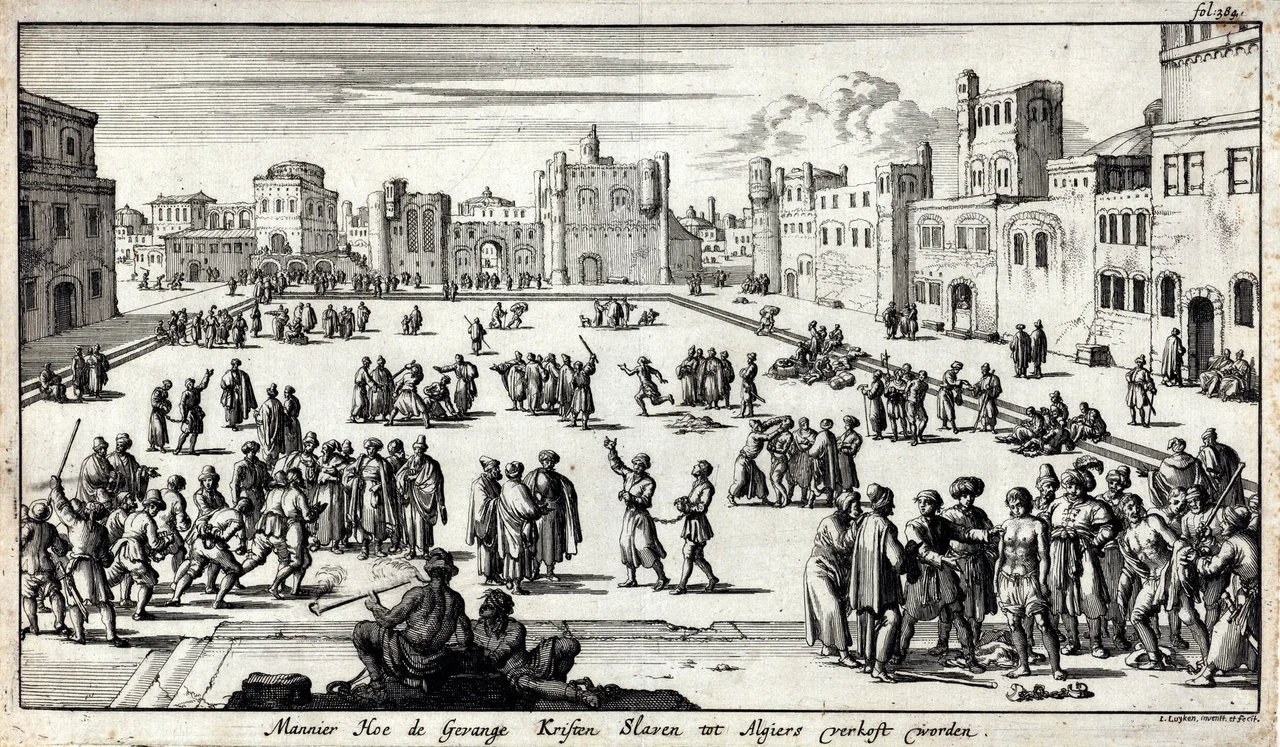
In Algiers the captives were taken to the slave market that visitors to Baltimore today can read about in the 1684 engraving still sometimes reproduced beside the story. Families were separated at the auction block. Some of the men were sold to row in the Mediterranean galleys, where they lived chained to the oars for as long as their bodies held out, never setting foot on shore. Women and children went into domestic slavery; some of the women into harems. One man, Joane Broadbrook, was ransomed almost at once; two more, William and Stephen Broadbrook, were ransomed in 1646, fifteen years later. The rest were never accounted for. They died in Algiers, or in Ottoman ports further east, or wherever the slave trade carried them. The remaining villagers of Baltimore, the ones who had not been in the Cove that night, abandoned the place and moved up the coast to Skibbereen. Baltimore stayed virtually deserted for generations. The houses fell in. The fishery collapsed. The village that exists today is, in a sense, a different village, rebuilt later on the same ground. The pub now standing in Baltimore is called The Algiers Inn, with North African decor. The Irish poet Thomas Davis wrote a 19th-century ballad about it. The British rock band The Darkness wrote a song called Roaring Waters about it in 2015. The thing it remembers is real.
From the Air
The site of the sack -- the cove at Baltimore Harbour -- is at approximately 51.48N, 9.37W in southwest County Cork. Cork Airport (EICK) is roughly 90 km east-northeast; Kerry Airport (EIKY) approximately 95 km north-northwest. From the air, the village sits on the western shore of the harbour, with the white cone of the Baltimore Beacon on the eastern headland and Sherkin Island lying south across the channel. The area of the village called the Cove -- where the landings took place in 1631 -- is on the north side of the harbour. Best in clear westerly conditions; Atlantic weather closes the area down quickly. From altitude the Algiers-bound corsairs would have come up the open Atlantic from the south, swinging in close round the headland between Sherkin and the mainland.
Nearby Stories
- Bear (barony) 2.5 km away
- Castle Donovan 2.7 km away
- Bandon, County Cork 8.1 km away
- HMHS Llandovery Castle 14 km away
- The Sinking of the Lusitania: The Torpedo That Changed the War 17 km away
- Wolfpack Prien 61 km away
- SM U-27 111 km away
- 1356 Lisbon Earthquake 1629 km away