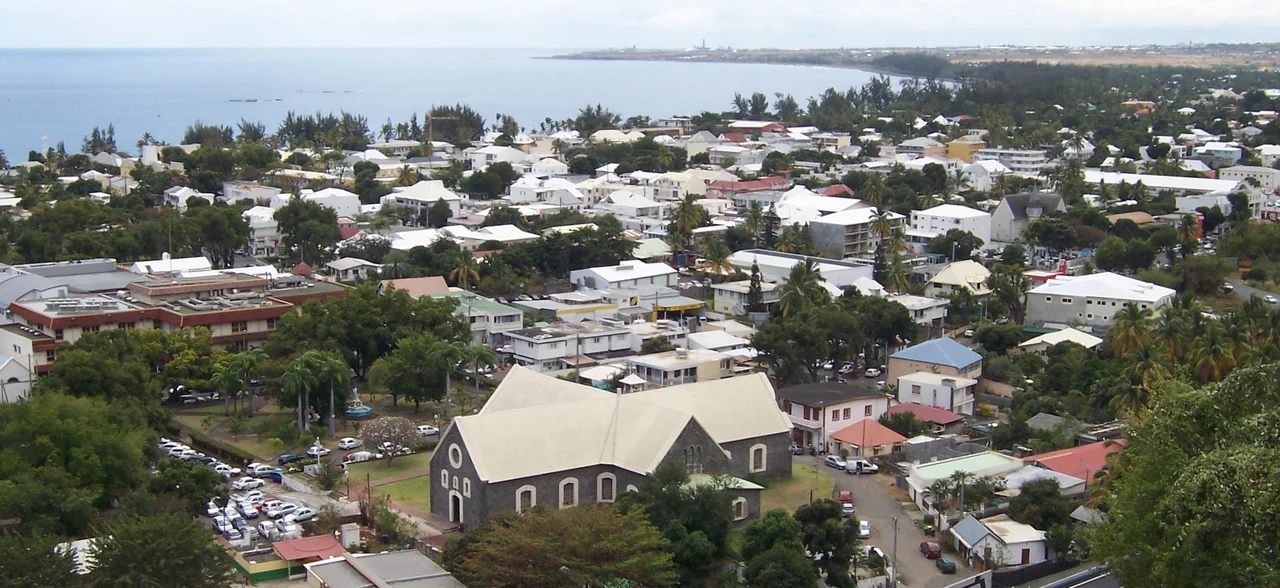

Saint-Paul, Réunion
The treasure hunters come for a grave. In a cemetery wedged between black sand and a wall of basalt cliffs, they crouch over a weathered headstone carved with a skull and crossbones, copying its markings, convinced it points to a fortune. The tomb belongs to Olivier Levasseur - "La Buse," the Buzzard - a French pirate hanged in 1730, and the legend that he scattered a coded map of his loot to the crowd at his execution has lured fortune seekers to Saint-Paul for the better part of a century. None has found a thing. But the pull of the story says something true about this place: Saint-Paul is where Réunion's recorded history begins, and the town wears its centuries openly, layered along a single curving bay.
Where the Island Began
In November 1663, two Frenchmen named Louis Payen and Pierre Pau stepped ashore on the western coast of an uninhabited volcanic island then called Bourbon. They did not come alone. With them arrived ten Malagasy servants - in truth, the island's first enslaved people, brought from nearby Madagascar to clear and work a land that had no human history at all. Slavery would shape the colony for nearly two centuries, drawing captives from Madagascar, East Africa, and India; many fled into the rugged interior to escape it, and in Saint-Paul alone hundreds became fugitives in the early 1730s. The settlers chose this spot because its leeward shore offered the calmest anchorage and steadiest winds on the island. From this beginning grew a colony, and Saint-Paul became Bourbon's first capital, the seat from which the island was governed until that role shifted permanently to Saint-Denis in 1738.
The Buzzard's Grave
Olivier Levasseur earned his nickname for the speed with which he fell upon his prey. His greatest prize was the Portuguese ship Nossa Senhora do Cabo, seized off these very waters in 1721 with a hold full of treasure. Captured years later, he was hanged for piracy at Saint-Paul in 1730, in front of the church, and buried in the seaside cemetery nearby. The famous tale - that he flung a 17-line cipher to the spectators crying "Find my treasure, who can!" - is almost certainly fiction, invented in a 20th-century novel and absent from every record of his death. Yet the cryptogram has taken on a life of its own, sending divers and diggers across the Indian Ocean in search of a hoard that may never have existed. The grave endures as both a curiosity and a monument to how a good story outlives the truth.
Poets in the Sea-Cemetery
Pirates are not the only famous residents of the Cimetière marin. The same ground holds Réunion's literary dead. Leconte de Lisle, born in Saint-Paul in 1818 and later acknowledged as France's foremost poet after the aging Victor Hugo, is commemorated here, along with the poet Eugène Dayot and the painter Arthur Grimaud. There is a fitting symmetry to a cemetery that gathers a buccaneer and a Parnassian poet beneath the same cliffs - the violent and the lyrical sides of a small island that, for all its remoteness, kept reaching toward the wider world.
A Town Between Cliff and Sea
Saint-Paul today is Réunion's second-largest town, strung along its bay beneath the towering rampart of the interior. Its lively Friday and Saturday market spills across the seafront, a riot of vanilla, spices, fruit, and woven baskets that has long been a fixture of island life. The graceful Hôtel de Ville dates from around 1740, a survivor of the colonial era. Just inland rises a landscape so steep and folded that Réunion's planners have struggled for decades to connect Saint-Paul to the rest of the island - a proposed tram line to the town was abandoned in 2010 for lack of funds. The mountains that make Saint-Paul beautiful also keep it hemmed against the sea, exactly as they did when the first settlers chose this shore.
From the Air
Saint-Paul sits on Réunion's leeward west coast at 21.01°S, 55.27°E, recognizable from the air as an urban strip pinned between a wide bay and the abrupt basalt cliffs and ravines of the island's interior. Just south lies the Étang Saint-Paul wetland and, beyond it, the turquoise lagoon of Saint-Gilles. Roland Garros Airport (ICAO: FMEE) is roughly 25 km northeast on the north coast near Saint-Denis; Pierrefonds Airport (ICAO: FMEP) lies to the south near Saint-Pierre. The town is best seen mid-morning during the dry austral winter (May-October), when the leeward coast stays clear while cloud gathers over the central peaks of the Piton des Neiges massif.
Nearby Stories
- Tromelin Island: The Forgotten Enslaved People of the Isle of Sand 540 km away
- Battle of Tamatave 644 km away
- Toamasina 688 km away
- Canal des Pangalanes 742 km away
- Fianarantsoa 858 km away
- Siege of Galle (1640) 3989 km away
- Galle Fort 4010 km away
- French Western Australia 5783 km away