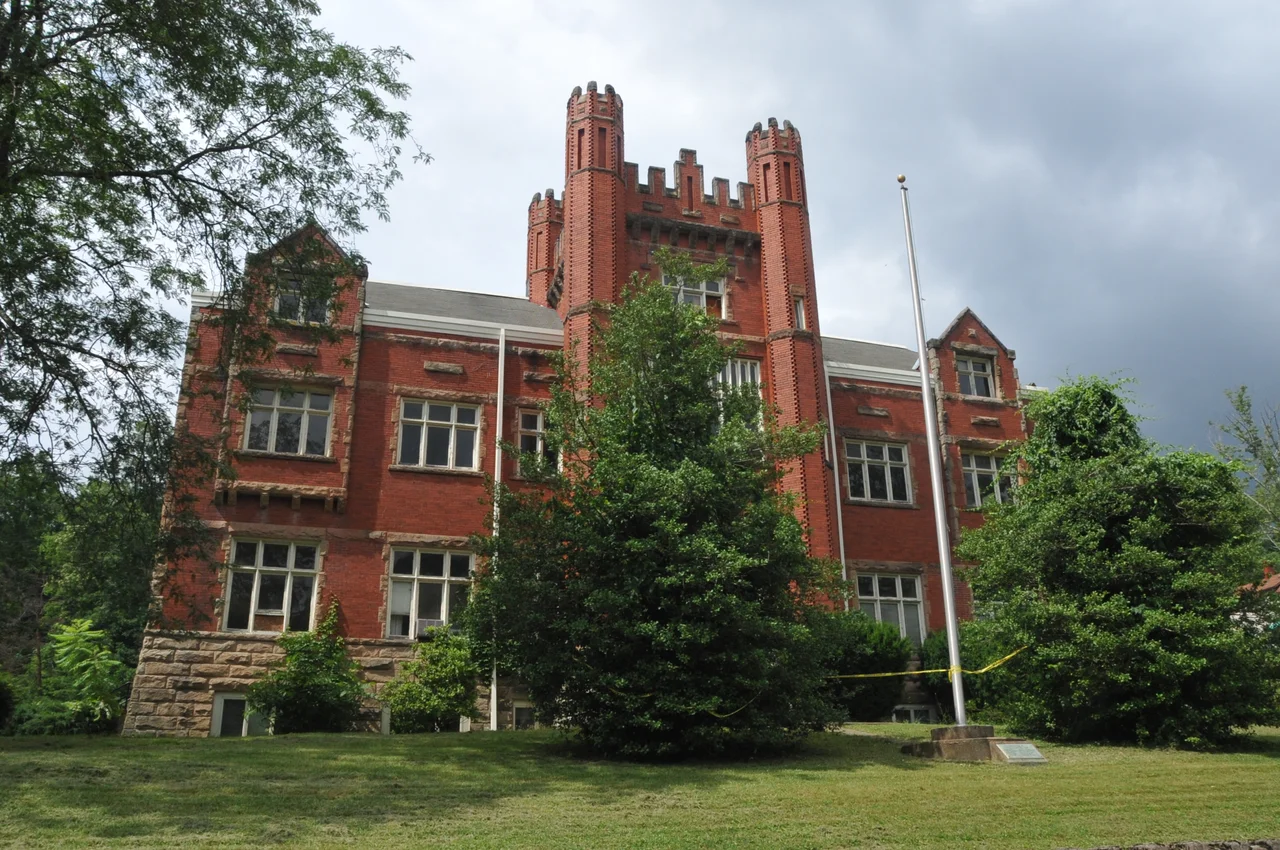

Salem University
For most of the 1990s, the dominant language on the campus of Salem College in West Virginia was Japanese. The school had been struggling financially, and in 1989 an alliance with Teikyo University in Tokyo brought nearly two hundred Japanese freshmen to the small town of Salem in northern Harrison County. The Los Angeles Times sent a reporter to write about the experiment, which produced a profile titled 'East Meets West Virginia: When a Japanese University Takes Over a Small Appalachian College, Football Is Out, the Dairy Queen Is In and Love Blooms on Main Street.' The Teikyo arrangement ended in 2000. Investors from Singapore bought the school. The name changed to Salem International University. Five years later it changed hands again. In 2017 it became simply Salem University. Through every transformation, the institution founded by the Seventh Day Baptists in 1888 has kept its doors open.
The Seventh Day Baptists
The Seventh Day Baptists are a small, historically distinctive American Protestant denomination, distinguished from other Baptists by their practice of observing the Sabbath on Saturday rather than Sunday. They are not numerous - probably fewer than five thousand members in the United States - but they have been organized in America since the seventeenth century, longer than most Protestant denominations. In December 1888 the Eastern Seventh Day Baptist Association obtained a state charter to build the Academy of Salem in northern Harrison County, West Virginia, where a Seventh Day Baptist community had settled. The charter required that the academy become a college as soon as practicable; that conversion happened in 1890. Through most of the twentieth century the school operated as a small liberal arts and teacher-education institution, technically Seventh Day Baptist but non-sectarian in its teaching and administration. It produced governors and senators and football coaches, none of whom were notably Seventh Day Baptist in their public lives.
The Teikyo Years
By the late 1980s, Salem College - like many small denominational liberal arts schools - was struggling with declining enrollment and uncertain finances. The solution that materialized was unusual. Teikyo University, a large Japanese institution looking to give its students immersive English-language experience in an American setting, entered into an alliance with Salem. Nearly two hundred Japanese freshmen - 145 boys and 45 girls - enrolled together in the fall of 1989. The campus was reorganized to accommodate them. Football was de-emphasized. New student facilities were built. The Japanese students were taught American history and culture alongside English language; many lived with American host families in town; relationships and friendships formed across what should have been formidable cultural distance. The arrangement ran through the 1990s and produced both alumni and stories that endure in Salem to this day. It ended in 2000 when the school was sold to Singaporean investors and rebranded Salem International University.
From For-Profit to Online
Under the Singaporean ownership and a 2005 sale to Salem Education LLC, the school transitioned to a for-profit university structure with a heavy emphasis on online education. Today about 250 students attend on the historic Salem campus and about 600 study online. Programs are delivered in monthly cycles: classes are four weeks long, which allows degrees to be completed unusually quickly - an MBA or M.Ed. in twelve months, a bachelor's in forty months, an associate's in twenty - a structure aimed at non-traditional students who are juggling work, family, and education. The accreditation is held by the Higher Learning Commission, the same body that accredits most large American universities, which gives Salem's degrees a recognized standing in the employment and graduate-school markets despite the institution's small size and complicated history.
The Tigers in the Independent Wilderness
Salem athletics compete in NCAA Division II as the Tigers. The conference history is dizzying: charter member of the West Virginia Intercollegiate Athletic Conference from 1924, member through the WVIAC's dissolution in 2013; member of the Great Midwest Athletic Conference from 2013 to 2016; independent ever since for most sports. Since 2022 Salem has dual-affiliated with the United States Collegiate Athletic Association and has won three national championships in that body - men's basketball in 2023, women's basketball in 2024, baseball in 2025 - a remarkable run for a school of this size. The university also has a scheduling agreement with the Mountain East Conference that filled gaps when Alderson Broaddus University and Notre Dame College closed in 2023 and 2024. Salem fields fourteen varsity teams, including the unusual sport of water polo, which competes in the Western Water Polo Association.
Alumni From a Small College
The alumni list runs broader than the student-body numbers would predict. Two U.S. senators - Jennings Randolph (who later had the campus's Randolph House named for him) and Rush Holt Sr. - came through Salem. So did Matthew M. Neely, who served in both houses of Congress and as governor of West Virginia; and Cecil Underwood, who also served as the state's governor. College football has been a significant outlet: Jimbo Fisher, who won a national championship at Florida State in 2013, and Rich Rodriguez, the long-time West Virginia and Michigan coach who pioneered the spread option, both graduated from Salem. Adam Curry, the MTV video jockey of the 1980s who later became one of the inventors of the modern podcast, came through Salem before launching his media career. Michael B. Surbaugh served as Chief Scout Executive of the Boy Scouts of America. For a school of about 250 in-person students in a town of fewer than 1,800 people, the alumni footprint is unexpectedly large.
From the Air
Salem University is at 39.28 N, 80.56 W in northern Harrison County, West Virginia. Best viewed at 2,500-4,000 feet AGL; the historic campus on West Main Street and the surrounding small town of Salem are easy to identify. Nearest airport: North Central West Virginia Airport (KCKB) about 12 nm east at Clarksburg. US-50 passes through Salem to the north; the North Bend Rail Trail runs roughly east-west through the area, paralleling the highway. The hills of north-central West Virginia surround the town on all sides.
Nearby Stories
- West Virginia Industrial Home for Boys 8.5 km away
- Volcano, West Virginia 8.8 km away
- Burning Springs, West Virginia 9.1 km away
- West Virginia 16 km away
- Battle of Rich Mountain 26 km away
- West Virginia Penitentiary 41 km away
- The Monongahela: River of Black Gold and Dead Miners 52 km away
- The Y-Bridge of Zanesville 81 km away