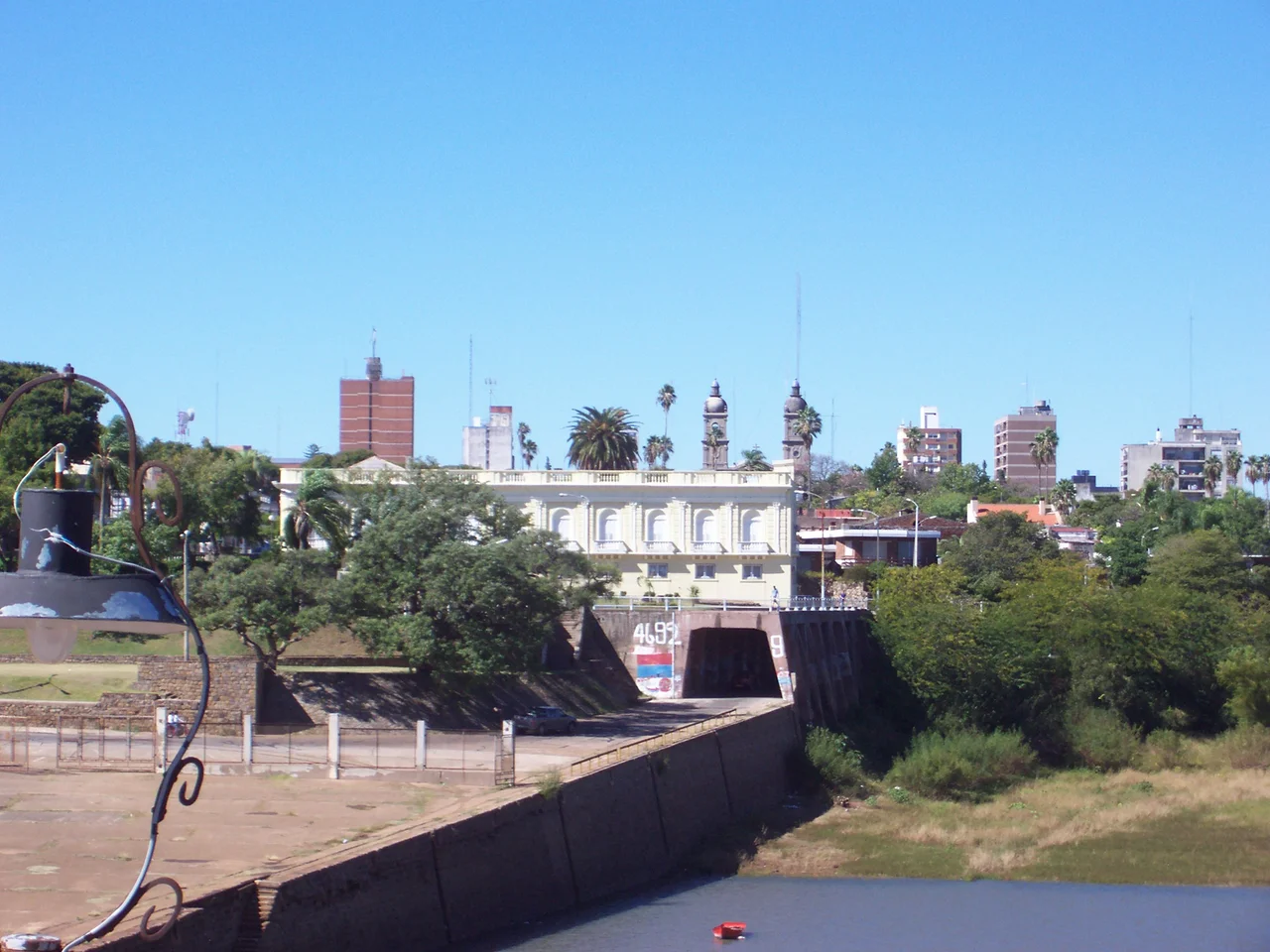

Salto, Uruguay
In the 1940s, prospectors drilled into the ground around Salto hoping to strike oil. They never found it. What they tapped instead, deep beneath northwestern Uruguay, was the vast Guaraní Aquifer, and the water that surged up was hot, mineral-rich, and steaming. The disappointment of one generation became the fortune of the next. Today the thermal springs that bubble from those old well sites draw visitors from across the region to pools kept above 38 degrees Celsius year round. Uruguay's second-largest city had gone looking for fuel and discovered, by accident, a reason for the world to come and soak.
The Big Jump
Salto takes its name from the river it sits beside. Here the Río Uruguay tumbles over rapids that early travelers called the salto, the leap or big jump, where the water breaks white over rock. The city rises on hills and bluffs above the eastern bank, looking across to the Argentine city of Concordia on the far shore. Just upstream, the great Salto Grande Dam now harnesses that drop, its long span doubling as a bridge that links the two countries. With more than 114,000 people counted in the 2023 census, Salto is the largest city in Uruguay's interior and second only to distant Montevideo, a regional capital of cattle country, citrus groves, and river trade.
A City of Builders and Writers
Salto has produced more than its share of remarkable people. The author Horacio Quiroga, master of the dark Latin American short story, was born here in 1878. So, more than a century later, were two of the most famous footballers Uruguay has ever sent into the world: Luis Suárez and Edinson Cavani, both born in Salto in 1987, both members of the national team that reached fourth place at the 2010 World Cup. The city's streets carry another signature too. The engineer Eladio Dieste, celebrated for his soaring brick vaults, left a remarkable concentration of his work in Salto, and a sculptural monument at the city's entrance, known locally as La Gaviota, the Seagull, greets arrivals with his spirit of inventive design.
The Rhythm of the River Town
Life in Salto moves to easy, sociable rhythms. On weekend nights people stroll the length of Calle Uruguay, the city's main street, gourd of mate in hand, stopping to talk with friends in the warm evening air. Many cross the river to shop in Concordia, then return. North of the city, the thermal complexes at Salto Grande and Daymán fill with families easing into the hot pools, a ritual built on those accidental wells. The climate is humid and subtropical, with long hot summers and mild winters, and the same warmth that makes the springs so inviting also keeps the citrus orchards heavy with fruit. Salto is unhurried, proud, and shaped at every turn by the river at its feet.
From the Air
Salto lies at about 31.39°S, 57.96°W on the east bank of the Río Uruguay in northwestern Uruguay, directly opposite Concordia, Argentina. The Salto Grande Dam and its bridge, roughly 12 km north of the city, are the standout landmarks from the air, spanning the river where it once leapt over rapids. The city is served by Nueva Hespérides International Airport (ICAO: SUSO), recently resurfaced and re-lit; across the river is Concordia's Comodoro Pierrestegui Airport (ICAO: SAAC), and about 120 km south lies Paysandú's Tydeo Larre Borges (ICAO: SUPU). A viewing altitude of 4,000 to 6,000 feet captures the city, the dam, and the river border in one frame. The low riverbank elevation, about 48 meters above sea level, and clear subtropical skies make for reliable visibility most of the year.
Nearby Stories
- Federación 17 km away
- El Palmar National Park 52 km away
- San José Palace 89 km away
- Battle of Masoller 116 km away
- Tacuarembó 126 km away
- Cayastá 173 km away
- Minas de Corrales 176 km away
- 1973 San Justo Tornado 215 km away