
Federación
Somewhere under the still green water of the Salto Grande reservoir lies a town that was founded in 1777. Its streets, its plaza, its houses — all of it sits on the riverbed now, demolished and submerged on purpose. The Federación you can visit today is barely more than four decades old, a planned city built from scratch on higher ground because the old one was condemned to flood. Few places carry their own death and rebirth so plainly. Walk the spotless lakefront promenade and you are standing above the ghost of everything that came before.
The Town That Had to Move
The decision to dam the Uruguay River sealed Federación's fate. As the Salto Grande hydroelectric project advanced, the rising reservoir would swallow the original riverside town, so the people had to leave it. Through the late 1970s, roughly 82 percent of the population was relocated a few kilometers to the northwest. The new city was formally inaugurated on March 25, 1979 and named Nueva Federación. Days later, on April 1, the filling of the reservoir began. Before the water came, the old town was demolished — not abandoned to decay but deliberately razed, so that little would float free. Only a few peripheral neighborhoods on higher ground survived, remembered now as Vieja Federación, Old Federación.
A City With No Past in Its Walls
Most towns wear their history in crooked streets and weathered facades. Federación cannot. Everything you see was laid out at once, in the same brief window, with the orderly geometry of a place designed rather than grown. The effect is unusual: a town that is genuinely centuries old in spirit but only decades old in stone, its memory severed from its body. The local economy held onto what it could carry across the water — citrus groves and timber, the same crops that fed the old town. The fruit trees do not care that the ground beneath them changed; they simply went on bearing oranges in a new place with an old name.
Hot Water From Far Below
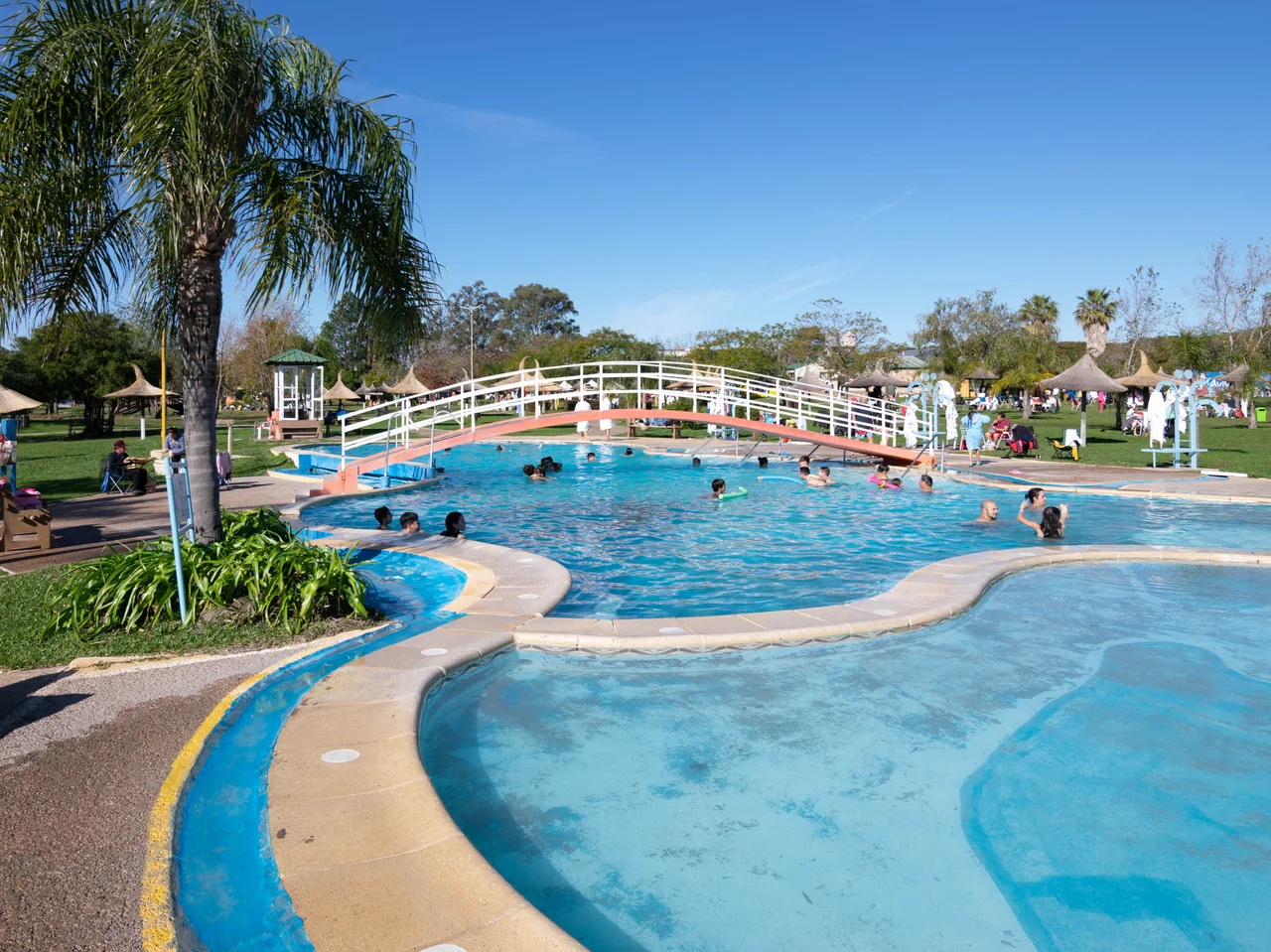
Federación's modern fortune rose, fittingly, from beneath the earth. The town's thermal complex draws water from a depth of 1,268 meters, where it emerges at a constant 42°C — hot enough to be classified as hyperthermal. Around those springs the town built one of the most visited spa destinations in Argentina, complete with a water park, and offering kayaking, horseback riding, craft fairs, and walks through the Chaviyú forest reserve. A place that lost everything to water found a second life in it. The same river that drowned the old town now laps against an eight-kilometer lakefront avenue, the Costanera, where the rebuilt city turns its face to the reservoir it once feared.
The Weight of a Planned Goodbye
It is one thing to lose a town to a flood that arrives without warning. It is another to know for years that the water is coming, to pack a life and carry it uphill, and then to watch the bulldozers level the streets where you were born so the reservoir can rise over clean ground. That is what the people of Federación lived through. The town keeps the memory deliberately, much as it once kept its citrus and timber. The Museo de la Imagen gathers photographs of what was lost, and the name Vieja Federación still clings to the surviving high-ground neighborhoods, a quiet reminder that the bright new city has an older self resting on the riverbed. To live here is to know your hometown twice — once above the water, once beneath it.
Subtropical and Slow
This is a small town, and it knows it. Taxis are cheap, distances are short, and most residents get around on foot or by bicycle. The climate is gently subtropical, averaging around 25°C in summer and a mild 13°C in the depths of winter, with generous rainfall topping 1,200 millimeters a year, heaviest in autumn and spring. Visitors come for the springs and stay for the unhurried rhythm: a harbor, a breakwater called the Espigón Stella Maris, and pizzerias by the dozen. You can buy leather goods, knives, semiprecious stones, mate gourds, and jars of regional jams and sausages. It is the kind of place built, quite literally, for a fresh start.
From the Air
Federación lies on the western shore of the Salto Grande reservoir at 30.98°S, 57.92°W, in northeastern Entre Ríos. The closest sizable airport is Concordia's Comodoro Pierrestegui (ICAO: SAAC), roughly 50 km south along the river. From 2,000–4,000 feet the planned grid of the town reads clearly against the broad blue sheet of the reservoir, with the eight-kilometer Costanera tracing the waterfront. The Salto Grande Dam itself spans the river to the south, a major navigational landmark on the Argentina–Uruguay frontier. Calm, clear days from April through September give the steadiest views over the water.
Nearby Stories
- Salto, Uruguay 17 km away
- Brazilian Island 67 km away
- Uruguaiana 114 km away
- Battle of Masoller 116 km away
- San José Palace 128 km away
- Tacuarembó 134 km away
- Cayastá 173 km away
- Moisés Ville 299 km away