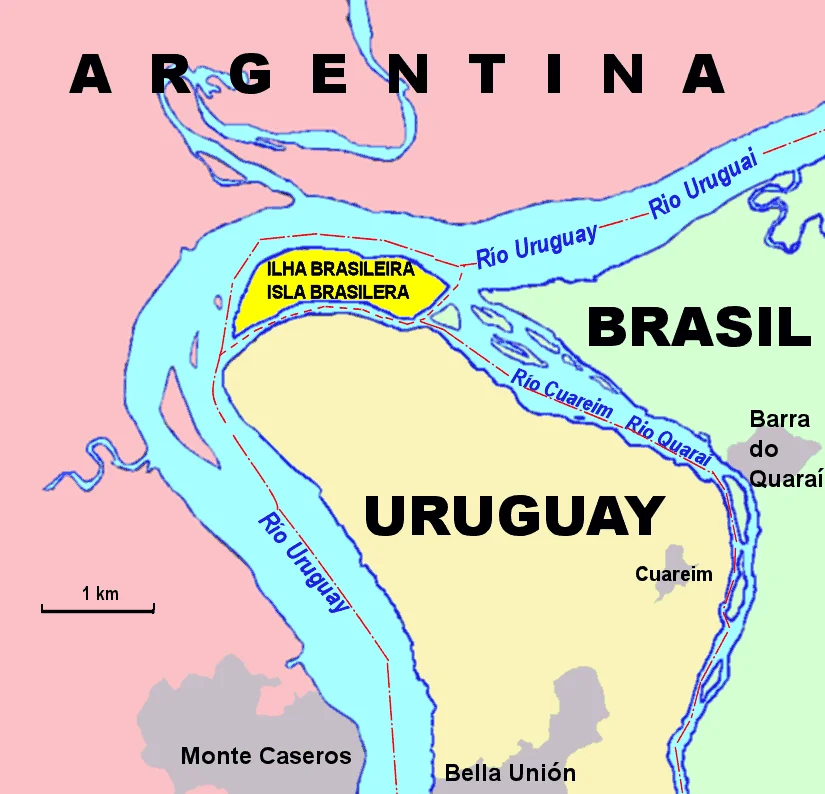

Brazilian Island
For forty-seven years, the most disputed sliver of land in the Southern Cone had exactly one resident. From 1964 to 2011, a Brazilian farmer named José Jorge Daniel lived alone in a single house on Isla Brasilera, a low green island where the borders of Argentina, Brazil, and Uruguay converge in the middle of a river. Two nations have claimed the ground under his feet for over a century. Neither has ever sent a soldier to take it. And when Daniel finally left, too ill to stay, the island simply went quiet — an uninhabited dot of contested earth that nobody is fighting for and nobody will let go.
Where Three Borders Touch
Brazilian Island lies at the confluence of the Uruguay River and the Quaraí, the river the Uruguayans call the Cuareim, at the triple frontier where the three countries meet. It is small — about 3.7 kilometers long and just 900 meters across at its widest. In the Portuñol of the borderlands, that hybrid of Spanish and Portuguese spoken where the languages blur, it is the Isla Brasilera. The setting is deceptively peaceful: a wooded, flood-prone island in a wide brown river, ringed by water on every side, with Brazil to one bank, Argentina to another, and Uruguay just downstream. Geography placed it precisely where three sovereignties have to decide what belongs to whom.
A Dispute Written in Old Treaties
The quarrel is genuinely about which river the island sits in. A treaty signed in 1851 settled that islands in the channel of the Quaraí belonged to Brazil, while those in the channel of the Uruguay River belonged to Uruguay. Simple enough — until topographic studies in 1940 gave Uruguay an argument that the island actually lies south of the Quaraí's mouth, in the Uruguay River itself, and therefore on Uruguayan soil. Brazil holds the opposite view, grounding its claim in the 1851 treaty and in decades of quiet, unbroken occupation. Brazil places it in the municipality of Barra do Quaraí, in Rio Grande do Sul; Uruguay has historically counted it as part of Bella Unión, in the Artigas Department. Both are sincere. Neither will budge.
The Gentlest Border War
What makes this dispute remarkable is how little it matters in practice. No troops have ever been deployed. No fences, no patrols, no diplomatic crises. Like the similar disagreement over territory near the Uruguayan village of Masoller, the argument over Brazilian Island has done nothing to disturb the warm relations between Brazil and Uruguay. It is a border dispute conducted almost entirely on paper and on maps, with both sides content to disagree indefinitely. In a world where contested borders so often mean barbed wire and bloodshed, here two neighbors have spent generations claiming the same uninhabited island while remaining close friends — a quiet rebuke to the idea that every disputed line must be defended with force.
Fire and Recovery
The island's calm broke on August 7, 2009, when a fire — its cause never confirmed, though arson was suspected — burned through at least 40 percent of its area. The response said everything about the place. Firefighters from Brazilian Barra do Quaraí and Uruguayan Bella Unión crossed the disputed water together and put it out as one transnational crew, the contested status of the ground beneath them apparently beside the point. José Jorge Daniel, still living there at the time, and his lone house came through untouched. In the years since, biologists and students from Brazilian universities, backed by ecological NGOs from both countries, have made periodic expeditions to the island to study the burn scars and help its wildlife and vegetation recover.
After the Last Resident
In 2011, his health failing, José Jorge Daniel left the only home most people associate with the island and moved in with relatives across the water in Uruguaiana, Brazil. He died there soon after, at 93 or 95 — even his age is uncertain, as so much about the island is. Since then no one has lived on Brazilian Island. It sits empty in its river, claimed twice over and inhabited by none, its single abandoned house slowly surrendering to the vegetation that the scientists come to study. It remains exactly what it has always been: a piece of land that three countries surround, two countries want, and only the herons and the floodwaters now possess.
From the Air
Brazilian Island sits at the triple frontier of Brazil, Argentina, and Uruguay at 30.19°S, 57.63°W, at the confluence of the Uruguay and Quaraí (Cuareim) rivers. The nearest major airport is Uruguaiana, Brazil (ICAO: SBUG), to the northwest across the river. From 2,000–3,500 feet the island reads clearly as an elongated, wooded landmass roughly 3.7 km long, marooned mid-river with the meeting of two waterways visible at its southern end. The towns of Barra do Quaraí (Brazil) and Bella Unión (Uruguay) flank it on opposite banks, and the international bridge near Bella Unión is a useful waypoint. Dry-season days from May through September give the steadiest air and the clearest view of the braided river channels.
Nearby Stories
- Uruguaiana 41 km away
- Yapeyú, Corrientes 48 km away
- Federación 76 km away
- Mercedes, Corrientes 76 km away
- Battle of Masoller 110 km away
- Battle of Yatay 117 km away
- El Palmar National Park 163 km away
- Pueblo Liebig 224 km away