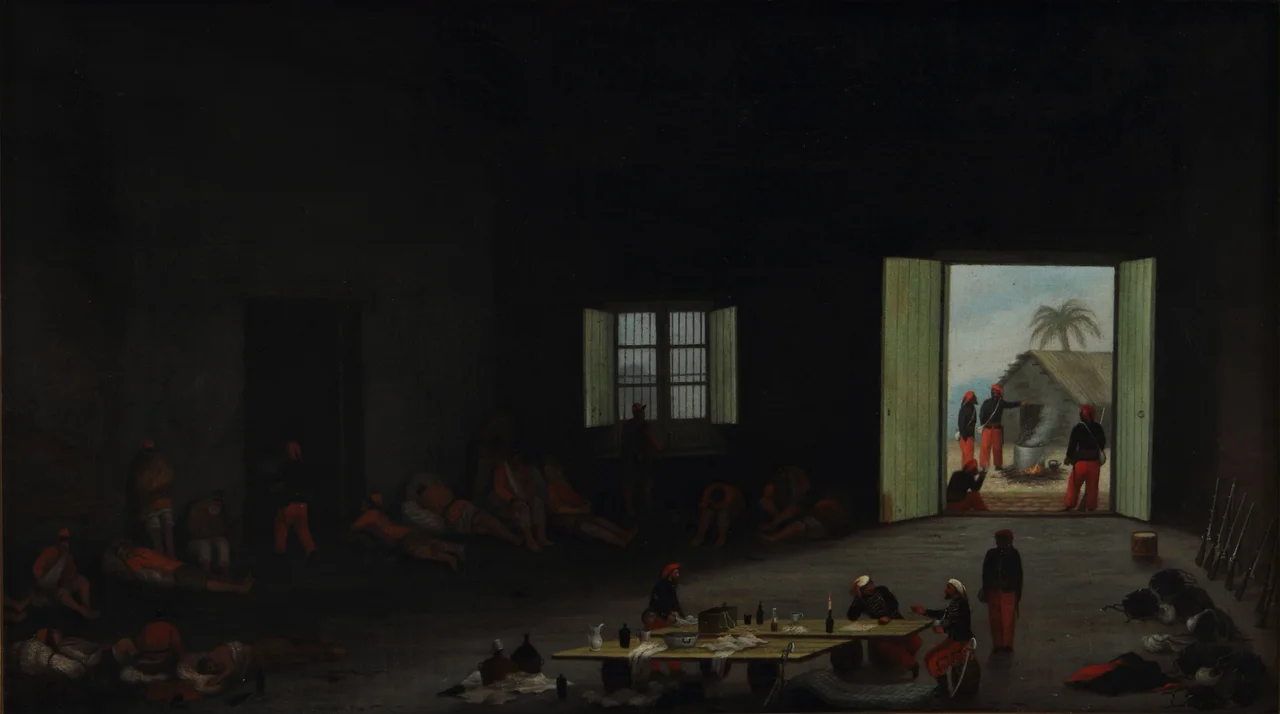

Battle of Yatay
Three thousand men stood with their backs to a swollen stream and watched twelve thousand close in. Colonel Pedro Duarte had been ordered to hold the bank of the Uruguay River, then abandoned by his own commander to face the entire allied army alone. He could have fled. Instead, on the morning of August 17, 1865, near the Corrientes village of Paso de los Libres, he formed his lines among the flooded estates of Yatay and prepared to die fighting. Among the soldiers advancing toward him was a young Argentine lieutenant named Cándido López, sketching the scene in a notebook he would later turn into some of the only eyewitness paintings of the war.
A War of Two Columns
The Paraguayan War began with ambition. President Francisco Solano López, fearing Brazilian expansion, sent two great columns south through Argentine territory in 1865 - one to seize the city of Corrientes, the other to strike at Brazilian lands along the Uruguay River. For a moment the plan worked. The Paraguayans took Corrientes; General Estigarribia's column crossed into Brazil and captured town after town. But the Imperial Brazilian fleet shattered the Paraguayan squadron at the naval Battle of Riachuelo, severing the rivers that were supposed to carry supplies and reinforcements. The invading columns were suddenly cut off from each other and from home, deep in hostile country, with the allied armies of Argentina, Brazil, and Uruguay converging from every direction.
Abandoned on the Riverbank
Estigarribia detached Duarte with roughly three thousand men to guard the Uruguay River, then marched on without him. When the allied general Venancio Flores joined forces with Wenceslao Paunero's troops on August 13, their combined army swelled to twelve thousand - nearly four times Duarte's strength. Duarte sent word to Estigarribia begging for support. The reply was so dismissive that, insulted, Duarte resolved to give battle anyway. He pulled back from Paso de los Libres and took up positions on the banks of the Yatay stream. Both the Yatay and the Uruguay had recently overflowed, turning the battlefield to mud and water. The marsh shielded his men from a frontal charge, but the stream at their backs meant there could be no retreat. Defeat, Duarte knew, would mean annihilation.
Two Hours on Horseback
The battle opened at ten in the morning when allied infantry under Leon de Pallejas struck the Paraguayan line. Duarte seized the moment and counterattacked with nearly all his cavalry, inflicting hundreds of casualties and driving the attackers back. For two hours the fighting was waged on horseback alone, sabers and lances in the flooded fields, while Duarte's outnumbered horsemen held. But numbers tell. When the allied infantry finally pressed forward in force, the Paraguayans fought with a tenacity that impressed even their enemies. In a last desperate charge Duarte's horse was shot from under him. Paunero himself rode up and demanded his surrender. There was nothing left to do but agree.
The Cost
Of the roughly three thousand who had stood on that riverbank, the Paraguayans counted seventeen hundred dead, three hundred wounded, and twelve hundred taken prisoner. A few hundred swam the Uruguay River to escape. These were not statistics to the men who lived it - they were conscripts and volunteers who had marched a thousand miles from home and were cut down in a swamp far from anyone who would mourn them. Among the captives, Flores found Uruguayan exiles of the rival Blanco party and had them executed as traitors, a grim coda to a grim day. A month later Estigarribia surrendered at Uruguaiana, and the war moved north into Paraguay, where it would grind on until 1870 and consume a staggering share of that nation's men. Yatay was only the beginning.
What Remains
There is no grand monument on the field at Yatay - only the quiet bend of a stream near Paso de los Libres, the Uruguay River sliding past toward the Atlantic, and the flat green country of Corrientes that floods still when the rains come. The battle survives mostly in memory and in art. Cándido López, the young lieutenant who sketched the campaign, lost his right arm to a grenade at a later battle, taught himself to paint with his left hand, and spent his life rendering the war he had seen - including the wounded prisoners of Yatay. Far to the south, a street in the Buenos Aires neighborhood of Caballito still bears the battle's name, a small thread connecting a crowded modern city to a flooded field where three thousand men refused to run.
From the Air
The battlefield lies at roughly 29.12°S, 56.72°W, on the Argentine bank of the Uruguay River near Paso de los Libres, Corrientes Province - directly across the water from Uruguaiana, Brazil. The terrain is flat, low, and seasonally flooded subtropical grassland; the Uruguay River itself is the dominant navigational landmark, a broad ribbon marking the international border. The nearest major airport is Doctor Fernando Piragine Niveyro Airport at Corrientes (ICAO SARC), about 230 km to the northwest. Recommended viewing altitude is 2,000-3,000 feet AGL to follow the river bends and pick out Paso de los Libres and its Brazilian twin city. Humid subtropical weather brings afternoon haze and summer thunderstorms; clearest visibility is on cool, dry winter mornings.
Nearby Stories
- Yapeyú, Corrientes 13 km away
- São Borja 30 km away
- João Goulart's House 54 km away
- Iberá Wetlands 56 km away
- Mercedes, Corrientes 77 km away
- Ibera National Park 94 km away
- Brazilian Island 97 km away
- Battle of Ituzaingó 166 km away