.jpg)
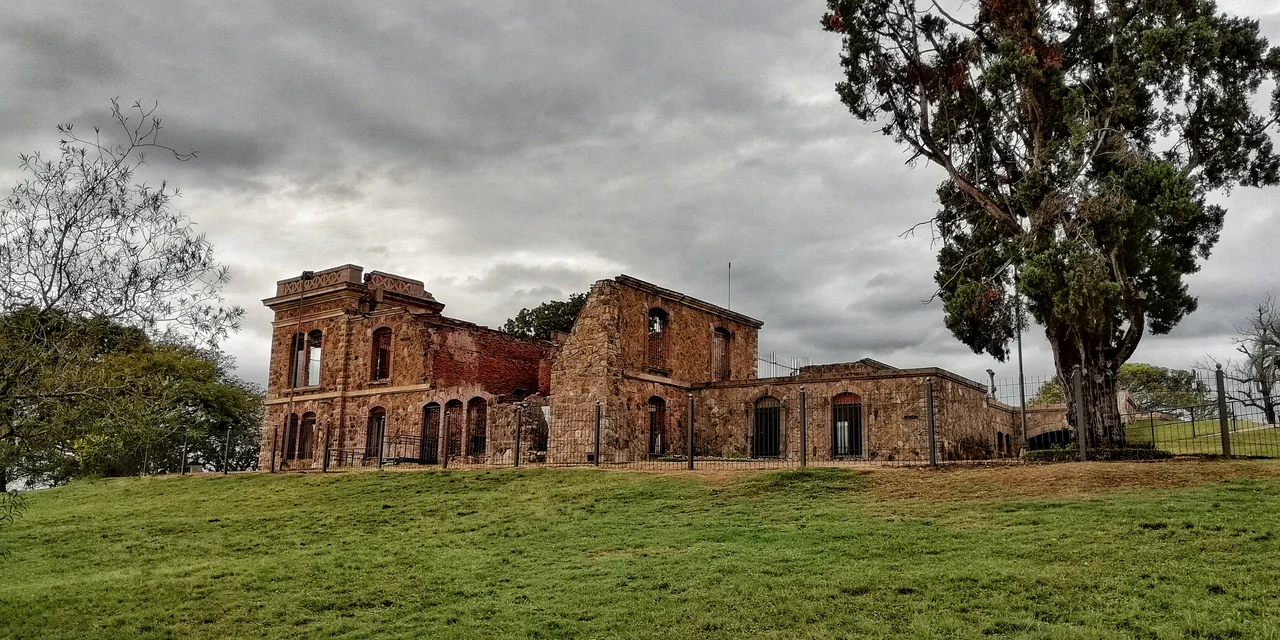
San Carlos Castle
One night at dinner, a hissing came from beneath the table. One of the blonde Fuchs Valon girls glanced down and said, without alarm, that it was only the snakes nesting in a hole under the floorboards. The household kept an iguana, a mongoose, a fox, a monkey, and bees, and the snakes had simply moved in among them. A French pilot stranded in Concordia witnessed the scene, and Argentina has spent the better part of a century insisting that the strange, tender little book he later wrote was conceived right here, in the gardens of a roofless castle on the Uruguay River.
A Magnate's Folly
In 1888, the French magnate Éduard Demanchy raised a mansion of imported European stone on the riverbank near Concordia and called it San Carlos. The Demanchys lived in it only three years, from 1888 to 1891, before moving on. Another French household, the Fuchs Valon family, took their place. Then came September 1938 and a fire that gutted the building, leaving the elegant walls open to the sky. What had been a showpiece of European ambition in the Argentine littoral became, in turn, a candle workshop, a fruit stand, and a salting house. The castle did not so much fall into ruin as drift through a series of humbler lives, each one a little further from the grandeur Demanchy had imagined.
The Aviator's Forced Landing
In 1929, a Latécoère 25 mail plane developed engine trouble over the river plains. Its pilot was flying for the Aéropostale, threading the long, lonely routes that stitched Buenos Aires to Asunción del Paraguay, and he brought the failing aircraft down in the open ground beside the castle. The pilot was Antoine de Saint-Exupéry. Stranded, he was taken in by the family living in the half-ruined mansion with their menagerie and their unbothered snakes. He stayed long enough to remember it. Years later, marooned again in the Sahara after a real crash, Saint-Exupéry would draw on the experience of being a downed flier in the middle of nowhere for the book that made him immortal.
Where the Prince Was Born
The legend is simple and beloved: that the two wild Fuchs Valon daughters, Edda and Susana, and their menagerie planted the seeds of "The Little Prince." There is no documentary proof, and most scholars trace the story's true origin to the desert crash. But the connection refuses to die. In 2019, the writers Nicolás Herzog and Lina Vargas published a book they called "The Little Princesses," tracing the legend of how the girls and their snakes and roses may have surfaced in Saint-Exupéry's imagination. A 2016 film, "Vuelo Nocturno" — Night Flight — borrowed the castle's romance directly. Whether or not the prince was truly conceived here, Concordia has decided that he was, and who can blame the city for keeping the story?
The Wild Sisters and Their Menagerie
The household Saint-Exupéry stumbled into has become the heart of the legend. The Fuchs Valon daughters, Edda and Susana, were remembered as untamed blonde girls who roamed the grounds barefoot among a private zoo. Beyond the snakes under the dining floor, the family kept dogs and birds, a pet iguana, a mongoose, a fox, a monkey, and bees. To a French aviator passing through the South American backcountry, the scene must have felt like something out of a fable: a crumbling European castle on a tropical river, two feral princesses, and a houseful of animals treated as ordinary company. Whether or not it shaped a single line of his book, it is exactly the kind of place where one could imagine a small prince keeping a rose and taming a fox.
Rescued Because People Wanted It
By the 1990s the castle was a scenic wreck, and the idea of saving it began circulating in agreement with the architect Magadán. Real work started in 2008, funded by the municipality of Concordia, the province of Entre Ríos, and the special fund tied to the nearby Salto Grande dam. In 2011 walkways were threaded through the ruins so visitors could move safely among the open arches. The restoration team won a prize for the best intervention of more than a thousand square meters, awarded by the International Conservation Center and the Central Society of Architects. The roof never came back. That was the point: San Carlos is preserved as a ruin, a romantic shell where the river light pours through empty windows.
From the Air
San Carlos Castle stands on the west bank of the Uruguay River at 31.37°S, 58.00°W, just north of Concordia in Entre Ríos. The nearest airport is Concordia's Comodoro Pierrestegui (ICAO: SAAC), about 13 km north of the city. From a low circuit of 1,500–2,500 feet, look for the river's broad braided channel and the roofless rectangular shell of the castle set in open parkland near the water. The wide Salto Grande reservoir lies upstream to the north, a useful landmark. Clear, dry autumn and winter days (April through August) offer the best visibility over the littoral.
Nearby Stories
- Federación 17 km away
- El Palmar National Park 52 km away
- San José Palace 89 km away
- Battle of Masoller 116 km away
- Tacuarembó 126 km away
- Cayastá 173 km away
- Minas de Corrales 176 km away
- 1973 San Justo Tornado 215 km away