
San Cristóbal (Galápagos)
The sea lions arrive before anyone tells you they will. They sprawl on the wooden benches of Puerto Baquerizo Moreno's malecon, flop across the public docks, and sleep on the steps of the fish market, indifferent to foot traffic. Dogs give them wide berth. Tourists learn to as well. San Cristobal is the easternmost of the Galapagos, the first island to emerge for anyone approaching from mainland Ecuador, and its capital is a town that humans and Zalophus wollebaeki - the endemic Galapagos sea lion - share on terms the animals set.
The Island Darwin Walked First
When HMS Beagle reached the Galapagos in September 1835, Charles Darwin went ashore here. San Cristobal was the first island he stepped onto, and the bay near what is now Las Tijeretas - Frigatebird Hill - is where the boats made landfall. The archipelago he would eventually describe in On the Origin of Species began, for him, on this particular strip of volcanic coast. The island itself is one of the oldest geologically in the Galapagos, composed of three or four fused volcanoes, all now extinct. Its 730-meter high point, population of about 6,000, and area of 558 square kilometers make it modest in size, but it sustains what few Galapagos islands can: year-round human settlement, drawn here originally by the one resource this archipelago almost uniformly lacks.
A Lake in a Crater
Up in the highlands, in the southern half of the island, El Junco lake fills a volcanic crater at about 700 meters elevation. It is the only large body of fresh water in the entire Galapagos archipelago. The availability of that water is why San Cristobal became the first permanent settlement of the islands - sailors could refill their casks here in a way they couldn't anywhere else. Reaching the crater today means climbing a set of steep steps from the parking area, but the view that opens at the rim stretches 360 degrees across the island. A narrow circuit trail follows the crater edge, muddy in places, threading through the vegetation that crowds the lake. The water below draws birdlife in concentrations that would be routine in most places and feel almost shocking here.
Kicker Rock's Strange Name
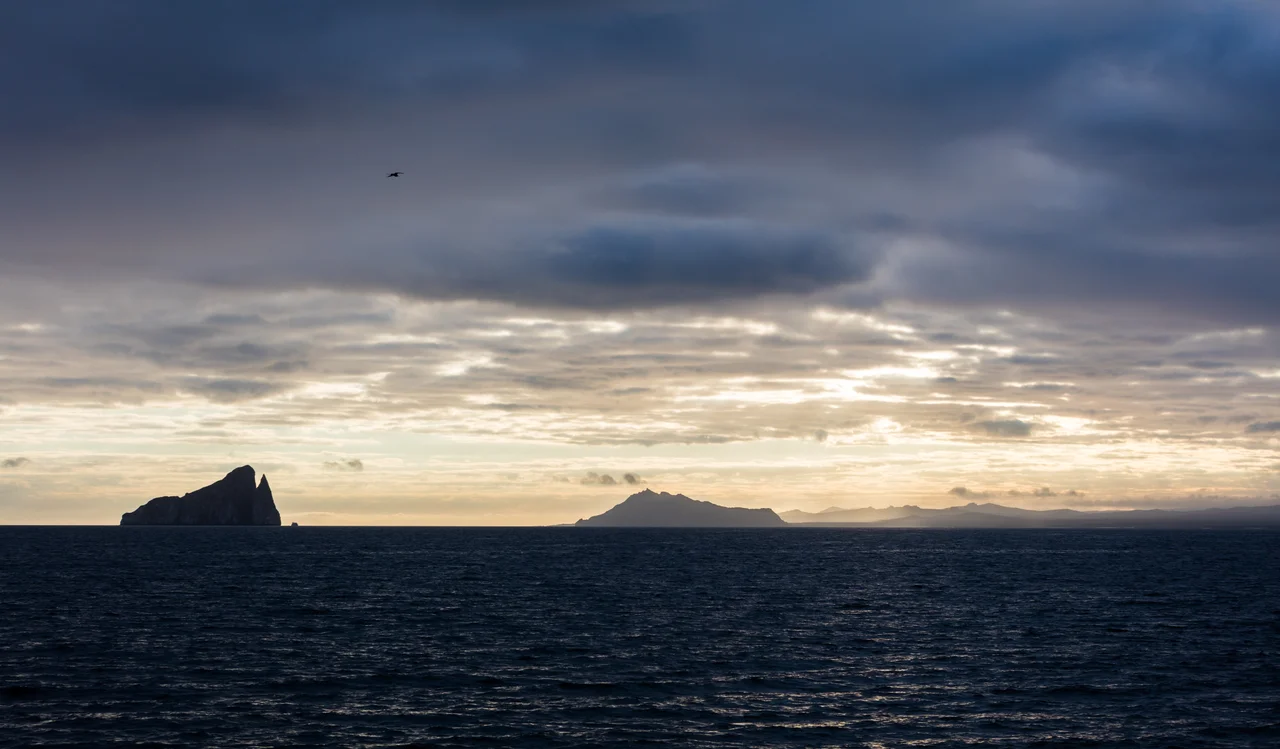
Offshore, a vertical slab of rock rises from the water - Leon Dormido in Spanish, 'sleeping lion,' for its resemblance to a reclining cat. The English name, Kicker Rock, is older and stranger. British captain James Colnett charted this coast in 1793 and named the formation, probably in reference to two navigational towers in Hampshire - Kickergill and Gilkicker - that guided ships into Portsmouth Harbour in the seventeenth century. Colnett gave the island itself the name Lord Chatham Island that same year, for John Pitt, 2nd Earl of Chatham and First Lord of the Admiralty. The Spanish name San Cristobal - Saint Christopher, patron saint of sailors - eventually prevailed. Today the rock is a dive site where snorkelers drift past sea turtles, white-tip reef sharks, and occasional hammerheads. The water is deep and the current can run strong.
The Tortoise Breeding Center
La Galapaguera de Cerro Colorado, along the road between El Junco and Puerto Chino, is a reserve set aside for the repopulation of San Cristobal's variety of giant tortoise. The tortoises were moved here from the northern part of the island to protect the breeding program. Pens hold animals up to age five, after which they are released. Trails wind through the reserve, and admission is free. Closer to Puerto Baquerizo Moreno, the Interpretation Center - ten minutes walk from the town center - tells the longer story: how the Galapagos formed, how they were settled, how conservation happens. A penal colony was built on San Cristobal in 1880 for prisoners from mainland Ecuador, which later became a military base and an export center for sugar, coffee, cassava, cattle, fish, and lime.
Punta Pitt and the Three Boobies
Getting to Punta Pitt requires a boat and a guide. The northeast tip of the island is a wet landing site - you step off the inflatable into shallow water and wade to the beach - and it is one of the few places in the archipelago where all three booby species nest in the same area. Blue-footed boobies with their absurd cerulean feet, red-footed boobies that perch in trees, and masked boobies with their black-and-white plumage. Lava formations from older eruptions cast the landscape in dark, eroded shapes. Frigatebirds sometimes patrol overhead, looking for smaller birds to harass into dropping their catches. The visit is usually a few hours. It is the kind of Galapagos experience that, even after decades of tourism, still rearranges what you expect nature to look like.
From the Air
San Cristobal sits at 0.80 degrees south, 89.40 degrees west, as the easternmost of the Galapagos Islands. San Cristobal Airport (SEST/SCY) is within walking distance of Puerto Baquerizo Moreno. Inter-island flights via EMETEBE Airlines connect to Isabela, Santa Cruz, and Baltra. Approach from mainland Ecuador is about 600 nautical miles west from Guayaquil (SEGU/GYE). Look for Kicker Rock (Leon Dormido) jutting from the sea off the western side - a distinctive twin-spired landmark. Trade winds and generally clear conditions prevail, with a cooler garua season from June through December.
Nearby Stories
- Genovesa 108 km away
- Cocos Island National Park 704 km away
- Cocos Island 733 km away
- Salinas (Ecuador) 956 km away
- Easter Island: The Mystery of Rise and Collapse 3558 km away