
Cocos Island
Cocos Island is the only thing sticking out of the sea on its own tectonic plate. That is not a metaphor. The Cocos Plate is one of Earth's minor crustal slabs, and this twenty-four-square-kilometer wedge of basalt and forest is the single piece of it above water. Everything else is ocean floor. Add that to the rest of what Cocos is - a UNESCO World Heritage Site, a hammerhead shark mecca, a pirate-treasure legend, the inspiration behind half a shelf of adventure fiction - and you start to understand why Jacques Cousteau visited it several times and called it, in 1994, the most beautiful island in the world.
A Volcano in the Middle of Nowhere
The oldest rocks here are between 1.91 and 2.44 million years old, dated by potassium-argon methods and overwhelmingly basaltic - the signature of a shield volcano built slowly by cooling lava. Cocos sits atop the aseismic Cocos Ridge, with a caldera and a trachytic lava dome inside it. The youngest lava flows came from northeast-trending fissures on the flanks. The island is roughly rectangular, roughly eight kilometers on its long axis, ringed by ninety-meter sea cliffs that make landing difficult almost everywhere. Its highest point, Cerro Iglesias, climbs to 634 meters, and more than two hundred waterfalls drop from the interior into four bays - Wafer, Chatham, and Weston on the north side, where the only reasonable anchorages are.
Rain, Cloud, and a Forest That Arrived by Accident
Cocos has a tropical rainforest climate with more than 7,000 millimeters of rainfall a year, comparable to the rainiest corners of Colombia's Chocó. Constant cloudiness and convergent ocean currents keep the island wet essentially year-round. Because Cocos was never connected to a continent, every species of plant and animal arrived across open ocean. That long-distance dispersal produced unusual results: 235 species of flowering plants, seventy of them endemic, along with Cocos Island's own endemic cuckoo, flycatcher, finch, anole, and gecko. The Cocos finch is so distinctive it forms its own monotypic genus. The island has no native land mammals - every pig, deer, goat, cat, and rat living there today was brought by humans and is now a conservation problem.
The Ocean Around It
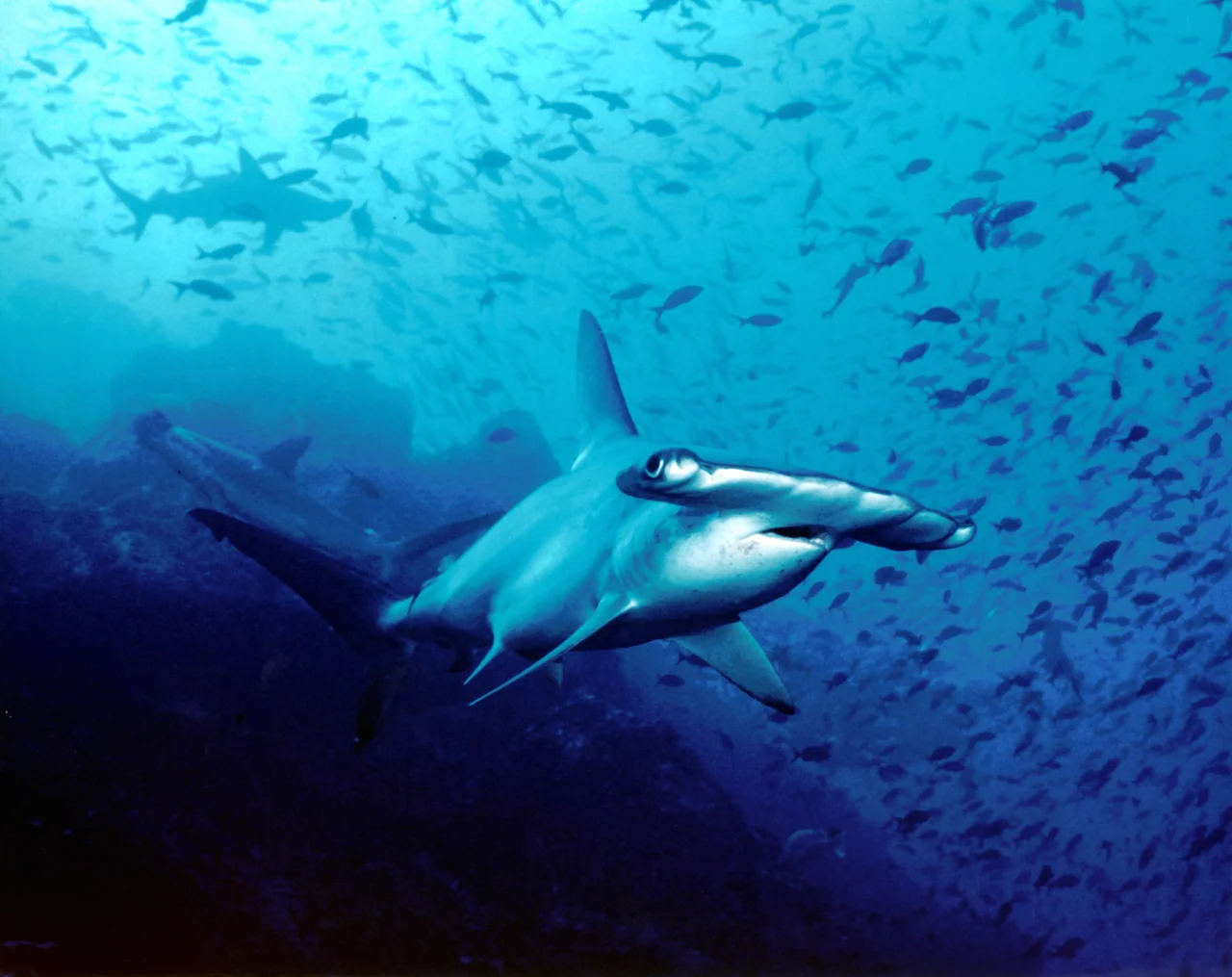
The marine ecosystem is why the island is protected. Surrounding reefs and volcanic tunnels hold more than thirty species of coral, sixty species of crustaceans, six hundred species of mollusks, and over three hundred species of fish - including yellowfin tuna, giant mantas, sailfish, whale sharks, and the hammerhead schools that made Cocos famous among divers. In 2017, a female tiger shark killed a scuba diver at Manuelita Islet, a species that had returned to these waters in 2012 after three decades of absence. Costa Rica expanded the marine reserve in 2002, and in 2022 Ecuador announced the Hermandad Marine Reserve connecting the Cocos protected zone to the Galápagos - creating a corridor of open-ocean protection that migrating sharks and rays actually follow.
The Treasure and the Fiction
Cocos has featured in pirate lore for nearly two centuries. The first treasure claim came from a woman named Mary Welch, who said 350 tons of gold raided from Spanish galleons lay buried here by Captain Bennett Graham in 1818. The Portuguese pirate Benito Bonito supposedly hid another cache on the same island. The most famous of the legends concerns the Treasure of Lima - gold and silver entrusted to British trader William Thompson in 1820, which he and his crew allegedly buried here before being hunted down. German adventurer August Gissler lived on Cocos for most of the years between 1889 and 1908 searching, and found only a few gold coins. Over three hundred expeditions have tried. Costa Rica no longer issues permits. Robert Louis Stevenson is often credited with drawing on these stories when he wrote Treasure Island.
A Painful Administrative Past
The island's human history is thin but not empty. Cocos was annexed by Costa Rica in 1832, and whalers stopped here regularly until kerosene displaced whale oil in the mid-1800s. In October 1863, one of the darkest episodes in its history: the ship Adelante marooned 426 Tongan people - survivors of the blackbirding labor trade - on the island after they were discovered to have contracted smallpox. By the time the rescue vessel Tumbes arrived a month later, only 38 of them were still alive. That event, tied to the depopulation of the Tongan island of ʻAta, is remembered as one of the cruelest moments of the Pacific slave trade. Today the only people living on Cocos are Costa Rican park rangers. They voted in a Costa Rican election for the first time in 2006.
From the Air
Cocos Island sits at approximately 5.53°N, 87.06°W, about 550 km southwest of the Costa Rican mainland and the only land above water on the Cocos tectonic plate. No airports on the island or nearby. The island is a useful solitary visual waypoint on oceanic flights between Central America and the Galápagos. From cruising altitude it reads as a single rectangular dark-green island with sheer cliffs, ringed by deep blue water with no surrounding reef.
Nearby Stories
- Corcovado National Park 443 km away
- Drake Bay 469 km away
- Nature Air Flight 144 486 km away
- Malpelo Island 559 km away
- Genovesa 613 km away
- Genovesa Island 639 km away
- Malpelo Plate 680 km away
- Gulf of Fonseca 829 km away