
Genovesa Island
Before it became Genovesa, this island was called Quita Sueño - Nightmare Island - by the Spanish sailors who kept nearly running into it. You can still see their point. The horseshoe-shaped rim of a collapsed volcanic caldera rises out of the equatorial Pacific with almost no warning, cliffs on three sides, a narrow entrance on the fourth. Slip through that entrance and you enter Great Darwin Bay: an inundated crater where your boat floats inside the volcano itself, surrounded by bird colonies so dense that the sky above you is constantly in motion.
A Crater You Can Sail Into
Genovesa is a shield volcano that covers roughly 14 square kilometers above the waterline, with its highest point at 64 meters. Its caldera wall has partially collapsed to seaward, allowing the ocean to flood the crater and form Great Darwin Bay. Inside that bay sits Lake Arcturus, a small saltwater lake whose sediments are less than 6,000 years old. No historical eruptions have been recorded from Genovesa, but very young lava flows mark the flanks of the volcano - a reminder that geologically recent does not mean geologically over. The island is the northernmost of the main Galápagos islands, sitting almost on the equator itself.
The Name Collectors
Few places change names as often as this one. The Spanish first called it Quita Sueño for the hazard it posed. The English pirate William Ambrosia Cowley charted it in 1684 as Eure's Island, a name whose origin is still debated - possibly after William Ewres of Jamaica, possibly after Ralph Eure, the 8th Baron Eure. In 1813, during the War of 1812, an American lieutenant on the frigate Essex named John Downes recorded the island's position. Through a string of misspellings - Dowers's, Dowers, Tower's - the name mutated into Tower Island on an Admiralty chart by 1841. The current Spanish name, Genovesa, was adopted in 1892 when Ecuador marked the 400th anniversary of Columbus's first voyage by renaming islands after places tied to him - Genovesa for the Italian city of Genoa, his birthplace. Informally, sailors and naturalists still call it Bird Island.
The Birds That Run the Place
Genovesa is one of the best birdwatching sites in the Galápagos, and that is saying something. Great frigatebirds nest in numbers that would be hard to believe if you weren't standing in the middle of them - males with their red throat pouches fully inflated, trying to attract mates with a noise like low drumming. Red-footed boobies, Nazca boobies, swallow-tailed gulls, storm petrels, tropicbirds, Galápagos mockingbirds, and several of Darwin's finches all breed here in concentrations that exist because there are almost no predators. The island also hosts the smallest marine iguanas in the archipelago - an adaptation to a food supply that cannot support larger bodies.
Prince Philip's Steps
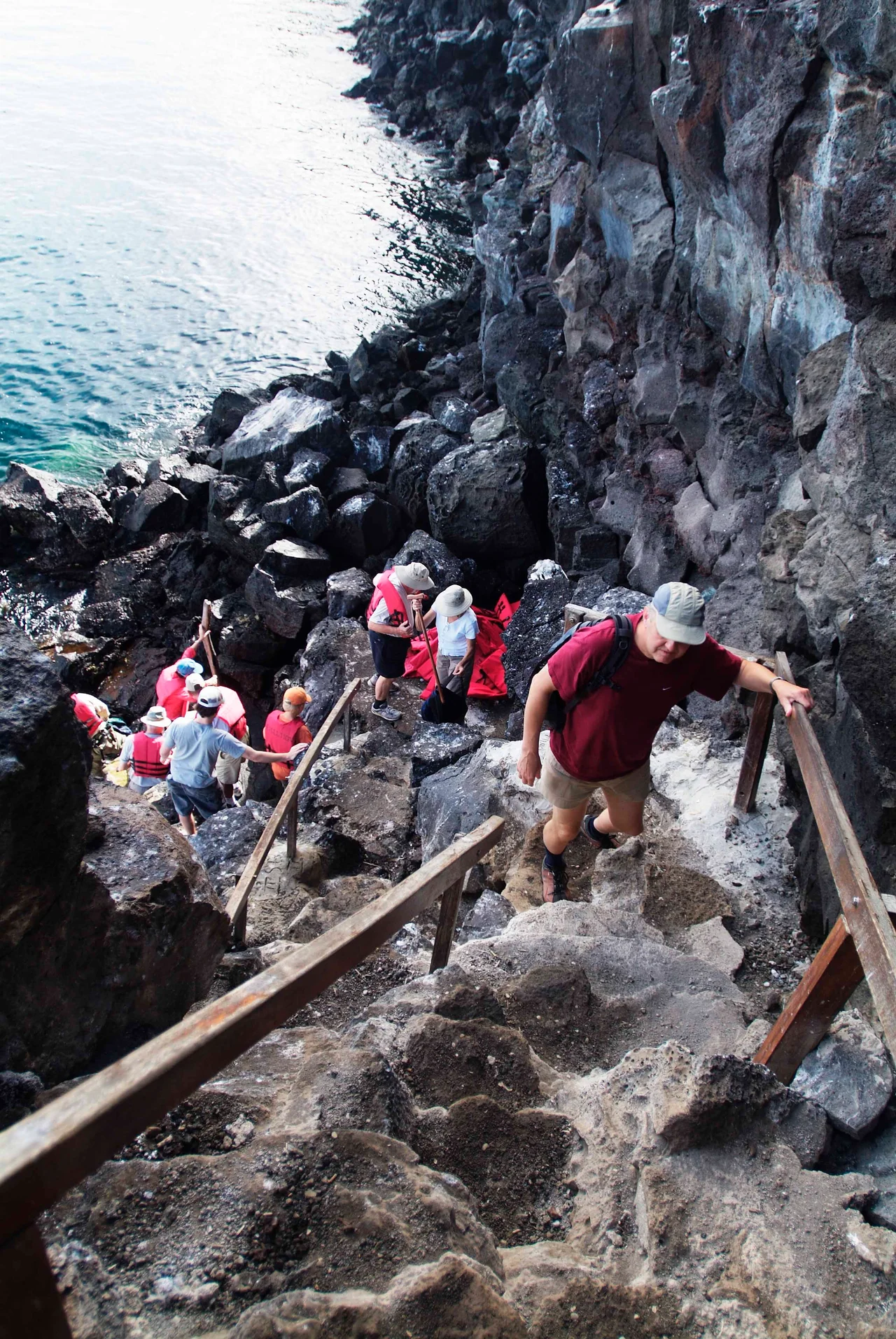
One of the two main visitor trails climbs a steep natural staircase up a 25-meter cliff, known as Prince Philip's Steps after the British royal who visited Genovesa. At the top, the path continues inland through a thin palo santo forest and across a rocky plain, passing colony after colony of nesting seabirds who barely notice you. The storm petrels here do something almost no other storm petrels do - they are active during the day. That behavior is shaped by a single predator: short-eared owls that have learned to pick them out of their nesting crevices. To survive, the petrels return to their holes only after dark, when the owls can no longer see them.
Diving the Caldera
Great Darwin Bay is one of the more distinctive dive sites in the Galápagos simply because of its geography. Divers can descend along the inner wall of the caldera, exposed to calm water and the cliff's hanging communities of invertebrates. The outer wall of the volcano offers less protected conditions and more open-water encounters - hammerhead sharks, mantas, the occasional larger pelagic species passing through. A third option is to drop in outside the volcano and pass through the channel between the rocks into the flooded crater itself. It is a dive that lets you understand, physically, what it means to be inside a volcano that happens to be underwater.
From the Air
Genovesa Island lies at approximately 0.32°N, 89.95°W in the northern Galápagos archipelago, Ecuador. There is no airport on Genovesa. Nearest airports are Seymour Airport (SEGS/GPS) on Baltra Island and San Cristóbal Airport (SEST/SCY). Access to the island is by boat only, generally as part of a live-aboard Galápagos cruise. The horseshoe caldera opening into Great Darwin Bay is distinctive from the air and makes an excellent visual waypoint in the northern archipelago.
Nearby Stories
- San Cristóbal (Galápagos) 101 km away
- Cocos Island National Park 608 km away
- Cocos Island 635 km away
- Malpelo Island 950 km away
- Machalilla National Park 957 km away
- Balberta 1509 km away