,_Punta_Pitt,_isla_de_San_Crist%C3%B3bal,_islas_Gal%C3%A1pagos,_Ecuador,_2015-07-24,_DD_13.JPG)
San Cristóbal Island
A small lake in a crater explains everything. In the Galapagos - an archipelago of basalt cones and dry lava fields where the ocean provides the only moisture most islands ever see - San Cristobal has something no other island offers: Laguna El Junco, a freshwater lake sitting in an ancient volcanic crater at about 700 meters altitude. That one lake is why San Cristobal was settled before any of its neighbors. Sailors could refill their water casks here. The island became the first permanent settlement of the Galapagos, and it remains the administrative center today.
A Stack of Names
Sailors, pirates, and naval officers passed this island back and forth through their charts for over a century, each giving it a different name. The Spanish called it San Cristobal for Saint Christopher, the patron saint of sailors. In 1684, the English pirate William Ambrosia Cowley called it Dassigney's Island in honor of Philip Dassigny - a member of Bartholomew Sharp's crew whose translation of a captured Spanish atlas literally saved Sharp from being hanged for piracy. A trial jury, persuaded by the atlas's value to the Crown, acquitted him. Then in 1793, British captain James Colnett renamed it Lord Chatham Island for John Pitt, 2nd Earl of Chatham and First Lord of the Admiralty, on the specious claim that nobody had charted it before. Colnett knew this was not true. He named it anyway. Saint Christopher eventually won out.
Three or Four Fused Volcanoes
San Cristobal is composed of three or four fused volcanoes, all extinct, welded together into a single landmass of 558 square kilometers. Its highest point reaches 730 meters. The island is one of the oldest in the archipelago geologically, which matters in the Galapagos because the islands form above a hotspot in the Earth's mantle - as the Nazca tectonic plate drifts east, new volcanoes rise in the west while older ones drift away and erode. San Cristobal has been drifting for millions of years, long enough for the volcanoes to cool, the soil to develop, and the vegetation to thicken in the highlands where the rain is most reliable. The waters around the island hold sharks, rays, and lobsters. On land, endemic plants include Calandrinia galapagosa and Lecocarpus darwinii - named for the naturalist who stepped ashore here in 1835.
Kicker Rock and Its Towers
In Stephens Bay, on the island's western side, a vertical rock formation splits from the water. The Spanish call it Leon Dormido for its shape, like a sleeping lion. The English name, Kicker Rock, came from Colnett in 1793, and historians think the reference is to two navigational towers - Kickergill and Gilkicker - erected in Hampshire, England, in the seventeenth century to guide ships into Portsmouth Harbour. The rock serves roughly the same function: a prominent landmark for ships approaching the island. Today it is also a remnant of a lava cone, split in two by erosion and the slow violence of time. Local dive boats take visitors into the channel between the two halves, where hammerhead sharks sometimes patrol.
Penal Colony to Provincial Capital
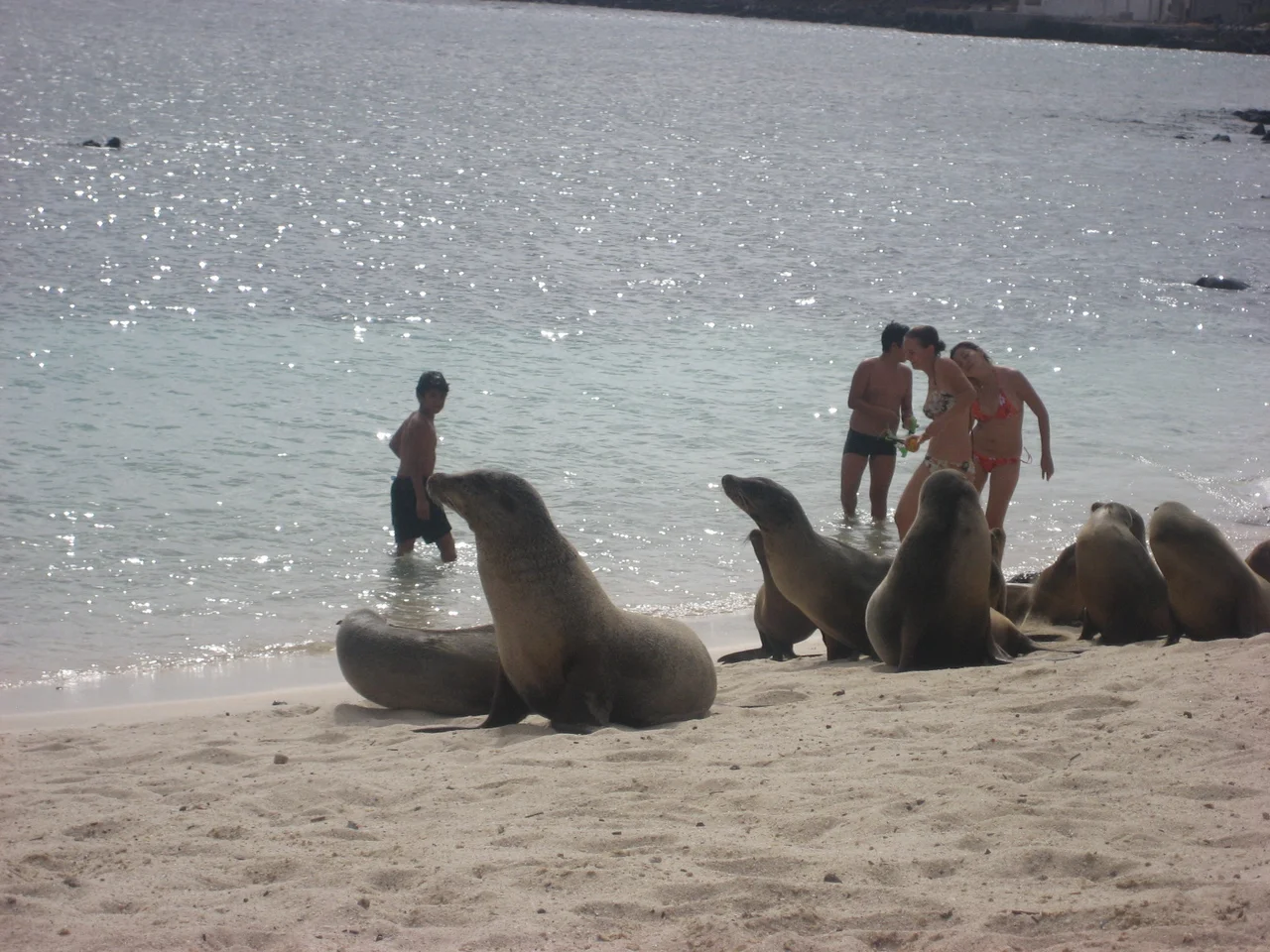
In 1880, Ecuador established a penal colony on San Cristobal for prisoners transported from the mainland. The colony eventually converted into a military base and then an export center for sugar, coffee, cassava, cattle, fish, and lime. In April 1888, a Navy-crewed research vessel assigned to the United States Fish Commission made landfall at an abandoned settlement on Charles Island nearby - one of many scientific expeditions that followed Darwin's. The population of San Cristobal today is approximately 6,000, most of them living in Puerto Baquerizo Moreno, the capital of Ecuador's Galapagos Province. They make their living through government work, tourism, and fishing, in that order. La Loberia, a ten-minute bus ride from town, hosts a colony of sea lions that have claimed the beach as their own.
The Birdlife at Laguna El Junco
The lake itself is small by mainland standards but enormous within the archipelago's parched context. It sits in the southern highlands, in a crater that once held molten rock. Today its waters draw a concentrated population of birds - frigatebirds, white-cheeked pintails, various finches that prompted Darwin's most famous observations. The walk up from the parking area is short but steep. The trail around the rim is narrow and can be muddy. Nearby, La Galapaguera is a breeding station for the island's endemic giant tortoises, which were once far more numerous and are slowly being restored. The connection between these two sites - water and animals, lake and tortoise - is the same connection that brought the first settlers here. Fresh water made life possible. Everything else followed from that.
From the Air
San Cristobal Island sits at 0.80 degrees south, 89.40 degrees west, as the easternmost of the Galapagos. San Cristobal Airport (SEST/SCY) at Puerto Baquerizo Moreno. The island is distinguishable from the air by its irregular shape - three or four fused volcanoes - and by Kicker Rock (Leon Dormido) off the western coast, a twin vertical spire in Stephens Bay. Fresh water Laguna El Junco shows as a dark crater lake in the southern highlands. Approach from mainland Ecuador is about 600 nautical miles west from Guayaquil (SEGU/GYE). Tropical climate with cooler, drier winters and warmer, wetter summers.
Nearby Stories
- Genovesa 108 km away
- Cocos Island National Park 704 km away
- Cocos Island 733 km away
- Salinas (Ecuador) 956 km away
- Easter Island: The Mystery of Rise and Collapse 3558 km away