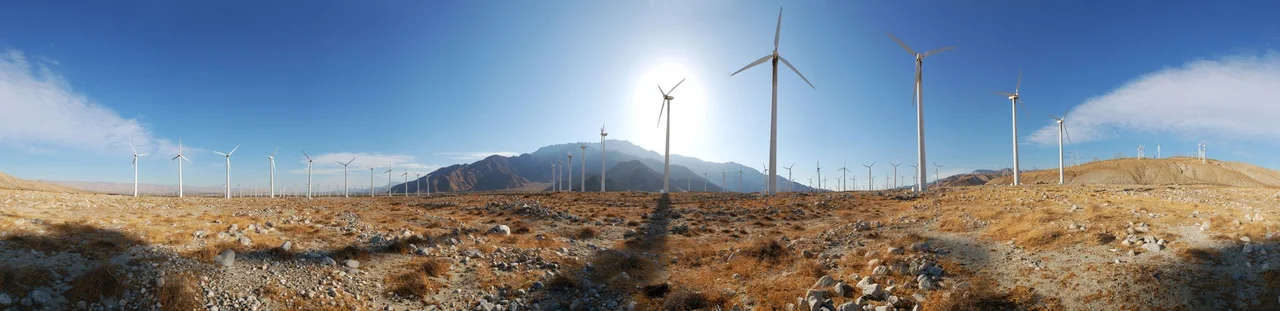

San Gorgonio Pass Wind Farm
In 1926, an inventor named Dew R. Oliver attempted to harness the wind at San Gorgonio Pass using a generator salvaged from a roller coaster. The attempt failed, which perhaps says less about the quality of the wind than about the readiness of the technology for what the wind was offering. The pass between the San Bernardino and San Jacinto mountains is a natural atmospheric funnel, compressing air moving from the high desert toward the coast into velocities that have attracted wind energy development for nearly a century. When California's wind energy industry began in earnest in the 1980s, San Gorgonio was one of the first three sites to receive major investment, alongside Altamont Pass and Tehachapi.
The Physics of the Pass
San Gorgonio Pass is not merely a gap in the mountains; it is a pressure differential made geographic. Hot air over the Coachella Valley rises and draws cooler air through the pass from the Pacific coast side, creating the persistent westerly winds that make the location so productive for wind energy. The effect is most pronounced in summer and early fall, when the valley's heat is most extreme and the atmospheric pressure gradients that drive the wind are strongest. This natural thermodynamic mechanism, operating continuously for geological epochs before any human thought to capture it, is why the view approaching Palm Springs from the west is dominated by turbines rather than untouched desert ridgelines.
From 4,200 Turbines to 667
The San Gorgonio Pass wind farm reached its peak turbine count in 1987: more than 4,200 individual machines, most of them small by modern standards, creating a visual landscape of extraordinary density. The machines of the 1980s California wind boom were often mechanical experiments, learning devices in an industry that was developing its technology in real time on commercial scales. Many of them were unreliable, inefficient by comparison with what would follow, and visually overwhelming. The repowering process that began in subsequent decades removed thousands of these older machines and replaced them with fewer, larger, more efficient turbines. As of May 2025, the farm operates 667 turbines with a total capacity of 656 megawatts — more power from fewer machines.
California's First Wind Farms
The three wind farms that California developed in the early 1980s — San Gorgonio, Altamont Pass east of San Francisco, and Tehachapi in the Tehachapi Mountains — represented a significant bet on renewable energy at a moment when the industry was still essentially experimental. Federal and state tax incentives made the economics work in the short term; the physics of the sites made them viable in the long term. San Gorgonio's position at one of California's most consistent wind resources gave it an advantage that the tax incentives could not supply: the wind was actually there, reliably, in volumes that would continue to justify investment long after the incentive structures that initiated development had expired.
Living with Turbines
For travelers approaching Palm Springs from the west on Interstate 10, the wind farm is the announcement of arrival — hundreds of white towers visible for miles before the city itself comes into view. The visual impact of this many turbines concentrated in a narrow corridor is significant, and the debates about wind energy's landscape effects play out in real time here, where the machinery of clean energy is impossible to ignore. The Coachella Valley communities that live within sight of the farm have developed relationships with the turbines ranging from utilitarian acceptance to aesthetic appreciation. On clear desert nights, the red aircraft warning lights atop the towers create a distinctive skyline that is, depending on your perspective, either an industrial intrusion or a kind of kinetic landscape art.
From the Air
Located at 33.90°N, 116.58°W in San Gorgonio Pass at the northwestern end of the Coachella Valley. The wind farm is one of the most visible features of the pass from cruising altitude, extending several miles along the valley's western entrance. Palm Springs International Airport (ICAO: KPSP) is approximately 8 miles to the southeast.
Nearby Stories
- Pioneertown, California 7.2 km away
- North Shore, California 11 km away
- Wonder Valley, California 11 km away
- Cholla Cactus Garden 12 km away
- Toro Peak 12 km away
- Tenaja Fire 20 km away
- San Bernardino Train Disaster 26 km away
- Bell Canyon 42 km away