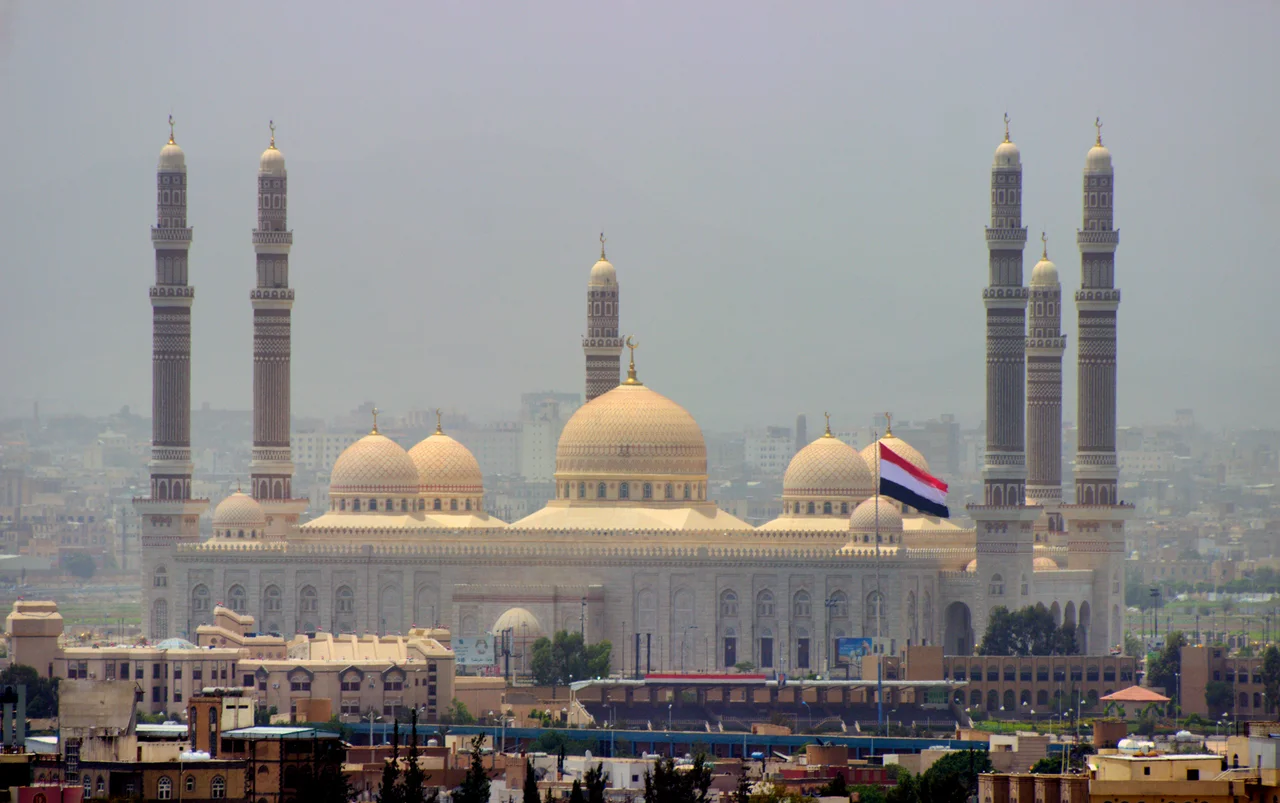

Sana'a
Tradition says Shem, the son of Noah, founded this city at the base of Jabal Nuqum. Whether the story is literal or symbolic, Sana'a has earned the nickname Sam City, and its claim to being one of the oldest continuously inhabited places on earth puts it in the company of Jericho, Damascus, and Aleppo. What a traveler notices first, though, has nothing to do with antiquity. It is the jambiya - the curved ceremonial dagger worn at the belt by policemen, civilians, shopkeepers, and small boys. In Sana'a, everyone who identifies as a man wears one.
First Impressions
The airport welcomes visitors into a city that is, among other things, at 2,250 meters elevation. The air thins noticeably. The temperatures moderate in ways they never do down on the Red Sea coast. Even in summer, nights in Sana'a get cool. The buildings as you leave the airport all look similar - windows and walls painted in coordinated palettes that give the city a visual unity found in few other capitals. Men's cheeks bulge with qat, the mildly narcotic leaf whose daily chewing sessions structure the afternoon. By custom, most of Yemen's adult male population spends late afternoons in a mafraj - a dedicated qat room - talking for hours as the leaf is chewed, not swallowed. It is the most consequential social ritual in Yemeni life.
The Old City
The Old City of Sana'a is a UNESCO World Heritage Site, and standing in its markets at dusk you understand why. The tower houses rise six to nine stories, built from rammed earth and basalt, their upper floors decorated with the distinctive qamariya - half-moon windows filled with colored glass and gypsum tracery. When the sun moves across those windows, the interior rooms flood with shifting patterns of light. At the heart of the Old City lies Souk al-Milh, the salt market, arguably the best souk in the Arabian Peninsula. Spice merchants, silversmiths, fabric sellers, and jambiya craftsmen line narrow lanes where the streets are poorly signposted and the unwary may accidentally walk into someone's courtyard. A local guide is essential, not just for navigation but for the vocabulary of haggling that separates the visitor from the regular.
The Jambiya
Buying a jambiya is a meditation on authenticity. The dagger itself is carried sheathed at the front of the belt, often paired with handmade leather belts and silver pouches. The sheath is leather, sometimes decorated with a base metal, in expensive models with silver. The most prized handles were traditionally made from animal horn - rhinoceros horn, for the most elite - or ivory. What is sold as such today is usually something else. Wood or amber handles are more honest and, sometimes, more beautiful. For customs purposes, remember that the jambiya still counts as a weapon even if it no longer functions as one. The wearing of it functions instead as social declaration. Every man signals who he is through his dagger - tribal affiliation, social standing, craft of the blade.
The Pace of Afternoons
Tourism in Yemen has collapsed under the weight of the civil war that began in 2014. For most of the twenty-first century, foreign visitors could still sit in coffeehouses and watch the world drift by at a pace that felt suspended - the unhurried rhythm of a country with almost no industrialization, where traffic jams were an event, and old men played dominoes outside barber shops. Study Arabic in Sana'a and you entered into that rhythm yourself. The Yemen College of Middle Eastern Studies had been the country's only accredited Arabic program with credit transferable to American and European universities. The Sana'a Institute of the Arabic Language, CALES, and the Yemen Institute for Arabic Language all operated in or near the Old City. Learning happened as much in the tea shops as in the classrooms.
Stay Safe, Stay Aware
Consular services at the American embassy have long since been suspended; travelers must contact the US embassy in Cairo. The British embassy has also suspended operations. Guns are visible - many men carry them for tradition as much as defense, and the sight of a Kalashnikov in the old markets is not, by itself, cause for alarm. It is instead a reminder that this is a country at war, where the ordinary rhythms of life continue anyway because they have to. The Old City endures. The qamariya windows still glow at sunset. Salta is still served steaming at lunch. Bottled water is still available, the tap water still unsafe. The carrot cake at the cafe near Shumaila Hari supermarket is still, by all accounts, worth the price. What a traveler saw in Sana'a was a city where an ancient pattern of life had outlasted everything thrown at it - and, as of this writing, still does.
Excursions
Dar Al-Hajr, the Rock Palace, is about thirty minutes from the city center in Wadi Dahr, a five-story palace that appears to grow out of a sandstone pillar. It was built in the 1930s by the last imam before republican revolution changed Yemen forever. A full day further out, the fortified mountain towns of Thulla, Kawkaban, and Shibam sit on their basalt plugs like small stone worlds, reached by a road that climbs steeply from the plain and delivers travelers to villages where the air is thinner still and the view stretches fifty kilometers.
From the Air
Located at 15.35°N, 44.21°E at 2,250 meters elevation in Yemen's central highlands. Sanaa International Airport (OYSN/SAH) shares a runway with Al-Dailami Air Base and has been repeatedly damaged by airstrikes during the Yemen civil war. Active conflict zone - no general aviation access. Recommended viewing altitude FL250-350 for geographic context. The highland plateau is clearly visible from altitude; Jabal An-Nabi Shu'ayb (3,666m) - the highest peak in the Arabian Peninsula - rises to the southwest. Expect significant dust haze in summer.
Nearby Stories
- Battle of Amran 20 km away
- Marib Dam 64 km away
- 2013 Radda airstrike 67 km away
- Al Hudaydah offensive 77 km away
- Battle of Port Midi 93 km away
- 2025 Israeli attacks in Yemen 93 km away
- Zafar, Yemen 105 km away
- Mundafan 332 km away