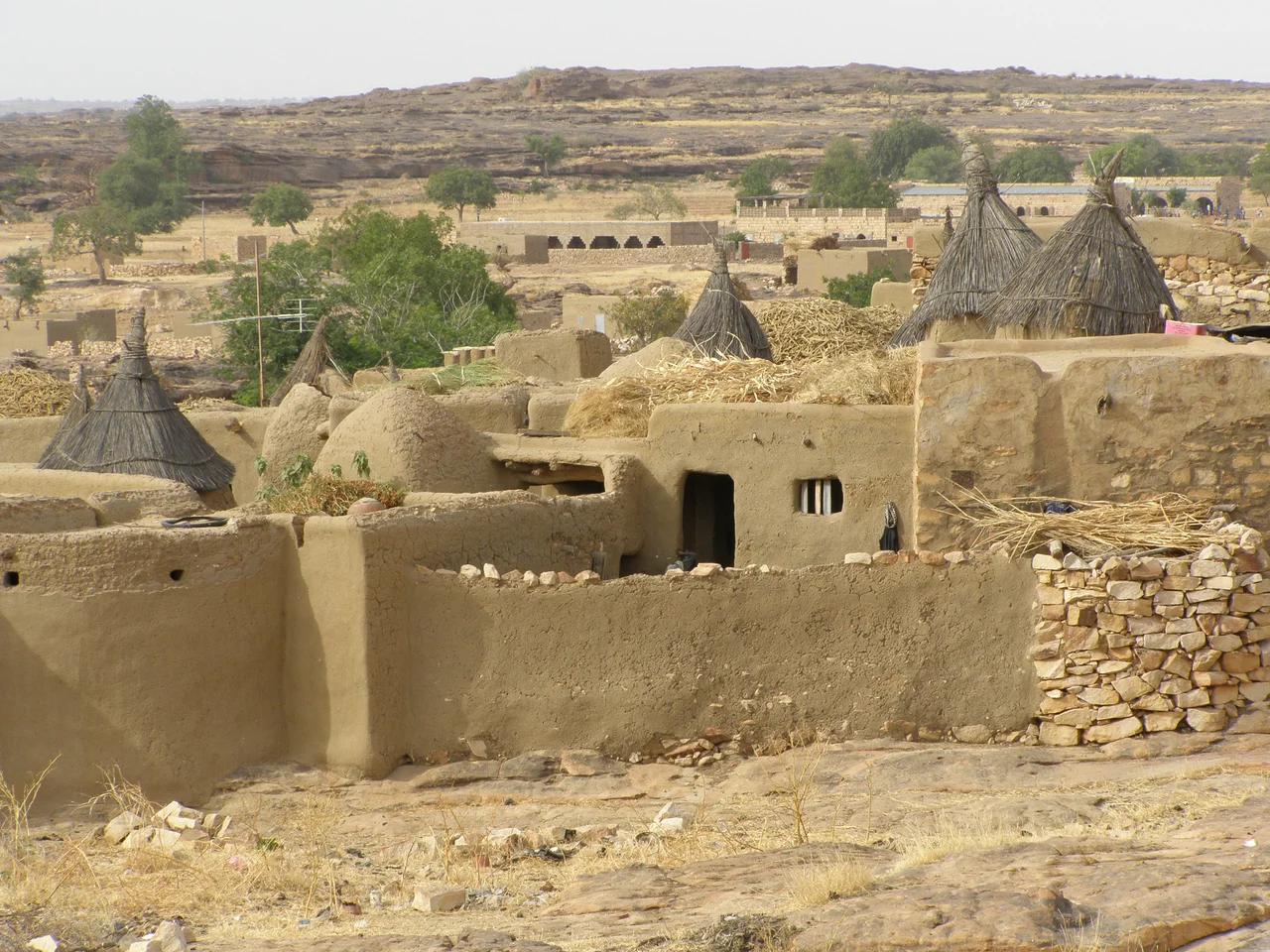

Sangha, Mali
Sangha is not one village but many. Perched at the very top of the Bandiagara Escarpment, the commune gathers some forty-four small settlements, and its administrative heart, Sangha Ogol Leye, is itself only one of at least ten villages clustered along the clifftop. Roughly thirty-two thousand people live here, on the high edge of Dogon country where the plateau breaks away into the long sandstone fall below. For generations this place has been two things at once: a deeply sacred center of Dogon religion, dense with temples and shrines, and the gateway through which the outside world has tried to reach an understanding of the Dogon at all.
A Place of Shrines
Sangha is known above all as a heartland of Dogon traditional religion. The villages here are thick with sacred architecture, altars and temples and the spirit-haunted spaces of a faith woven into every part of daily life. Among its features is the toguna, the low-roofed shelter where elders sit to deliberate, and the carved door of the Hogon's house, the Hogon being the spiritual leader whose authority binds the community to its ancestors and its land. The local language is Toro So, one of the many Dogon tongues, and to walk through Sangha is to move among shrines to figures like Lebe and Binou, the deities and earth-spirits at the center of Dogon belief.
The Ethnographer's Village
It was at Sangha that one of the most famous encounters in the history of anthropology unfolded. The French ethnographer Marcel Griaule carried out most of his work among the Dogon here, returning over many years from the 1930s onward. His conversations with a blind elder hunter named Ogotemmeli, recorded in a celebrated book, presented to European readers a Dogon cosmology of astonishing depth and intricacy, a complete vision of creation, the stars, and the order of the world. Scholars have long debated how much of that system Griaule faithfully recorded and how much took shape in the meeting of two very different minds. Either way, Sangha became, for the outside world, the place where the Dogon spoke.
Masks and Markets
Like its sister villages down the cliff, Sangha is a center of the masked dances that mark Dogon ceremonial life, including the towering multistory masks that appear at the great Dama funerary rites to lead the dead toward the ancestors. On ordinary days the rhythm is gentler. The Sangha market draws a crush of color, women in multicolored cloth selling cassava roots, children at their hips, the weekly gathering that knits the scattered hamlets into a single community. From this clifftop, generations of guides set out to lead visitors down to the villages below, Sangha serving as the traditional base camp for journeys into the escarpment.
Sons of the Cliff
The commune has sent its people out into the wider nation. Among them was Somine Dolo, who became independent Mali's first health minister, a reminder that this remote clifftop has been part of the modern Malian story as much as the ancient one. In recent years, the insecurity that has gripped central Mali since 2012 has fallen heavily on the Dogon country, closing the region to the travelers who once came to learn from it. Yet Sangha remains what it has long been: a high place where the everyday and the sacred sit side by side, on the very rim of the great cliff.
From the Air
Sangha sits at roughly 14.47 N, 3.31 W, on top of the Bandiagara Escarpment in central Mali's Dogon country. From the air it appears as a cluster of small settlements on the elevated sandstone plateau, right at the lip where the land drops away to the southeast down the long cliff face toward the Seno plain. The cliff-base village of Tireli lies about 11 km to the south-southwest. Nearest airport is Mopti-Ambodedjo (GAMB), some 70-80 km west near Sevare. The clifftop location is most striking in low-angle light when the escarpment edge casts long shadows; harmattan dust can reduce visibility December-March.
Nearby Stories
- Battle of Konna 21 km away
- Hamdullahi 31 km away
- Bangime 47 km away
- Battle of Jenné 83 km away
- Ouahigouya 84 km away
- Yacouba Sawadogo 116 km away
- Hand of Fatima (rock formation) 121 km away
- Djenné 136 km away