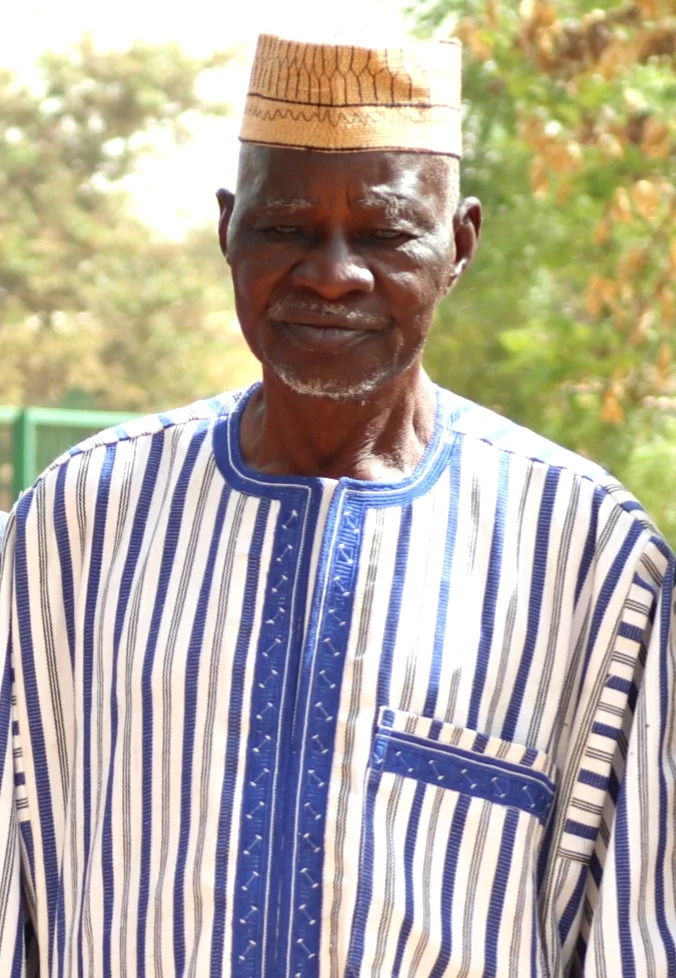

Yacouba Sawadogo
When Yacouba Sawadogo started digging little holes in the cracked, barren earth outside Ouahigouya, his neighbors thought he had lost his mind. The Sahel was drying out. In the droughts of the 1980s, the water table beneath northern Burkina Faso was dropping nearly a meter a year, and families were abandoning farmland that would no longer grow anything. Into that despair, an illiterate farmer who could read neither French nor Arabic decided to do something almost no one believed could work: he decided to grow a forest. He had no degree, no funding, no scientific theory. He had a tradition older than memory, a stubborn faith, and a shovel. He would later be honored by the United Nations and the world as the man who stopped the desert.
The Wisdom in a Hole
Sawadogo's method was not invented; it was rescued. He revived an old planting technique called zaï - small pits dug into hardened soil before the rains. The genius is in what the pit collects. Sawadogo filled each hole with manure and compost, which drew termites; the termites tunneled deeper, breaking up the compacted earth so water could finally sink in instead of running off. He paired the pits with cordons pierreux, low lines of stones laid along the contours of the land. When rain came, it pushed silt across the surface until it caught against the stones and settled. Water that once fled the land now stayed, soaked in, and woke the seeds sleeping in the soil. Holes by hand, stones by hand, season after season - this was his whole technology.
The Forest of Wisdom
It worked, slowly and then unmistakably. Over more than two decades, Sawadogo coaxed roughly 62 acres of dead ground into a dense, biodiverse woodland - dozens of species of trees and bushes, some grown from seeds he had carefully saved. He named it Bangr-Raaga, which in Mooré means roughly "place of knowledge" or "market of wisdom." The name was earned twice over: by the ancient knowledge it grew from, and by the new knowledge it created. Researchers came to study what one farmer had done with his hands. The Dutch scientist Chris Reij of the World Resources Institute and the charity Oxfam helped carry the technique outward. Today, across Burkina Faso and into neighboring Niger, tens of thousands of hectares of ruined land have been restored using methods Sawadogo helped prove. The forest was not just his. It was a seed of its own.
Honors and a Final Fight
Recognition came late, then all at once. A 2010 documentary, The Man Who Stopped the Desert, carried his story far beyond the Sahel. In 2018 he received the Right Livelihood Award, often called the "Alternative Nobel," and in 2020 the United Nations named him a Champions of the Earth laureate. But even as the world celebrated his forest, his own city threatened it. As Ouahigouya expanded, land that Sawadogo had made valuable - precisely because he had made it green - was annexed for development. He spent his final years fighting to protect what he had grown, and in June 2021 a protective fence was finally inaugurated around the forest. There is a bitter irony in it: the man who turned worthless desert into wealth nearly lost it for that very success.
A Quiet Giant
Yacouba Sawadogo died on December 3, 2023, at the age of 77, a native Mossi speaker who never stopped being a farmer first. He did not stop a desert with bulldozers or billions. He stopped it with patience - one pit, one stone, one rainy season at a time - and with the conviction that traditional knowledge, dismissed by the impatient and the educated alike, was worth more than they imagined. The forest he planted still stands outside Ouahigouya, green against the encroaching sand, an argument that the future of the drylands may lie not in new inventions but in remembering, and trusting, what the land already knew.
From the Air
Yacouba Sawadogo's Forest of Wisdom (Bangr-Raaga, also called the Forêt de Gourga) lies near Gourga, just outside Ouahigouya in northern Burkina Faso, at approximately 13.54°N, 2.38°W. The nearest airport is Ouahigouya (DFEO), a few kilometers away; Ouagadougou (DFFD) is about 180 km to the south. From the air the forest appears as a striking dark green patch amid the pale, sparsely vegetated Sahel - a man-made woodland in semi-desert. Best viewed late in the rainy season (September to October) when the contrast with the surrounding dry land is sharpest. Harmattan dust may reduce visibility December through February.
Nearby Stories
- Djibo 28 km away
- Kaya 79 km away
- Tireli, Mali 80 km away
- Ancient Ferrous Metallurgy Sites of Burkina Faso 102 km away
- Bandiagara Escarpment 104 km away
- Koudougou 124 km away
- Sangha, Mali 128 km away
- Opera Village Africa 131 km away