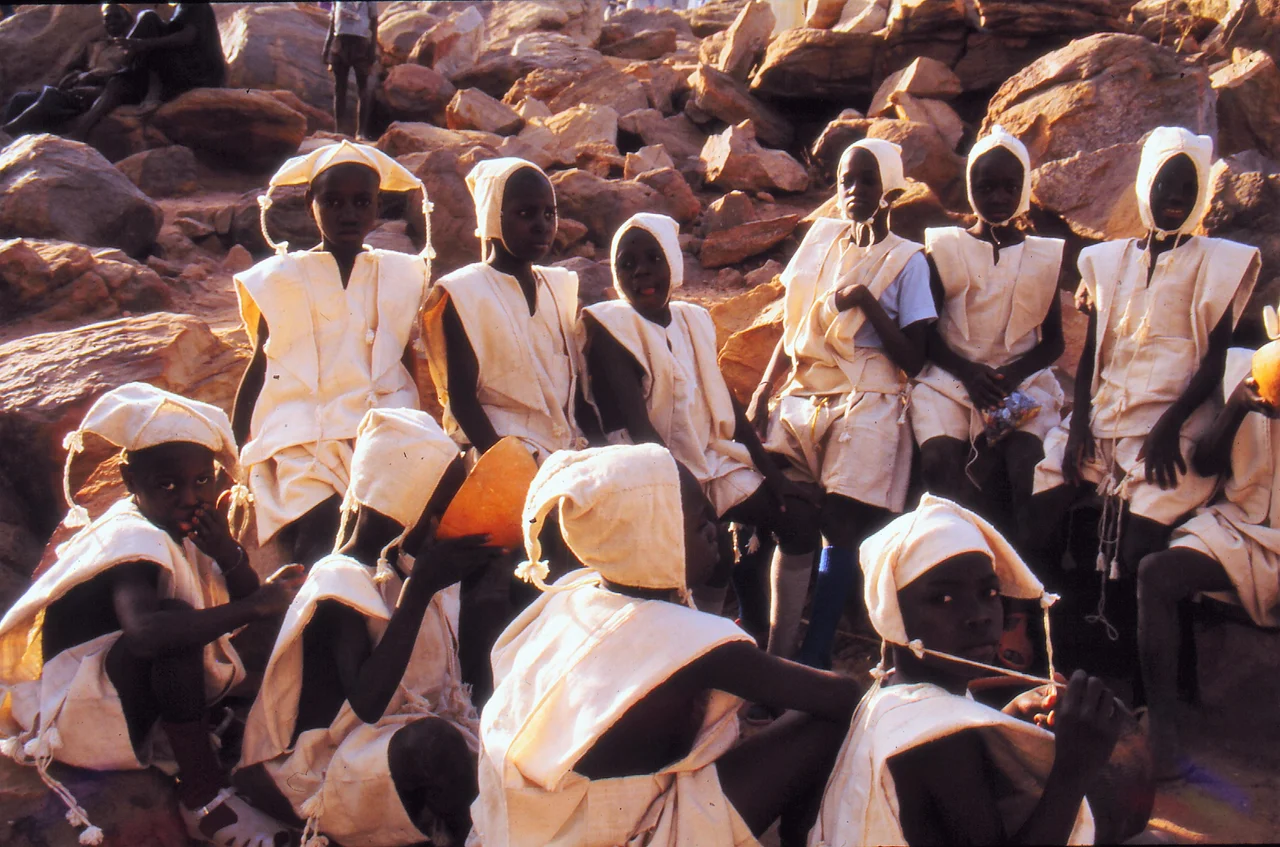

Tireli, Mali
The village climbs the talus where the plain meets the wall. At Tireli, the Bandiagara Escarpment looms hundreds of meters overhead, a vast curtain of sandstone, and the houses gather at its foot like figures sheltering under an enormous awning of rock. Above the rooftops, dark squares pock the cliff face: the ancient granaries and burial chambers cut into the stone long before any living Dogon was born. This is one of the cliff villages of Dogon country, eleven kilometers south-southwest of Sangha and twenty-eight kilometers east of the town of Bandiagara, and for the people who live here the escarpment is not scenery. It is home, ancestor, and altar all at once.
Farming in a Hard Land
Life here is wrested from a difficult landscape, and the Dogon are famous for the ingenuity with which they do it. In the dry season, photographs from the 1980s show villagers cultivating tobacco in the bed of a stream that runs only when the rains come, coaxing a crop from the cracked ground while it waits. Women carry manure out to small fields tucked among the rocks, and onions and grain are grown in plots that look impossible to anyone raised on flat farmland. Every patch of soil is precious on the narrow shelf between the cliff and the open Seno plain, and the Dogon have spent centuries learning to read it.
Market Day
Tireli's market is the village turned inside out. On market day, traders settle among the worn 'sitting stones' that serve as benches, and the place fills with color and bargaining. Old photographs catch the texture of it: a schoolboy weaving between the stones, young women selling home-brewed millet beer who cheerfully scold a passing photographer that he, too, must buy a calabash if he means to take their picture. Markets in Dogon country rotate from village to village across a five-day week, so the same crowd reappears down the cliff at Tireli one day and up at Sangha the next, the rhythm of trade keeping the scattered settlements bound together.
The Masks Come Down the Cliff
Tireli is one of the villages renowned for the Dama, the great Dogon funerary ceremony that escorts the spirits of the dead to the realm of the ancestors. In preparation, young men withdraw to make and don elaborate carved masks, among them the towering Kanaga with its arms reaching toward earth and sky, and the soaring multistory Sirige. When the ceremony reaches its climax, days of masked dancing unfold, and the maskers descend the steep footpaths of the escarpment to perform before the gathered village below. It is a sacred obligation, not a show, performed so that the disturbance death brings to the world can be set right and the dead given their proper place.
Between Old and New
The wider world has long reached even here. A portrait from 1985 shows a young Dogon man newly returned from Abidjan on the coast, a transistor radio in his hands, the labor migration that has long carried young people away and brought them back changed. Tireli sits within the Bandiagara Escarpment, inscribed by UNESCO as a World Heritage Site in 1989 for its extraordinary marriage of geology and human culture. In recent years insecurity across central Mali has made the region dangerous and largely closed it to outside visitors, but the village endures at the foot of its cliff, as it has for generations.
From the Air
Tireli lies at approximately 14.38 N, 3.35 W, at the base of the Bandiagara Escarpment in central Mali's Dogon country. From the air the defining feature is the long sandstone cliff running roughly southwest-to-northeast; the village sits on the talus slope at its foot, with the flat Seno-Gondo plain stretching away to the southeast. Sangha lies about 11 km to the north-northeast. Nearest airport is Mopti-Ambodedjo (GAMB), roughly 70-80 km west near Sevare. Best viewed low and in raking morning or late-afternoon light, when the cliff face and its shadowed cave openings stand out sharply; harmattan dust can reduce visibility December-March.
Nearby Stories
- Hamdullahi 25 km away
- Battle of Konna 40 km away
- Bangime 52 km away
- Ouahigouya 68 km away
- Battle of Jenné 76 km away
- Yacouba Sawadogo 99 km away
- Hand of Fatima (rock formation) 131 km away
- Djenné 132 km away