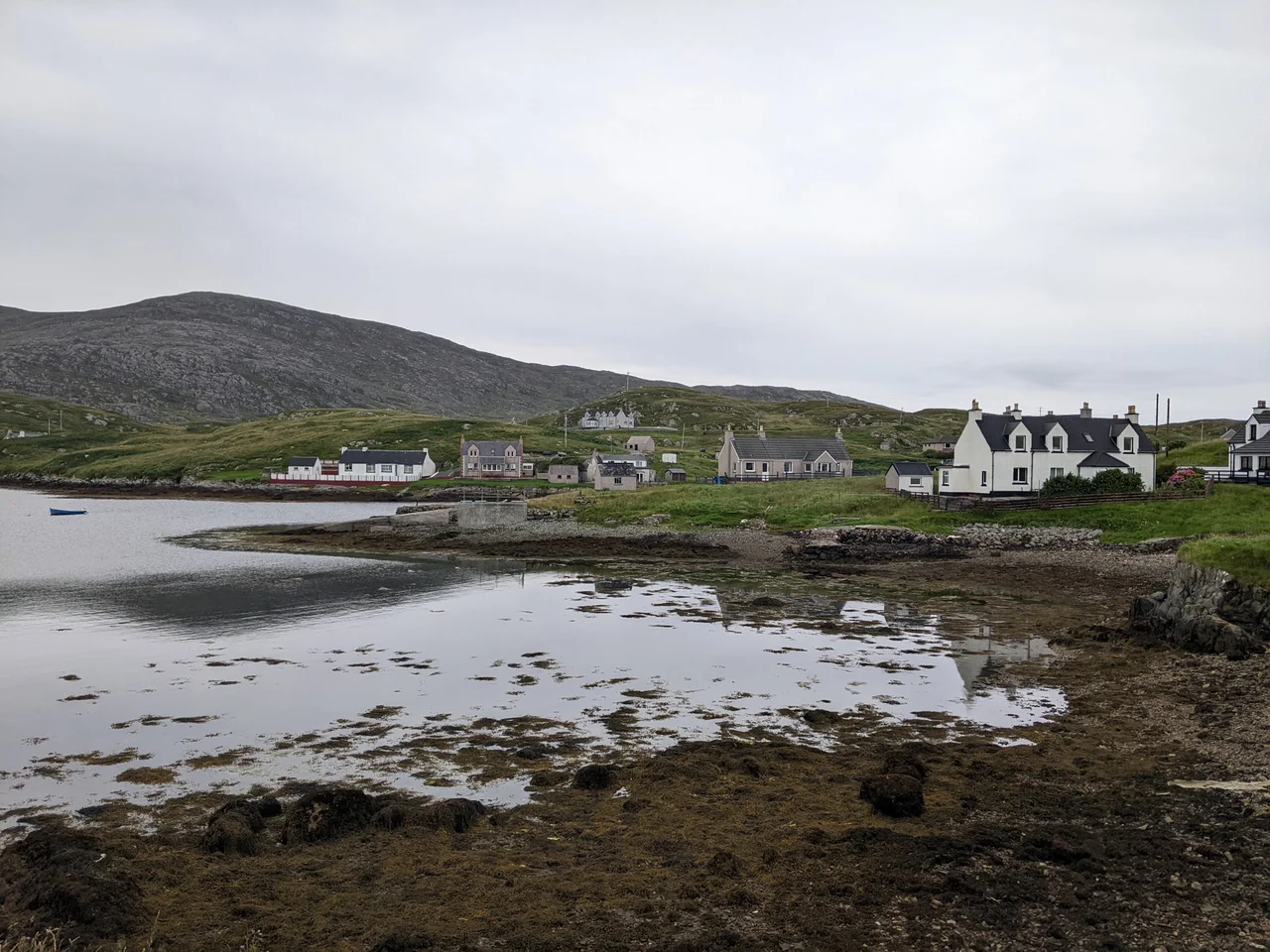

Scalpay, Outer Hebrides
Three hundred metres of water separate Scalpay from Harris. In 1997, a bridge closed the gap, and the ferry that had carried generations of islanders to school and shop and church was retired. The bridge changed the island in ways that are still being argued about - made it easier to leave, easier to live, easier to be only half there. What it did not change is the shape of the place: a lumpy granite-and-gneiss island peppered with small lochans, fringed by an Atlantic that comes in three different colours depending on the day, and home, at last count in 2022, to 282 people.
Ship or Scallop, Take Your Pick
The Gaelic name Sgalpaigh na Hearadh - 'Scalpay of Harris,' to distinguish it from the other Scalpay off Skye - is borrowed from Norse. The toponymist Mac an Tàilleir argued in 2003 that it comes from a Norse word meaning 'ship island.' The geographer Hamish Haswell-Smith preferred Skalprøy, 'scallop island.' Both are plausible. Either way, the name reaches back to the centuries when Norse-speaking sailors held these waters and gave their names to the islands they passed. The largest of Scalpay's many lochans is Loch an Duin, the 'Loch of the Fort,' which contains a small island still bearing the remains of an Iron Age dun. Eilean Glas, the tied islet on the east coast, was the site in 1789 of the first lighthouse built anywhere in the Hebrides.
Bonnie Prince Charlie's Fugitive Week
In April 1746, the Jacobite cause died at Culloden Moor. The defeated Prince Charles Edward Stuart - 'Bonnie Prince Charlie' - became the most hunted man in Britain, with £30,000 on his head, and for the next five months he ran across the Hebrides one step ahead of redcoats and rumour. He came to Scalpay in late April, taking shelter for a few nights with the tenant farmer Donald Campbell, who refused to betray him despite the bounty. From Scalpay the prince made his way to Stornoway, then back south through the Uists, finally escaping to France in September. The Scalpay episode lasted barely a week. It is the kind of week that locals were still telling stories about two centuries later.
The Community That Bought Itself
Scalpay's fortunes through the 20th century rose and fell with fish. In 2001 the island had 322 people, most working in fish farming and prawn fishing. A salmon factory provided steady employment from 2001 until it closed in 2005. The last general shop on the island closed in 2007. By 2011 the population had fallen 9 percent to 291, while Scottish island populations as a whole were growing. Then, in 2011, Scalpay's owner Fred Taylor announced he intended to hand the entire island over to the people who lived there. The islanders voted to accept the gift, formed a partnership with the community-owned North Harris Trust, and in 2013 became, formally, their own landlords. In 2012 they opened Buth Scalpaigh, a community shop and café. The bridge from Harris remains the lifeline. The island is now, for the first time in centuries, its own.
From the Air
57.865°N, 6.678°W in East Loch Tarbert, just east of Harris. The 1997 bridge across the 300 m Caolas Scalpaigh narrows is unmistakable from the air. Cruise 2,000-4,000 ft to see the lochan-pocked interior and Eilean Glas lighthouse on the eastern peninsula. Stornoway (EGPO) lies about 25 nm north. Tarbert is just west across the bridge. The Shiant Islands sit roughly 8 nm east in the Minch. Expect Atlantic westerlies and rapid weather changes.
Nearby Stories
- Lewis 5.9 km away
- Lochmaddy 9.7 km away
- Uig 11 km away
- Rua Reidh Lighthouse 12 km away
- Loch Torridon 15 km away
- Stoer Head Lighthouse 34 km away
- The Flannan Isles Mystery: The Lighthouse Keepers Who Vanished 35 km away
- Sollas 36 km away