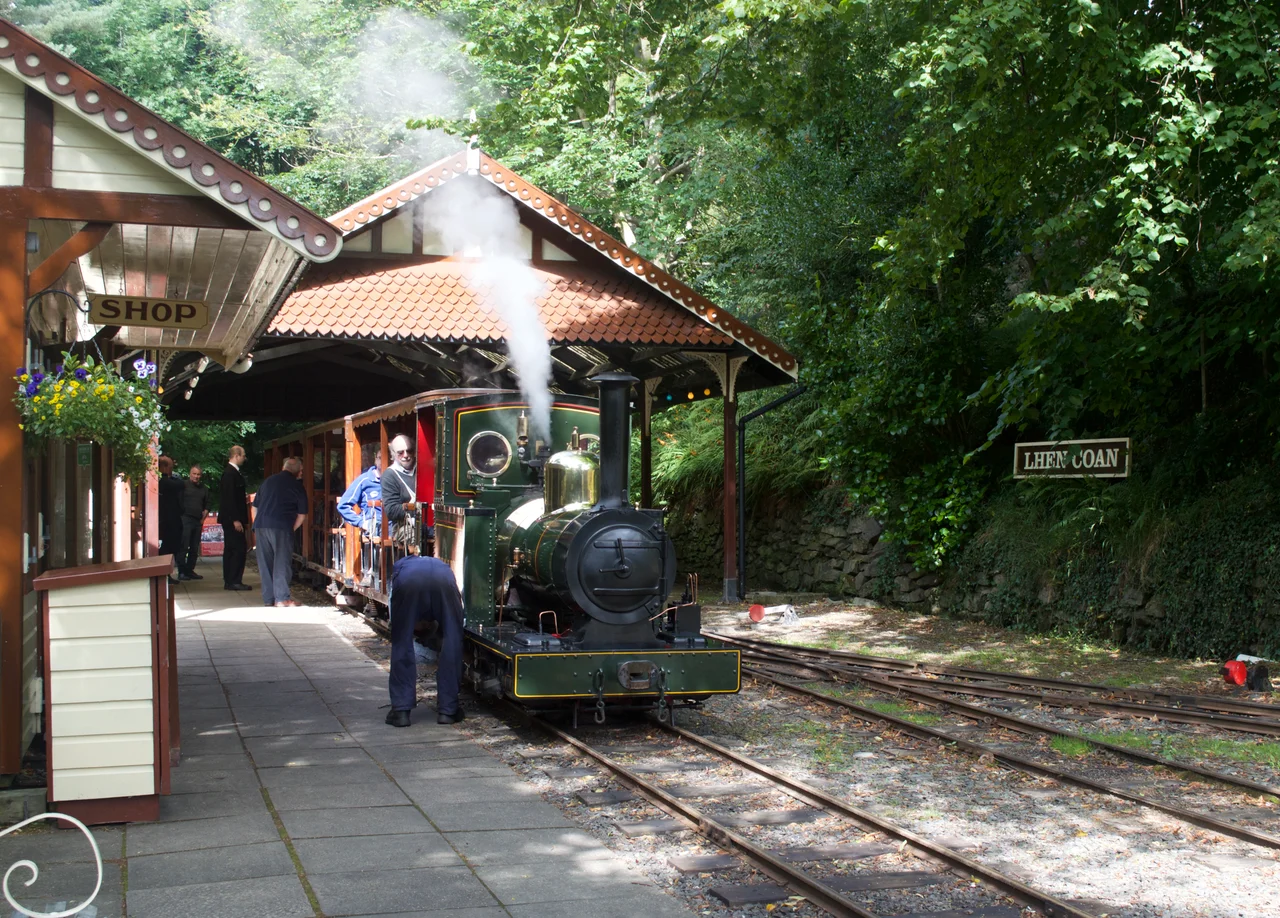

Sea Lion (steam locomotive)
When the apprentices at Sellafield took her on in 1986, Sea Lion was barely a locomotive at all. Brass fittings had been pried off by collectors and thieves. She had spent years in the open air at a Kirk Michael steam centre. After that she had been hauled to Loughborough by a preservationist who moved to England and took her with him. By the time the campaign to bring her back to the Isle of Man got going, she was a derelict 90-year-old machine that had not turned a wheel under her own steam since 1939. The trainees of British Nuclear Fuels rebuilt her anyway. By 1987, on a stretch of test track laid at the Ravenglass and Eskdale Railway in Cumbria, she moved.
Built for a Cliff Edge
Sea Lion was built by W. G. Bagnall and Company in Stafford and delivered in May 1896, ordered for the Groudle Glen Railway. The line had been built to carry Victorian holidaymakers three-quarters of a mile out to a clifftop zoo that featured sea lions and polar bears. The locomotive took her name from the principal attraction. For nine years she ran the line alone. In 1905 a sister engine arrived, named Polar Bear after the zoo's other star, and the railway had its pair. By the 1920 season Sea Lion was deemed too costly to keep repairing. The line tried to replace both steam engines with battery electric locomotives that inherited their names, but the experiment was a financial disaster, and within a few years Sea Lion was hauled back to the works for rebuilding. She kept the line running until war shut everything down in 1939.
A Long Slow Wreck
The railway reopened in 1950 with Polar Bear only. Sea Lion had spent her wartime in the open, in poor condition, and demand had dropped. The line itself struggled on until 1962. By then the locomotive was a corpse with brass missing and metal pitted. She was saved from scrap by John Walton, a local preservationist, who hauled her to his steam centre at Kirk Michael, on the island's northwest coast. There she sat in the car park as an exhibit. When Walton moved to Loughborough he took her with him. Years passed. When restoration of the Groudle Glen Railway began, a campaign formed to bring the engine home. The apprentices at British Nuclear Fuels stepped forward and took the locomotive to Sellafield in 1986 for full restoration.
Back Under Steam
By 1987 Sea Lion had been transported to the Ravenglass and Eskdale Railway, where a short section of three-foot test track was laid for her. She turned a wheel under her own steam for the first time in 48 years. She went back to the works for finishing and paint, then arrived at Groudle Glen that September. The first passenger train ran at Christmas 1987, the locomotive turned out in her original olive green colour scheme. Reboilering was completed in 2003, and she emerged in the darker Brunswick green she had carried in the 1920s, kept that way for years until volunteers stripped her back to bare metal at the end of one season and repainted her into the very first 1896 livery, her name in gold leaf with blue shadowing, the green and black buffer beams lined out by hand. The volunteers did the research themselves, getting down to the specific shades of paint.
Visiting and Visited
Sea Lion has not stayed on the island. She visited the Ffestiniog Railway in 1997, then in 2005 went to the Amberley Museum in West Sussex to help celebrate her sister Polar Bear's centenary. In a neat exchange, Polar Bear came back with her to Groudle Glen for a return visit. A plaque honouring Alastair Lamberton, one of the line's engineers, was placed inside the cab in 1999. After Christmas 2011 she was withdrawn for her ten-year overhaul, with her boiler going to the Isle of Man Railway Workshops for re-tubing and her frames and motion attended to at the Isle of Man Steam Packet Workshops. She was back in service by July 2012. Of the four locomotives left in the world with E. E. Baguley's patented valve gear, Sea Lion is one. The others are Isabel at the Amerton Railway, Rishra at the Leighton Buzzard Narrow Gauge Railway, and an unknown Bagnall on display somewhere in India.
From the Air
Sea Lion's home line at Groudle Glen runs along the cliffs at approximately 54.177 degrees north, 4.422 degrees west, about three miles northeast of Douglas. From the air the track is a thin ribbon on the south side of Groudle headland, ending at Sea Lion Rocks above the small cove that once held the Victorian zoo. Ronaldsway Airport (EGNS) lies about twelve nautical miles south. The Manx Electric Railway runs along the coast just inland.
Nearby Stories
- St Bees Lighthouse 15 km away
- Celtic Array 22 km away
- Kirkmaiden 23 km away
- Isle of Whithorn 23 km away
- Seascale Lifeboat Station 31 km away
- German submarine U-1024 36 km away
- SS Georgetown Victory 40 km away
- Blackpool Illuminations 56 km away