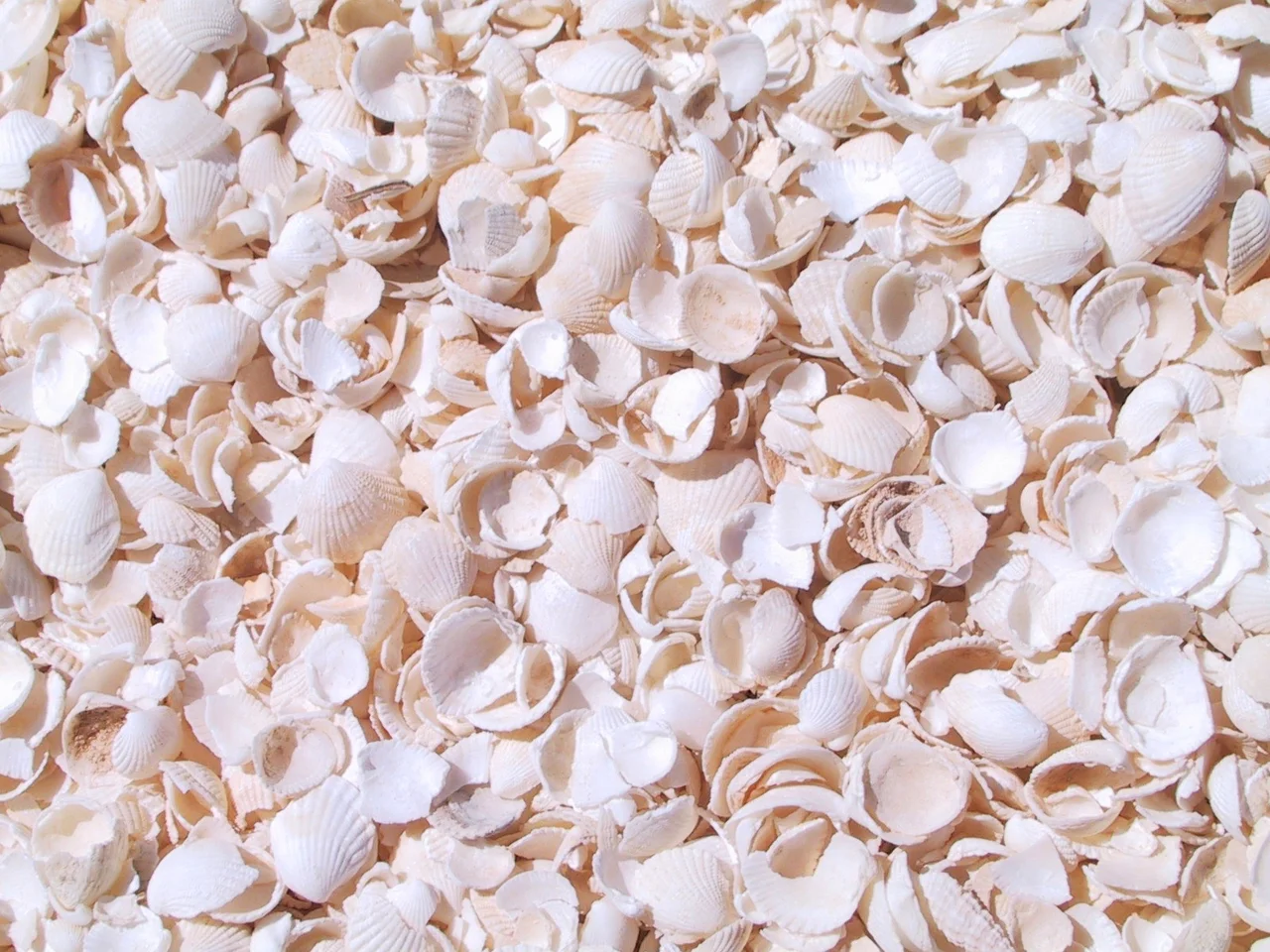

Shell Beach (Western Australia)
Reach down and grab a handful, expecting sand, and your fingers close on something else entirely: thousands of tiny white shells, smooth and intact, no larger than a fingernail. There is no sand at Shell Beach. There is no rock. For a 60-kilometre stretch of the Shark Bay shore, and to a depth of as much as ten metres beneath your feet, the beach is built from nothing but the shells of a single small cockle, piled up over thousands of years into a blinding white shore that meets impossibly turquoise water. It is one of only two beaches on Earth made entirely of shells, and standing on it feels like standing on a secret the planet has been keeping.
A Beach with No Sand
The shells belong to the Shark Bay cockle, Fragum erugatum, a bivalve barely larger than a thumbnail. Each one lived, died, and washed ashore, and the sheer arithmetic is staggering: countless billions of shells, accumulated grain by grain across millennia, until the beach became a deposit metres deep. Walk on it and it crunches softly underfoot, cool and dry. In bright sun the whiteness is dazzling, almost lunar, and the contrast with the deep blue of L'Haridon Bight beyond is so vivid it looks unreal. There is no muddy tideline, no scattering of seaweed, nothing but shells, packed so densely and uniformly that the beach reads as a single shimmering surface.
Why the Cockles Took Over
The secret lies in the water. L'Haridon Bight is hypersaline, far saltier than the open ocean, because of the bay's geography and the hot, dry climate that evaporates water faster than it can be replaced. Most marine life cannot tolerate such extreme salinity, and that is precisely the point. The predators and competitors that would normally keep the cockle population in check simply cannot survive here. Freed from anything that might eat or crowd them, the cockles bred in extraordinary numbers, generation upon generation. The same harsh saltiness that makes this corner of Shark Bay hostile to most creatures handed the little Fragum cockle a kingdom all its own, and the beach is the monument to its reign.
Building Blocks of Shell
Time and pressure transform the shells. Compacted and cemented together over the centuries, the lower layers fuse into a soft, pale limestone called coquina, a stone that is literally made of shells. People noticed its usefulness long before this became protected land. Before Shark Bay was inscribed as a World Heritage Site, blocks of coquina were quarried from the deposits and cut into building stone. Several historic buildings in the nearby town of Denham were raised from it, their walls assembled from compressed seashells. Few towns anywhere can claim to be built, quite literally, from the beach. The volume of shell matter produced here is so great that the coquina deposits run deep, a quarry made entirely by a thumbnail-sized mollusc. Today the quarrying has stopped, and the shells are left to lie where the tides arranged them.
Part of a Living Wonder
Shell Beach sits at the southern end of the narrow Taillefer Isthmus, the slender land bridge connecting to the Peron Peninsula, and it is far from alone in its strangeness. The hypersaline waters that grew these cockles also nurture the stromatolites of Shark Bay, living rocks built by cyanobacteria that represent some of the oldest forms of life on Earth. This is a landscape where extreme conditions produce extraordinary results, a place UNESCO recognized as globally unique. Wade in, and the dense salt water lifts you with an unexpected buoyancy, the same extreme salinity that built the beach now holding you up. The beach is beautiful in the simplest way, white and blue and endless, but its real wonder is what it reveals: that life, given the right strange circumstances, will fill every space it can, one tiny shell at a time.
From the Air
Shell Beach lines the northeastern shore of L'Haridon Bight at roughly 26.21 degrees south, 113.76 degrees east, along the narrow Taillefer Isthmus that links to the Peron Peninsula. From the air the beach appears as a brilliant white ribbon, unusually bright against the surrounding red earth and the deep blue of the bight, traceable for tens of kilometres. Best viewed from 2,000 to 4,000 feet for the colour contrast. The nearest airfield is Shark Bay (Monkey Mia) Airport (ICAO YSHK) about 45 km northwest near Denham; Carnarvon Airport (ICAO YCAR) lies roughly 130 km north. The dry Gascoyne climate offers reliable visibility year-round, and high overhead sun maximizes the white glare that makes the beach unmistakable from above.
Nearby Stories
- Steep Point 15 km away
- Ocean Park Aquarium 18 km away
- Dirk Hartog Island 29 km away
- Woodleigh Impact Structure 48 km away
- Zuytdorp Cliffs 74 km away
- Pimbee National Park 82 km away
- Eurardy Reserve 117 km away
- Chatham Islands 6476 km away