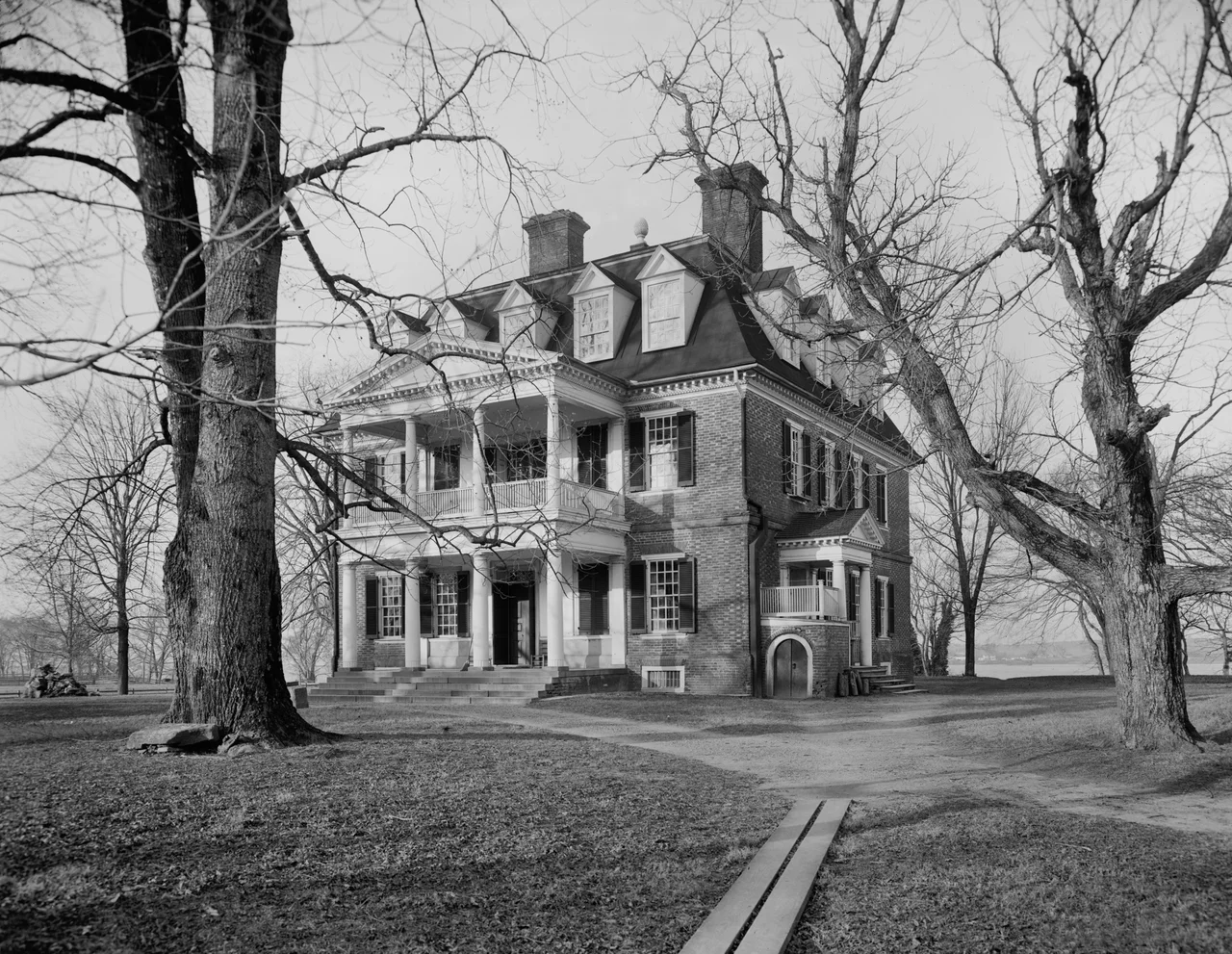

Shirley Plantation
The Hill Carter family has lived in the same house for nearly three centuries. The Great House at Shirley Plantation was completed in 1738, and at least eight generations of the same family have called it home since. That continuity is the story Shirley tells about itself. But for most of those centuries, the people who actually made the place work, who plowed the fields and cooked the meals and washed the laundry and raised the children, are buried in the unmarked margins of that family story. Seventy to ninety enslaved Africans labored at Shirley each year in the 19th century. Their names, mostly, are not on the walls.
A Foothold on the James
European settlement here began in 1613, when Sir Thomas West, 3rd Baron De La Warr, claimed the land and called it West and Sherley Hundred. Three years later, John Rolfe (Pocahontas's husband, who would not be widowed until her death in 1617) named it among the six European settlements in the colony. Captain Isaac Maddeson commanded twenty-five laborers and farmers. When the Powhatan uprising of March 22, 1622 swept through the river plantations and killed nearly a third of Virginia's colonists, West and Sherley Hundred came through largely intact. A 1623 census counted forty-five men, women, and children on the mainland and another twenty-four on what is now Eppes Island, visible from the front lawn. Tobacco moved downriver to Jamestown and across the Atlantic to England. It would become Shirley's foundation crop and, by extension, the foundation of its labor demands.
The Hill Carters and the Long Inheritance
Edward Hill arrived in the mid-17th century and patented his way into a sprawling estate. By 1660 he held 2,476 acres on the mainland and the 416-acre island. His son Edward Hill II owned the land through Bacon's Rebellion in 1676. One of them built the first Hill House, eventually torn down for salvage. The current mansion, the Great House, went up nearby and was finished in 1738. In its parlor, on June 18, 1793, Anne Hill Carter married Henry "Light-Horse Harry" Lee, the Revolutionary cavalry officer who had eulogized Washington as "first in war, first in peace." The couple's son, born thirteen years later at Stratford Hall, would lead the Confederate Army of Northern Virginia. Robert E. Lee's mother was born at Shirley, and the ties between Shirley and the Lee family run through everything else that happened here.
The Labor That Built It
Indentured Englishmen worked the early fields, but by the early 1700s, as the indenture flow dried up, Virginia's planters turned to chattel slavery. The 1787 Virginia tax census recorded that Charles Hill Carter held 67 enslaved people over the age of 16 at Shirley and another 67 children, alongside 16 horses and 70 cattle. He held still more enslaved people at his Long Bridge plantation in the same county. Through the 19th century, between 70 and 90 enslaved Africans were forced to work at Shirley each year: plowing the fields, cleaning the house, cooking, doing childcare, doing laundry. The two-story kitchen with quarters above it, the laundry building with quarters above it, and the slave quarters identified in the 1979 and 1980 archaeological excavations by William and Mary teams all testify to the architecture of forced labor. After emancipation in 1865, Hill Carter retired and divided the estate; his son Robert kept what is now Shirley, and his other son William Fitzhugh Carter inherited Upper Shirley, today a vineyard.
What Stands Today
Shirley was added to the National Register of Historic Places in 1969 and named a National Historic Landmark in 1970. The Great House still stands, surrounded by Queen Anne–era support buildings: a two-story kitchen, a two-story laundry, a smokehouse, a stable, an ice house, a large storehouse, and a brick dovecote that may be the oldest in North America. The James River slides past below the lawn. After Tuttle Farm in Dover, New Hampshire was sold and rebranded, Shirley took on the title of oldest continuously operating business in the United States, with the Hill family running it as a working farm since 1638. The plantation now interprets the lives of the enslaved alongside the family story, an honest reckoning that the marketing materials of an earlier era preferred to leave out.
From the Air
Shirley Plantation sits at 37.36 N, 77.24 W on the north bank of the James River in Charles City County, roughly midway between Richmond (KRIC, 18 nm northwest) and Williamsburg-Jamestown (KJGG, 25 nm east-southeast). Newport News/Williamsburg International (KPHF) lies about 35 nm east. From cruising altitude, follow the wide oxbow bends of the James east of Richmond; Shirley is on the inside of a sharp bend with Eppes Island just offshore. The Great House and dovecote are best picked out at 1,500–3,000 feet AGL on a clear afternoon.
Nearby Stories
- Rosewell Plantation 6.4 km away
- Christopher Newport University 13 km away
- Cactus Hill 18 km away
- Huguenot Memorial Chapel and Monument 24 km away
- Lewis Ginter Botanical Garden 27 km away
- Fort Christanna 44 km away
- USS Texas (1892) 50 km away