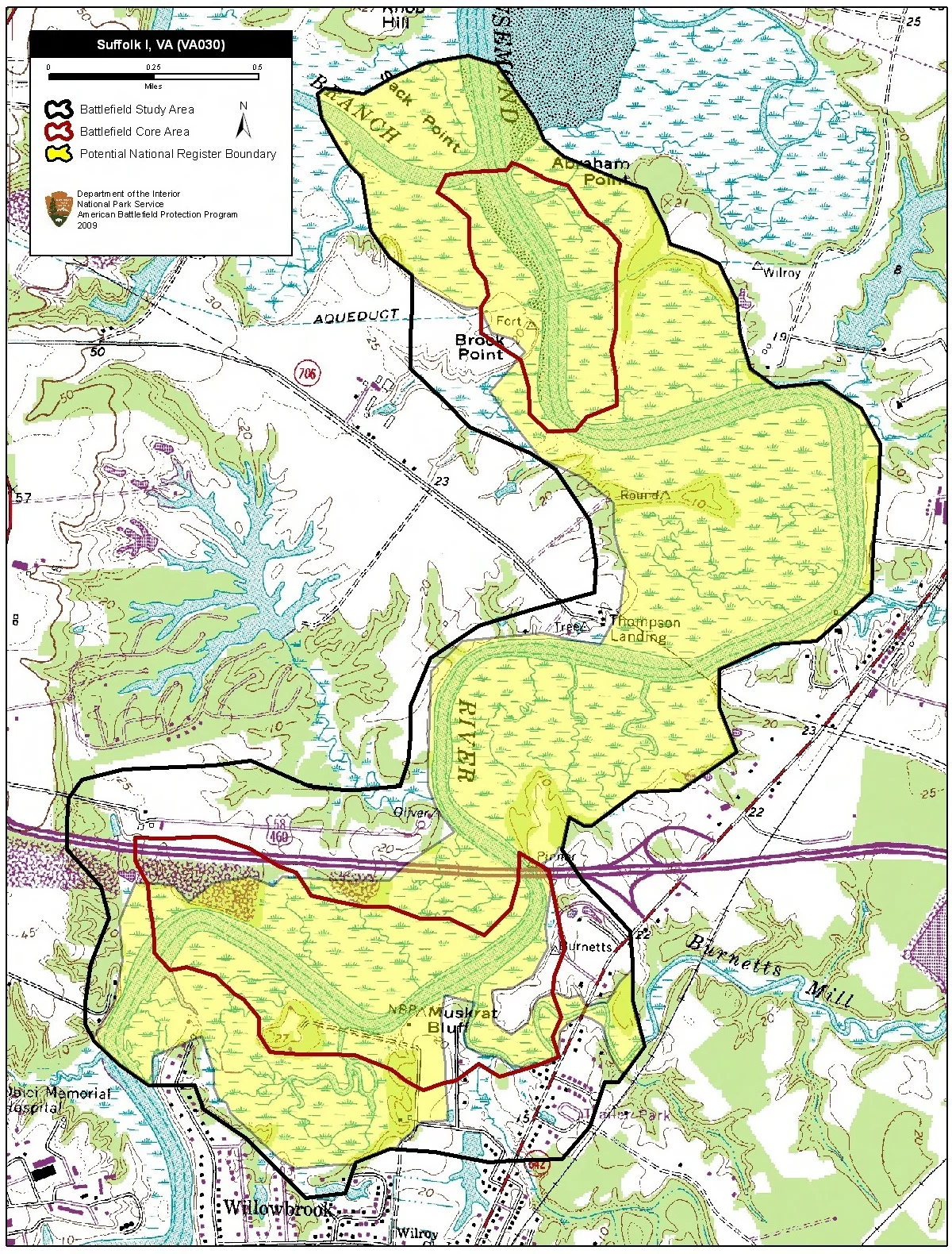

Siege of Suffolk
On April 19, 1863, a Union gunboat called the Stepping Stones came down the Nansemond River with its sides covered in canvas. To the Confederate gunners on Hill's Point, it looked like an ordinary attempt to run their battery. With thirty feet still to go to the bank, the boat grounded on an unseen obstruction. The two hundred and seventy infantrymen hidden under the canvas stood fully exposed on the deck. They could either freeze and be slaughtered or jump. Captain Hazard Stevens pushed through the troops and dropped into the water with his rifle held above his head. A hundred soldiers followed him. Ten minutes later they had taken the fort without firing a shot. It is one of the most improbable small-unit actions of the Civil War, and it happened during a siege that history has nearly forgotten.
Longstreet's Errand
Lieutenant General James Longstreet had four objectives when Robert E. Lee placed him in command of the Department of Virginia and North Carolina in early 1863: protect Richmond, reinforce the Army of Northern Virginia if needed, gather supplies, and - if possible - capture the Union garrison at Suffolk. He had about 20,000 men, including divisions under John Bell Hood and George Pickett. The Union garrison under Major General John J. Peck had 25,000, sitting behind formidable earthworks with the Great Dismal Swamp covering the east flank and the Nansemond River covering the west. It was Longstreet's first independent command. He looked at the Union works, decided a frontal assault would be slaughter, and settled in for a siege.
The River Was the Weak Point
Peck had pulled most of his infantry off the river to thicken his southern lines, leaving the Nansemond mostly to the Navy - two flotillas of gunboats under Lieutenants Roswell Lamson and William B. Cushing. Longstreet's engineers noticed. Confederate batteries went up at the Norfleet House and at the old Fort Huger site on Hill's Point. On April 14, Lamson's sailors spotted fresh dirt on the river bluffs; the next day Union gunboats tried to run the Norfleet battery and ended up trapped between the Hill's Point guns and the new emplacement. The Mount Washington grounded and was crippled; the Stepping Stones pulled her free with the rising tide. The army-navy argument that followed about whether gunboats could safely work the river eventually climbed all the way to the White House.
The Stepping Stones Raid
Hazard Stevens - son of General Isaac Stevens - had been watching the Hill's Point battery from a tree on the opposite bank. The garrison was five guns, fifty-nine artillerists under Captain Robert M. Stribling, with Captain David Bozeman's two infantry companies in support. Stevens proposed six p.m. as the attack time - enough light to see, not enough for a counterattack to form. After a morning bombardment from Lamson, Cushing, and Getty's batteries, Stevens loaded 270 men from the 8th Connecticut and 89th New York onto the Stepping Stones. The canvas-shrouded gunboat steamed down past the fort, dropped the canvas, and grounded. Stevens jumped. His men followed. Bozeman's infantry were still in cover from the morning shelling and could not get back to their guns in time. The garrison surrendered in ten minutes. Among the captured cannon were guns Stonewall Jackson had taken at Harpers Ferry the year before. Union casualties for the action: three killed and ten wounded for Getty, three killed and one wounded for Cushing in the morning bombardment, none for Lamson.
Lifting the Siege
The captured battery did not hold. Getty abandoned Hill's Point on April 21 rather than be cut off, and the Confederates moved back in. Lamson, frustrated, withdrew his gunboats. The standoff continued. On April 24, Michael Corcoran's Union division pushed out of Fort Dix against Pickett's right flank and was repulsed. Longstreet, meanwhile, was running an efficient foraging operation in the Blackwater region - the unsexy half of his mission, and the half he was completing brilliantly. Henry Halleck and William Seward both came down from Washington to inspect Peck's lines; Seward stayed overnight and got a fort renamed for him. On April 29, Lee ordered Longstreet to disengage and come north.
Aftermath, and Chancellorsville
Longstreet's withdrawal began on May 3, the same day Joe Hooker was fighting Robert E. Lee at Chancellorsville. Hooker had insisted to Peck that Longstreet must have already left; Peck, watching Longstreet's lines from inside Suffolk, knew better. The foraging wagons came back across the Blackwater first; the soldiers followed. By May 4 the last Confederate had crossed the river, and by May 9 Longstreet had rejoined Lee near Fredericksburg - too late for Chancellorsville, which Lee won anyway. Longstreet had completed two of his four objectives - protect Richmond, feed the army. He had failed at the fourth, which was Suffolk. The Union had held the town and lost the foraging argument. Both sides could claim a piece of the campaign, which may explain why nobody has ever quite known what to do with the Siege of Suffolk in the larger story of the war.
From the Air
The siege ran along the Nansemond River around Suffolk at 36.759N, 76.587W. The river bends through low coastal terrain south of Hampton Roads. Hill's Point, where the Western Branch meets the Nansemond, is about 4 nm north of present-day Suffolk. The Great Dismal Swamp lies east. Norfolk International (KORF) is 18 nm east-northeast. Recommended viewing altitude 2,000-5,000 feet AGL.
Nearby Stories
- Thomas Jefferson National Accelerator Facility 1.6 km away
- Cape Charles Lighthouse 4.6 km away
- Dismal Swamp Canal 7.6 km away
- Nat Turner's Rebellion 16 km away
- Chowan University 17 km away
- Flowerdew Hundred Plantation 25 km away
- False Cape State Park 27 km away
- Kitty Hawk: Where Humans First Flew 65 km away