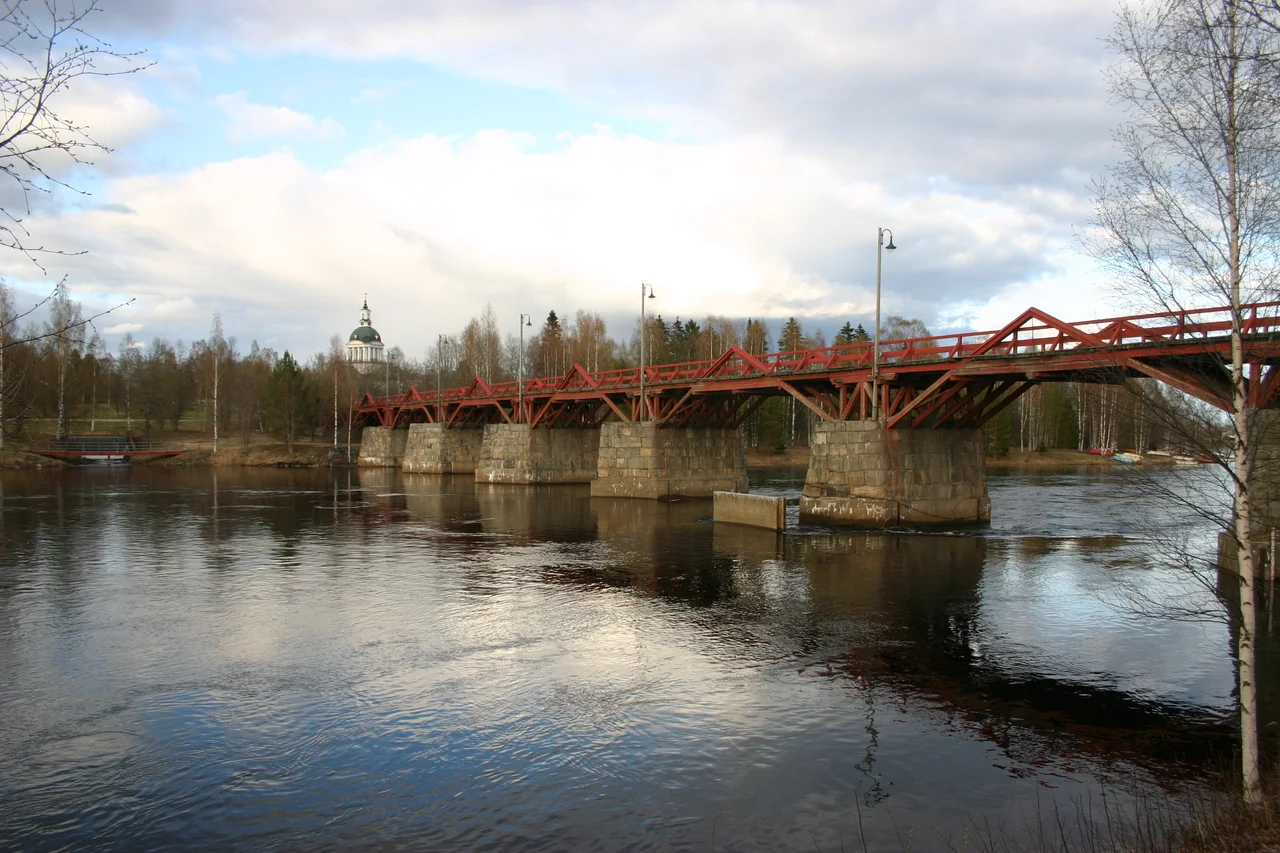

Skellefte River
Fifteen times between the mountains and the sea, the Skellefte River is stopped, spun through a turbine, and released. It begins as meltwater at Ikesjaure, high in Arjeplog Municipality within a few kilometres of the Norwegian border, and it ends 410 kilometres later in the Gulf of Bothnia. In between, it collects the drainage of 11,731 square kilometres, moves an average of 157 cubic metres of water every second, and hands roughly a gigawatt of capacity to the Swedish grid. This is not a wild river. It is a working one, and what it works for explains a good deal about northern Sweden.
Where the Water Collects
The upper river is less a channel than a chain of enormous lakes. Hornavan comes first among them, and it is a strange body of water: 221 metres deep, the deepest lake in Sweden, yet its surface sits 425 metres above sea level, so even the floor of it is still 204 metres up in the air. Below Hornavan lie Uddjaur and Storavan, shallower and broader, spread across the flat glacial country around the village of Arjeplog. In winter the whole system locks under ice for months at a time. In spring it releases, and the lakes do what engineers most want lakes to do — they hold the flood, then let it out slowly. Long before anyone built a dam here, the geology had already installed the reservoirs.
A Gigawatt of Falling Water
The first power station on the river, Finnfors, went up in 1906. Fourteen more followed — Rebnis, Sädva, Bergnäs, Slagnäs, Bastusel, Grytfors, Gallejaur, Vargfors, Rengård, Båtfors, Granfors, Krångfors, Selsfors, Kvistforsen — until the Skellefte produced about 4,241 gigawatt-hours in an average year. Tributaries feed the system along the way: Malån, Petikån, Finnforsån, Bjurån, Klintforsån. Something had to give for that, and what gave were the fish. Salmon and trout that once ran the river on their own are now stocked into it as compensation, and the river and its tributaries remain among the most popular fishing water in Norrland. It is an honest arrangement, if not a natural one — a river held to its old obligations by hatchery.
Skelepht, 1327
The name is older than almost anything written about the region. It appears as Skelepht in a document from 1327 and as Skellitta on the Carta marina, the great sixteenth-century chart of the north. What it means, nobody knows; the best guess is that it came from Sami, like most of the deep-map names up here, and that the original sense was lost before anyone thought to record it. The town at the river's mouth borrowed the name and then gave it back, so the water is now known by the settlement it passes through rather than the other way round. Skellefteå itself is young by Norrland standards — founded in 1845 by a vicar named Nils Nordlander, and home to roughly 36,000 people today, about fifteen kilometres inland from the open Bothnian Bay.
Metal Country
Water was never the only thing this valley produced. The bedrock south and west of the river holds one of Europe's richest sulphide ore belts, and Boliden AB has worked it for a century — around 1,200 employees, the largest private employer in Skellefteå, digging copper ore laced with gold, silver and platinum. The nickname stuck: Goldtown. When Northvolt chose Skellefteå in 2021 for an enormous battery plant, it looked like the same bargain renewed for the electric age, cheap hydropower married to northern metal. It did not hold. Layoffs came in September 2024 and bankruptcy followed in March 2025. The river kept turning its fifteen turbines regardless, which is the thing about infrastructure built to last a hundred years — it outlives the industries that justify it.
From the Air
The river's headwaters lie near 66.82°N, 16.12°E, in the lake-and-fell country of western Arjeplog Municipality, only a few kilometres east of the Norwegian border and the high ground around Sulitjelma. From 6,000 to 9,000 feet the drainage reads clearly: a braid of pale mountain lakes feeding southeast into the long dark sheets of Hornavan, Uddjaur and Storavan, then a single silver thread running 410 kilometres to the Gulf of Bothnia. Dam impoundments and their straight-edged reservoirs make useful checkpoints along the lower course. Nearest airports are Arvidsjaur (ESNX) to the southeast, Skellefteå (ESNS) at the river mouth, and Bodø (ENBO) across the mountains to the west. Expect low cloud and rapid weather changes over the border fells even in summer; the lower valley is generally clearer.
Nearby Stories
- Sørfold Municipality 11 km away
- Vuoggatjålme 16 km away
- Nasa Silver Mine 17 km away
- Blood Road Museum 24 km away
- Iraft 38 km away
- Saltstraumen 38 km away
- Laponia 50 km away
- Kungsleden 53 km away