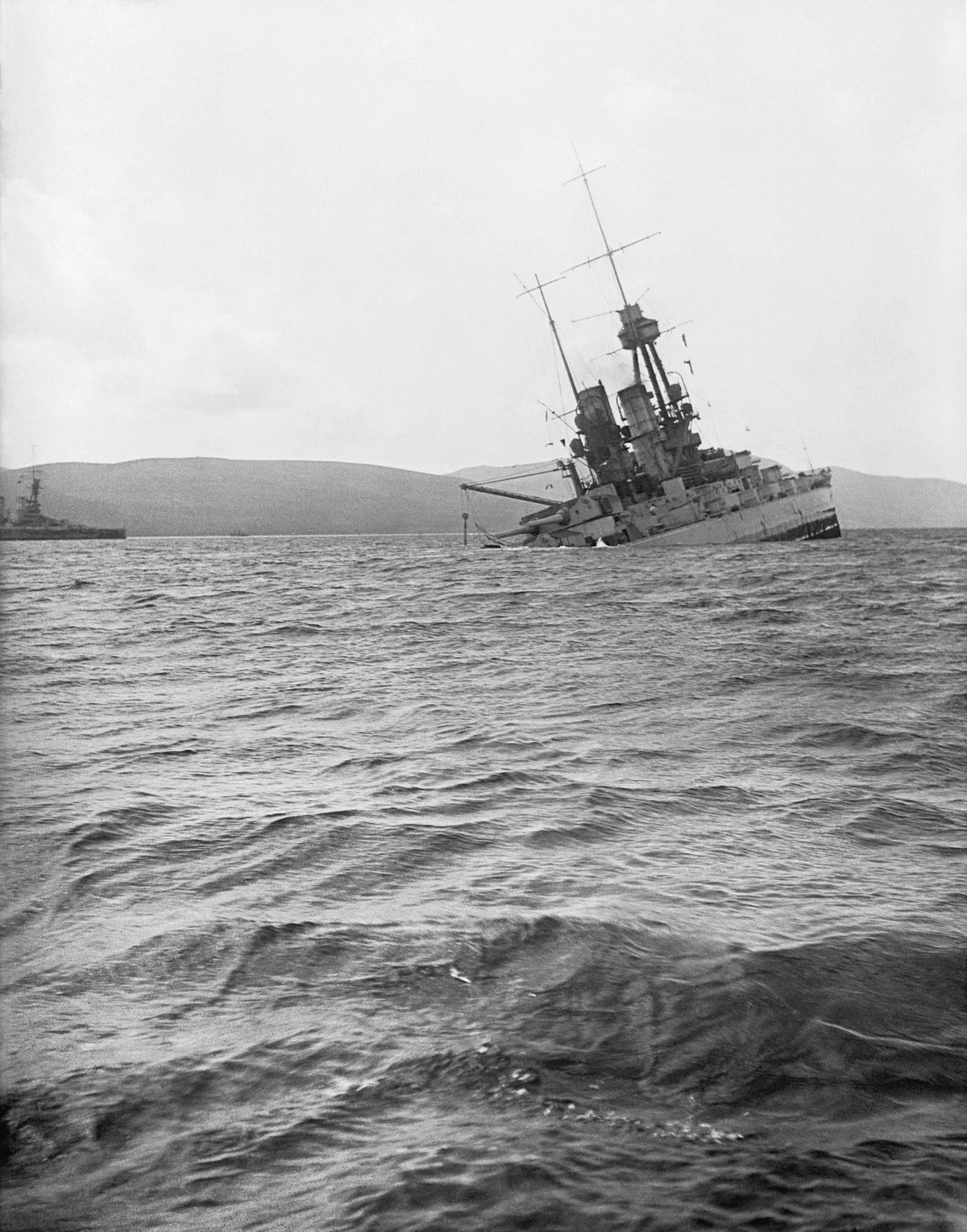

SMS Bayern
She was the most heavily armed battleship Germany had ever built, and she fired her guns in anger exactly once. SMS Bayern carried eight 38-centimetre guns in four turrets, the largest naval cannons ever mounted on a German warship up to that point. Her crew of just over eleven hundred men trained for the climactic fleet battle that German naval doctrine had been preparing for since the turn of the century. That battle, the Battle of Jutland, took place six weeks before she was ready for service. Three years later, while interned in a Scottish anchorage with a skeleton crew of two hundred sailors, her captain opened her sea valves and let the North Sea finish what the British had not.
Designed for a War She Missed
The Bayern-class battleships were Germany's answer to the British Queen Elizabeth class, which had introduced 15-inch guns to the Royal Navy. Design work began in 1910 against the backdrop of the Anglo-German naval arms race, and the calibre of the main armament was the central question. Earlier German dreadnoughts carried 30.5-centimetre guns. Bayern's designers settled on 38-centimetre weapons, accepting the additional cost in exchange for a decisive jump in shell weight. She displaced over 32,000 tonnes at full load, was nearly 180 metres long, and could make 22 knots on trials. Her keel was laid in December 1913. She launched in February 1915. She was finally ready for service on 15 July 1916, a month and a half after the Battle of Jutland had passed her by.
A Mine in the Baltic
Bayern's only significant combat operation came in October 1917, during Operation Albion, the German invasion of the Russian-held Baltic islands of Saaremaa and Muhu. She steamed into Tagga Bay alongside the battlecruiser Moltke and four König-class battleships to bombard Russian shore batteries. At 05:07 on 12 October, while moving into her firing position at Pamerort, she struck a naval mine. The explosion killed seven men, allowed a thousand tonnes of water into the hull, and dropped her forecastle by two metres. She fired on the battery at Cape Toffri despite the damage and was released from her station later that day. Temporary repairs failed; she had to be towed back to Kiel for two months of work in dry dock. That was her war.
The Voyage to Internment
On 21 November 1918, ten days after the Armistice, Bayern sailed from Wilhelmshaven with most of the High Seas Fleet under the command of Rear Admiral Ludwig von Reuter. They rendezvoused with a British light cruiser and then with a flotilla of 370 British, American, and French warships that escorted them to Scapa Flow. The Germans had not lost the war at sea, exactly. They had simply been outproduced and outwaited. The bulk of the fleet had not fought a battle since Jutland, and morale had collapsed into mutiny in October. The ships now riding north were manned by skeleton crews. The guns had been disabled by the removal of their breech blocks. The fleet was, in every meaningful sense, already finished.
The Day at 14:30
The internment dragged on for seven months while the Allied powers argued over the terms of the Treaty of Versailles. Reuter, isolated at Scapa Flow with limited news, believed the British intended to seize his ships on 21 June 1919, the original deadline for German signature. The deadline had actually been extended to 23 June, but Reuter did not know that. On the morning of the 21st, the British Atlantic Fleet sailed out of Scapa Flow for training exercises. At 11:20 Reuter transmitted the prearranged order. Across the anchorage, German sailors opened sea valves, smashed sight glasses, and jammed open watertight doors. Bayern slid stern-first under the surface at 14:30 in the afternoon. The largest scuttling in naval history sent fifty-two ships, including ten battleships and five battlecruisers, to the bottom of Scapa Flow.
What Remains
Bayern was salvaged in September 1934 and towed to Rosyth, where she was broken up for scrap the following year. The bulk of the great battleships rose from Scapa Flow in the 1920s and 1930s as Cox and Danks and later Metal Industries pioneered techniques for raising sunken capital ships. But not everything came up. Bayern's main battery gun turrets fell out of the inverted hull as she rose and remain on the seabed today, accessible to recreational divers in the cold green water of Scapa Flow. Her bell was eventually returned to Germany and now hangs in the Kiel Fördeklub. The ship that was supposed to lead a new battle squadron into Britain's North Sea backyard rests, in pieces, in the same waters her crew chose over surrender.
From the Air
SMS Bayern lies on the seabed of Scapa Flow at approximately 58.90°N, 3.18°W. Kirkwall Airport (EGPA) is 8 km north-northeast, with paved facilities and limited instrument approaches. From 2,000 to 3,000 ft AGL, Scapa Flow appears as a large sheltered anchorage roughly 15 km across, ringed by the islands of Mainland, Hoy, South Ronaldsay, and Burray. The wreck sites are not visible from the air but are marked on Admiralty charts and used regularly by recreational diving operators based out of Stromness and Houton. Westerly winds funnel down the flow and can produce significant turbulence around the surrounding hills. Best photographed in clear morning light from the east.
Nearby Stories
- Castle of Mey 9.7 km away
- Copinsay 12 km away
- HMS Sword Dance (1918) 27 km away
- Strathnaver Museum 28 km away
- HMS King Edward VII 35 km away
- Fair Isle 74 km away
- Jarlshof 135 km away
- The Laki Eruption: The Volcano That Changed World History 926 km away