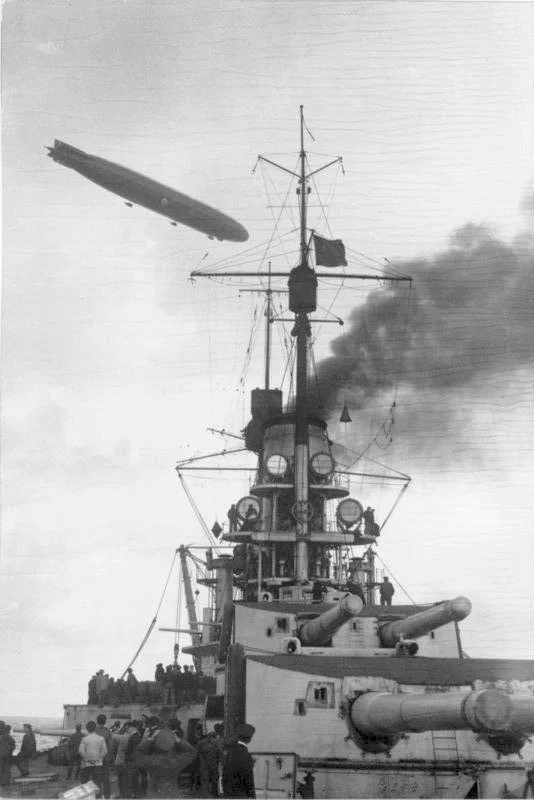

SMS Grosser Kurfürst
She rammed her own sister ship twice. She grounded several times. She was torpedoed once and mined once. She was hit eight times by British shells at Jutland and the flooding that followed nearly sank her on the way home. She survived all of it. Then her own captain opened her sea valves in a quiet Scottish anchorage and she went to the bottom alongside the rest of the High Seas Fleet. SMS Grosser Kurfürst had one of the most accident-prone careers in the Imperial German Navy and one of the more peculiar afterlives: her bell ended up in a back garden in Bristol, where it was used as an ornament for decades before being auctioned and bought by a museum.
Frederick William's Battleship
Grosser Kurfürst was the second ship of the König class, the fourth generation of German dreadnoughts and a refinement of the Kaiser class that preceded her. Her name, Great Elector, honoured Frederick William I, the seventeenth-century ruler who had transformed Brandenburg-Prussia into a European power. The contract name during construction was Ersatz Kurfürst Friedrich Wilhelm, replacing the older armored frigate that had carried the same name. Her keel was laid at AG Vulcan in Hamburg in October 1911, and Prince Oskar of Prussia christened her at the launch on 5 May 1913. She was commissioned on 30 July 1914, the day before Germany mobilised for war. Her ten 30.5-centimetre guns were arranged in five centerline-and-amidships turrets, an improvement on the cramped hexagonal layout of earlier classes.
The Collisions Begin
On 7 December 1914, just four months after commissioning, Grosser Kurfürst rammed her sister Kronprinz. Damage was light. On 4 March 1917 she rammed Kronprinz again, this time pushing her own bow in and requiring six weeks of dockyard repairs in Wilhelmshaven. Between those collisions she also grounded off Krautsand in the Elbe in February 1917, was torpedoed by the British submarine J1 off the Danish coast in November 1916, hit a mine off Saaremaa in October 1917, was damaged entering the Wilhelmshaven locks in April 1918, and ran aground at Helgoland in late May 1918. None of these incidents sank her. Some of them came close. Her career reads less like a battleship's logbook than like a particularly unlucky insurance file.
Jutland, Eight Hits
At 16:00 on 31 May 1916, Grosser Kurfürst was the second ship in the German battle line as Hipper's battlecruisers engaged Beatty's. She opened fire on HMS Princess Royal and then on HMS Valiant, scoring no confirmed hits. At 19:19, firing at extremely close range, she put two main-battery salvos into the British armored cruiser HMS Defence, which exploded and sank with all hands. Observers aboard noted both salvos hit, though the credit for the kill was never officially assigned. Then the British Grand Fleet found its range. Between 20:18 and 20:19 she took four hits in two minutes from HMS Iron Duke, with three more later from the 15-inch guns of HMS Barham or HMS Valiant. One shell destroyed her No. 2 port-side 15-centimetre gun. Another struck the main belt and drove the armor plating inward without penetrating. Damage control teams managed the flooding, but by the time she reached Helgoland the next morning, hundreds of tonnes of water had entered the ship. Fifteen men were killed; ten were wounded.
The Mutiny and the Red Flag
The grand sortie planned for the end of October 1918, the so-called death ride that Scheer intended as a last desperate attempt to inflict damage on the British, never happened. Crewmen on Thüringen and other ships refused to weigh anchor. Sabotage was reported across the fleet. On 31 October Scheer ordered III Squadron dispersed, and Grosser Kurfürst was sent to Kiel along with her sisters. On 4 November her crew joined the general mutiny and hoisted the red flag of the Socialists. The order to sail was rescinded. The Imperial German Navy, designed for a single climactic battle that had already happened and been survived, ended in revolution rather than action.
The Bell in the Garden
On 21 June 1919, Grosser Kurfürst followed her admiral's order and sank at 13:30. She rested on the bottom of Scapa Flow for nineteen years before Metal Industries raised her on 29 April 1938 and sold her to be scrapped at Rosyth. Her bell was sold separately, and it ended up in a private garden in Bristol where it was used as an ornament for decades. In March 2014 the bell was auctioned and bought by the National Museum of the Royal Navy in Portsmouth for £5,000, finally moving from one private back garden to a public collection. A bronze object made to ring across an Imperial German battleship spent the better part of a century rusting next to someone's rose bushes.
From the Air
SMS Grosser Kurfürst's wreck location lies at approximately 58.90°N, 3.18°W in Scapa Flow, in the area where the interned High Seas Fleet anchored between Cava and the Mainland shore. Kirkwall Airport (EGPA) is 8 km north-northeast, with paved facilities and limited instrument approaches. From 2,000 to 3,000 ft AGL Scapa Flow forms a large sheltered anchorage ringed by Mainland to the north, Hoy to the west, and South Ronaldsay and Burray to the southeast. The wrecks that remain on the bottom (seven still in place) are popular dive sites operated from Stromness and Houton. Westerly winds funnel down the flow; check Kirkwall and Wick (EGPC) METARs carefully.
Nearby Stories
- Castle of Mey 9.7 km away
- Copinsay 12 km away
- HMS Sword Dance (1918) 27 km away
- Strathnaver Museum 28 km away
- HMS King Edward VII 35 km away
- Fair Isle 74 km away
- Jarlshof 135 km away
- The Laki Eruption: The Volcano That Changed World History 926 km away