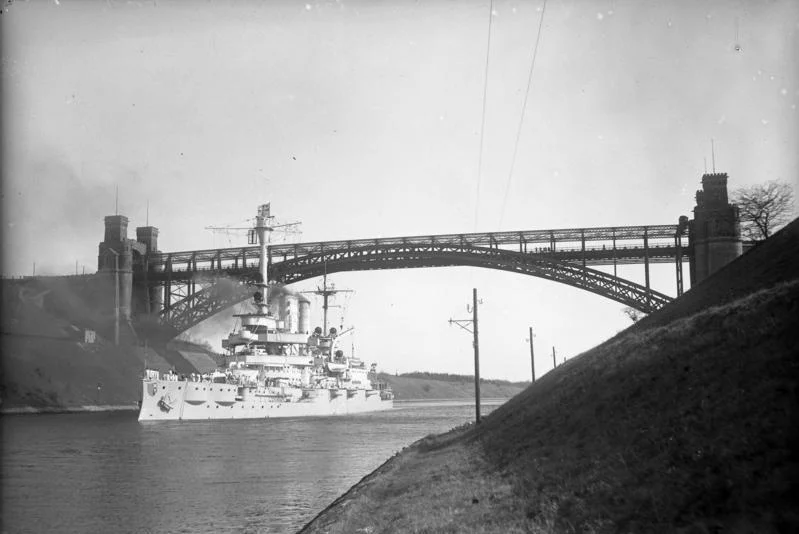

SMS Schleswig-Holstein
In the shallows off Osmussaar, a low limestone island at the mouth of the Gulf of Finland, lie the broken remains of the ship that opened the Second World War in Europe. Nothing marks the spot. The hulk was towed here in 1948, beached deliberately, and shelled by Soviet gunners until around 1966; what the shells left has since settled beneath the surface, and Estonia now protects the site as a historic wreck. A strangely anonymous end for a battleship that fought at Jutland, outlived two navies, and fired the salvo that opened the invasion of Poland.
Obsolete Before She Sailed
She was already the past when she was new. Schleswig-Holstein was laid down at the Germaniawerft yard in Kiel in August 1905 under the placeholder name "Q" and launched on 17 December 1906 — the last pre-dreadnought battleship Germany ever built. The German Empress, Augusta Victoria of Schleswig-Holstein, christened her, with Wilhelm II looking on. That same month the Royal Navy commissioned HMS Dreadnought, whose ten 12-inch guns made every existing capital ship in the world second-rate overnight. Schleswig-Holstein displaced 13,200 tonnes, carried four 28 cm guns in two twin turrets, and could just manage 19 knots. She was crewed by 35 officers and 708 enlisted men. None of that changed the arithmetic. In the High Seas Fleet, ships of her generation had already acquired a nickname that was grimmer than it sounds: the five-minute ships.
Twenty Rounds at Jutland
At Jutland on the last day of May 1916, Schleswig-Holstein was the final battleship in the German line, and her slowness nearly cost Admiral Reinhard Scheer his fleet — he could not turn for home without abandoning her and her sisters. Late in the evening the old ships pushed in between the opposing battlecruiser squadrons to shield Franz von Hipper's battered vessels. The light was so poor that her gunners never made out a target, and she never fired her 28 cm guns at all. Across the entire battle she loosed twenty rounds from her secondary guns.
At 21:35 a heavy shell punched a hole roughly 40 centimetres wide in her port side and detonated against the casemate armour, tearing open four and a half metres of deck. Three men died there. Nine more were wounded. In the running night fight that followed, a torpedo found her squadron mate Pommern, whose magazine detonated; the ship came apart within sight of Schleswig-Holstein's bridge. The navy withdrew the class soon afterwards, and by 1917 Schleswig-Holstein had been reduced to a barracks hulk.
The Courtesy Call at Danzig
The Treaty of Versailles let Germany keep eight pre-dreadnoughts for coastal defence, and she was one of them — fleet flagship again in 1926, then a cadet training ship from 1936, taking 175 young sailors on long cruises to South America and around Africa. In late August 1939 she anchored at Danzig on what was announced as a ceremonial visit, moored a short distance from the Polish military depot on the Westerplatte, with assault troops concealed below her decks.
At about 04:47 on 1 September 1939 her main battery fired into the Polish positions. Those shots are routinely called the first of the Second World War, and the claim is nearly true rather than exactly true: Luftwaffe bombers were over the town of Wieluń at almost the same minute, and eyewitness accounts place the first bombs there anywhere from 04:30 to 04:40. What is not in doubt is what her salvo was for. It was the signal to attack. The Westerplatte garrison — a reinforced force historians now put at 210 to 240 defenders, including six officers, plus mobilized civilians and off-duty regulars caught on site — was expected to hold for hours. It held for seven days, beating back assault after assault, and surrendered on 7 September only when ammunition, food and water were gone.
Kept Alive by Coal
She shelled the Polish fortifications at Hel later that month, took light damage from Polish coastal batteries there on 25 September, and in April 1940 joined the naval force sent against Denmark, running briefly aground in the Great Belt. Then she went back to teaching cadets. What eventually saved her from the scrapyard was fuel: by the end of 1943 Germany was desperately short of oil, and Schleswig-Holstein still had coal-fired boilers. Recommissioned on 1 February 1944, she was docked at Gotenhafen — today Gdynia — for conversion into a heavily armed convoy escort. Royal Air Force bombers hit her three times on 18 December 1944 and she settled in shallow water. Her crew was sent ashore to fight for Marienburg, and when that city fell, the men who remained aboard detonated scuttling charges in the wreck on 21 March 1945.
Target Practice
The Soviet Navy raised her in 1945–46 and towed her to Tallinn, and for decades reference books recorded that she was broken up there. She was not. In 1948 she was hauled out to Osmussaar and grounded in the shallows to serve as a gunnery target, which is what she remained until roughly 1966. By then the island itself had been emptied: its Swedish-speaking community was evacuated in June 1940 when the Soviet military claimed Osmussaar, which stayed a closed garrison until 1993.
So the ship that began at an imperial launching ceremony finished as a range marker off an island nobody was allowed to visit. Her bell survived, recorded in the collection of the Bundeswehr Military History Museum in Dresden as of 1990 — one legible object from a hull that was shot apart on purpose.
From the Air
The wreck site lies at 59.333°N, 23.533°E, in the shallow water off Osmussaar at the mouth of the Gulf of Finland. Osmussaar itself is the navigation cue: a low, pale limestone island roughly four kilometres long, lying off the northwestern tip of the Estonian mainland, with its lighthouse the only vertical feature for miles. Fly 2,000–4,000 ft for a useful view of the island's shape and the shoals that surround it; higher and the whole entrance to the Gulf of Finland opens up, with Hiiumaa to the southwest and the Finnish coast on the northern horizon. Nearest airports are Kärdla on Hiiumaa (EEKA) about 50 km southwest, Tallinn's Lennart Meri Airport (EETN) roughly 80 km east, and Hanko Airfield (EFHN) across the gulf in Finland. Baltic haze and low stratus are common from autumn through spring; late spring and summer give the clearest water and the best chance of reading the shoals from the air.
Nearby Stories
- Russian cruiser Pallada (1906) 2.8 km away
- Haapsalu Castle 16 km away
- Padise Abbey 17 km away
- Finnish minelayer Louhi 19 km away
- Koluvere Castle 21 km away
- Hitis 66 km away
- Saaremaa 75 km away
- Military Museum of Finland 87 km away