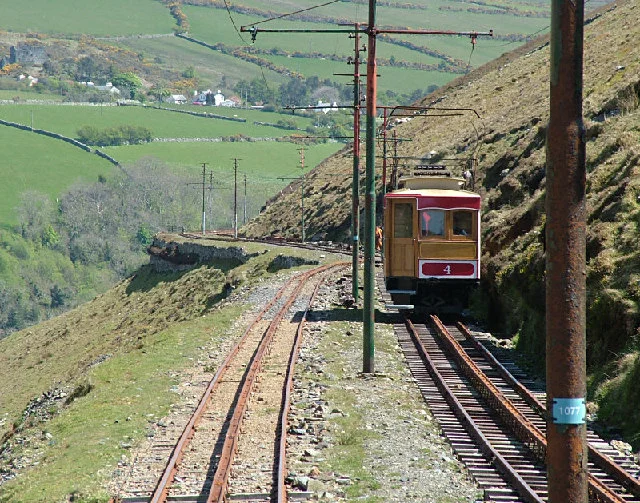

Snaefell Mountain Railway
Five wooden-bodied electric railcars, built in 1895 and numbered one, two, four, five and six, still work the line. There used to be a number three. On 30 March 2016 it ran away empty from the summit station and derailed just north of the Bungalow halt, the 121-year-old tramcar destroyed beyond rebuilding. The other five are still in service. Each March they bring the line back from winter dormancy; each November the overhead wires on the exposed upper section come down before icing tears them off the poles. In between, they carry passengers up five miles of mountain at 550 volts direct current.
The Line Tynwald Almost Built
The route was first surveyed by George Noble Fell, son of John Barraclough Fell, who had invented the Fell incline railway system. His proposal was for a steam railway using the Fell centre rail for both propulsion and braking, and Tynwald approved the scheme in 1888. It was not built. Seven years later the Snaefell Mountain Railway Association revived the plans on the same alignment, but built the line as an electric railway from scratch. They leased the entire route from landowners rather than seeking statutory powers, which let them work fast: ground broke in early 1895, and the line opened on 20 August 1895. The decision to go electric meant ordinary rail adhesion did the work of climbing; the Fell centre rail was kept only for braking on the steep descents, which is how the cars use it today.
How the Line Survived the Century
In December 1895 the SMRA sold the line to the Isle of Man Tramways and Electric Power Company, which also owned the Manx Electric Railway running up the coast. The deal was later challenged: the SMRA was unregistered, and most of the IoMT&EP's directors had also been members of the seller, voting on a purchase from themselves in breach of the company's articles. The IoMT&EP collapsed in 1900 after a banking crash. The Snaefell line and the MER passed through liquidation to a new Manx Electric Railway Company in 1902. By the late 1950s that company was also in financial trouble, and the Isle of Man Government acquired the railways in 1957. Today the line is owned and operated by Isle of Man Heritage Railways, a department of the island's government, which keeps it running as a working museum and a useful tourist transit at once.
The Rolling Stock
All five surviving passenger cars were built in 1895 by George F. Milnes and Company, delivered in time for the opening that summer. Car 5 was severely damaged by fire on 16 August 1970 and rebuilt locally, returning to service in 1971; the modern aluminium-framed sliding windows fitted then were swapped back for wooden sliders during a 2003 rebuild, when the tram became the first to carry the railway's name in Manx along its side. The current livery has been standard for more than a century, except for an unpopular green-and-white nationalisation scheme worn briefly from 1957. With Car 1's extensive rebuild beginning in 2011, the railway decided to revert that car to the original 1899 cream-and-Prussian-blue scheme with "tramway" wording, the first markedly different livery on the line since 1962. The non-passenger Car 7, nicknamed Maria, used to haul coal from Laxey to the power station near the Bungalow. The original rotted away on barrels in the depot; a replica built for the 1994 centenary now bears the number again after a long second life on the MER.
Stations, Aircraft, and a Runaway
There are only two stops in five miles: Laxey at the bottom, an interchange with the Manx Electric Railway, and the Bungalow halfway up, where the line crosses the A18 Mountain Road on the TT course. During TT race weeks, trams terminate on either side of the road and passengers cross by footbridge. Above Laxey a spur leads to the depot, rebuilt in winter 1994-95 for the railway's centenary. Inside the depot sits a smaller shed housing the small diesel Wickham trolleys used by National Air Traffic Services to reach the radio masts on the summit during winter, when the overhead is down. The line has had its share of incidents. The 2016 runaway of Car 3 ended in derailment without injuries; the 30 stranded passengers were rescued; the line was banned by the Health and Safety at Work Inspectorate in August 2017 for not adhering to a reduced 8 mph speed limit; service resumed on 30 March 2018 after modifications to the braking systems. Even in 1895, things slipped: during construction, the steam locomotive Caledonia lost grip on a hill near Dumbell's Row and crashed through a bakery and into a greengrocer's, damaging both shops but injuring no one.
From the Air
The Snaefell Mountain Railway climbs from Laxey on the east coast (54.227 N, 4.398 W) to the summit at approximately 54.262 N, 4.463 W, gaining about 600 metres over five miles of track. From the air the line is a thin scratch up the eastern face of Snaefell, with the Bungalow stop at the mid-way crossing of the A18 Mountain Road. The summit, marked by white communications masts, is the highest point in the Isle of Man at 620.9 metres (2,036 ft). Ronaldsway Airport (EGNS) lies about 18 nautical miles south.
Nearby Stories
- St Bees Lighthouse 15 km away
- Celtic Array 22 km away
- Kirkmaiden 23 km away
- Isle of Whithorn 23 km away
- Seascale Lifeboat Station 31 km away
- German submarine U-1024 36 km away
- SS Georgetown Victory 40 km away
- Blackpool Illuminations 56 km away