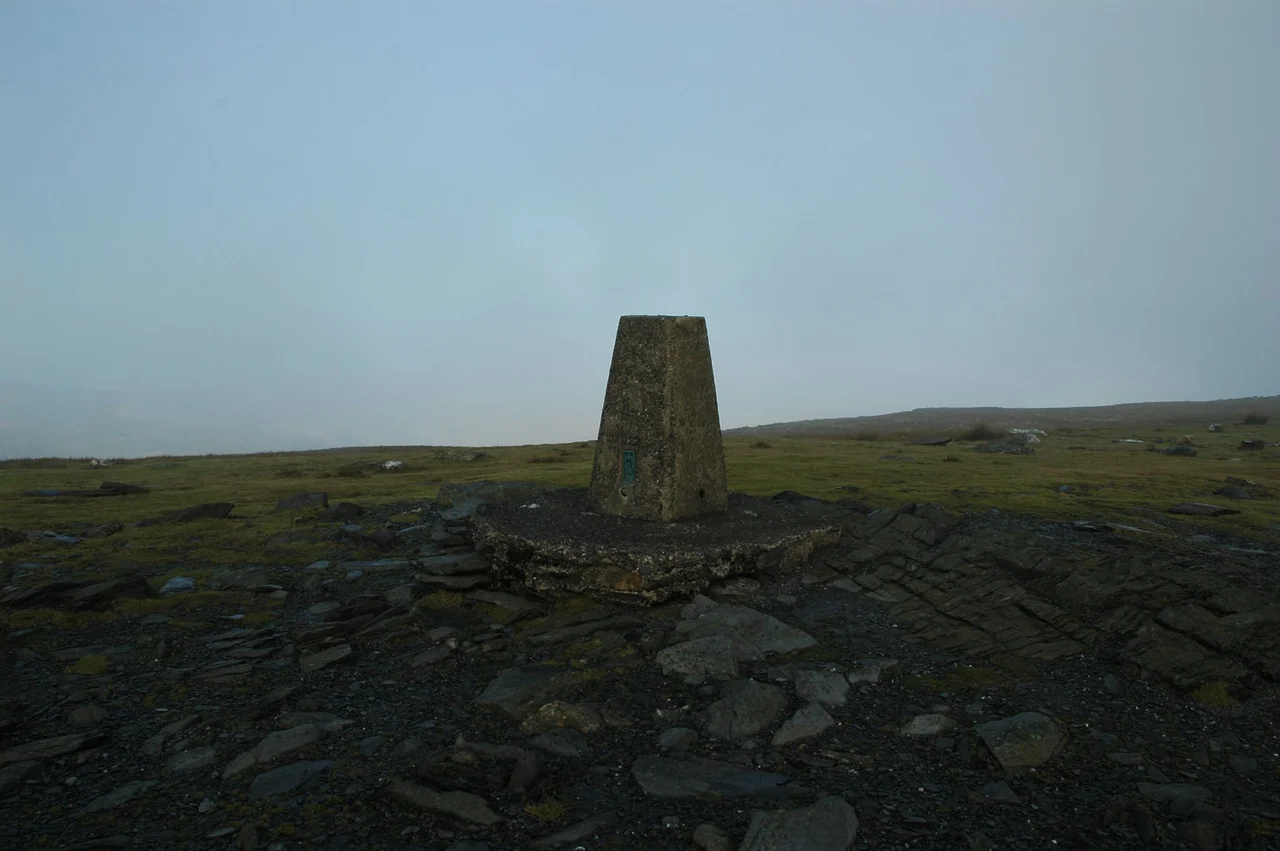

Snaefell Summit railway station
There is no road to it. Every operating day a tram delivers a bowser of drinking water, and at the end of the day the empty bowser goes back down. There is also no piped electricity from the grid in any conventional sense, just the same overhead wires that power the tram. When the wires come down in November to protect them from winter icing, the only access is a small diesel railcar stored in Laxey. For five months of every year, Snaefell Summit station is the busiest cafe in the British Isles that can only be reached by mountain tramway. For the other seven, it is a locked stone building on the highest ground on the Isle of Man.
From Wooden Chalet to Gothic Stone
The first building at the summit was a wooden chalet, erected when the railway opened in August 1895. It included a waiting room and staff facilities, and it was enough for a season or two. Within a few years the Victorian holiday crowds had outgrown it. A larger brick-and-stone structure replaced it in 1902, more gothic in feel and crowned with castellated turrets that gave it the look of a small Manx castle on the roof of the island. That replacement building is still the one in use today, on the same site as the original. But the castellations are gone. In 1982 a fire broke out and the building burned itself out almost completely; the remote location and difficult access meant the fire brigade could not save it. The damage was repaired but the gothic crenellations were never rebuilt.
Centenary and Caledonia
For the line's centenary in 1995, the building got remedial work and a set of historical displays for the waiting area, many of which are still there. Generally though it stayed in need of proper investment; serious refurbishment had to wait until central government funding arrived, with phase one starting in January 2011. The most extraordinary sight at the summit that centenary year was the steam locomotive Caledonia, on loan from the Manx Northern Railway, making the climb again to recreate her construction work of a hundred years earlier. Because the Snaefell line was built to three-foot-six gauge and Caledonia to three feet, a third rail had to be temporarily laid to let her run. She made the summit several times, hauling passengers in a winter saloon trailer. The presence of all six original mountain trams together at the summit during the centenary is believed to be the only time that has ever happened.
Seven Kingdoms at a Glance
The marketing slogan emblazoned on the railway's posters for decades promised that from the summit you could see "seven kingdoms at a glance." The list runs: England, Scotland, Wales, Ireland, Mann itself, and the kingdoms of Heaven and the sea. Different generations of advertising said five or six instead, but seven is the version that stuck. On a properly clear day the geographic reality is almost as impressive as the legend: the Mull of Galloway, the Lake District fells, the northern coast of Anglesey, the Mountains of Mourne, and across the sea to County Louth. The summit plaque points out five of those bearings with their distances, the longest being 97 miles to Dublin. Wales, oddly, is absent from the plaque. On a more typical day the visitor sees only weather, which is its own seventh kingdom in a sense, and the station building is a refuge from it.
Sunset Dinners and Pie in the Sky
Modern programming has stretched the line beyond a daytime sightseeing ride. In summer 2009 the railway ran an experimental evening service so that visitors could travel to the summit after the timetabled trams had stopped and eat dinner in the cafe. It was the first time in the line's history that regular evening services had been scheduled. The Sunset Dinners proved popular enough to expand: weekly through summer 2010, then once a week through 2011, then Friday and Wednesday evenings from June to September. A one-off Easter Lunch in 2011 marked the cafe's reopening after refurbishment, and the Seven Kingdoms Lunches started that summer on Sunday afternoons, unbookable because the weather at the top is too unpredictable. In 2010 the Pie in the Sky service began, taking passengers up for astronomical talks and stargazing, timed for the rings of Saturn at the end of May and for views of the Milky Way and Andromeda in late September. If the weather turns, the talk continues indoors with slides.
From the Air
Snaefell Summit station sits at approximately 54.262 degrees north, 4.463 degrees west, at the top of the highest mountain on the Isle of Man (620.9 m / 2,036 ft). From any altitude in clear weather the white communications masts on the summit are the easiest landmark in the central highlands of the island. Ronaldsway Airport (EGNS) lies about 18 nautical miles south. Snaefell sits in unstable mountain weather: a 1970 weather station here recorded a 150 mph gust, among the highest ever measured in the British Isles, and a 120 ft CAA radio mast was blown down on 2 December 1966.
Nearby Stories
- St Bees Lighthouse 15 km away
- Celtic Array 22 km away
- Kirkmaiden 23 km away
- Isle of Whithorn 23 km away
- Seascale Lifeboat Station 31 km away
- German submarine U-1024 36 km away
- SS Georgetown Victory 40 km away
- Blackpool Illuminations 56 km away