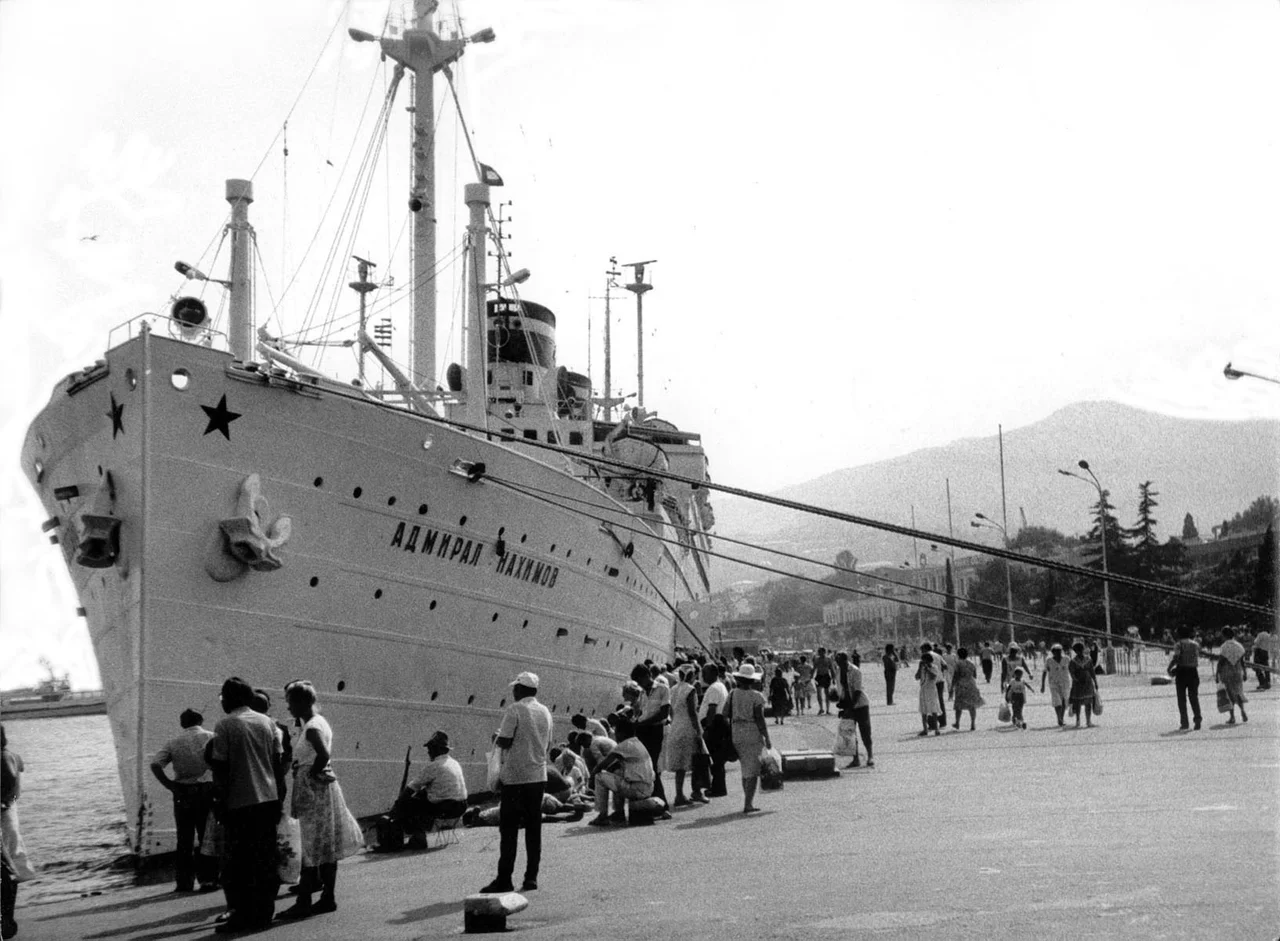

SS Admiral Nakhimov
She had already sunk twice before the night that killed her. Built in Germany in 1925 as the liner Berlin, she plied the Atlantic between Bremen and New York, once plucking survivors from a foundering ship off Virginia. War turned her into a floating hospital under the swastika; mines put her on the Baltic seabed in 1945. Salvaged as Soviet war reparations, she blew up and sank a second time during her own recovery. Rebuilt and renamed Admiral Nakhimov, she became the flagship of the Black Sea passenger fleet - and on the night of 31 August 1986, minutes out of Novorossiysk, a cargo ship's bow opened her side and finished, in seven minutes, what mines and explosions had twice failed to do.
Three Names, Three Flags
Her first life was gilded. As the North German Lloyd liner Berlin, launched in 1925, she carried passengers between Bremerhaven, Southampton, and New York. In 1928 she answered the distress of the sinking Vestris off the American coast and took aboard survivors of a disaster that claimed 108 lives. The 1930s brought darker service: chartered by the Nazi 'Strength Through Joy' program as a workers' cruise ship, then converted in 1939 into a Kriegsmarine hospital ship, designated simply Lazarettschiff A. In January 1945 she joined Operation Hannibal, the desperate evacuation of refugees and soldiers across the eastern Baltic, before a mine put her down. When the Soviet Union claimed her in reparations and renamed her for Pavel Nakhimov - the admiral who defended Sevastopol in the Crimean War - she was on her third identity and second resurrection.
The Pride of the Black Sea
By 1957 the rebuilt liner had entered service with the Black Sea Shipping Company, and for a time she was the fleet's flagship. Each summer she ran the six-day round trip between Odessa and Batumi, carrying around a thousand holidaymakers a voyage along a coast of resort towns and mountain-shadowed harbors. In 1962, during the Cuban Missile Crisis, she quietly ferried soldiers to Cuba. But the conversions that had saved her had also weakened her: several internal bulkheads that once compartmentalized flooding had been removed, and she could stay afloat with only a single compartment breached, where most ships could survive two. She was elegant, beloved, and - though no passenger boarding her sunlit decks could have known it - fatally thin-skinned.
Seven Minutes
At 10 p.m. she left Novorossiysk for Sochi with 1,234 people aboard, most of them Ukrainian vacationers. Barely into Tsemes Bay, the bulk carrier Pyotr Vasyov appeared on a converging course. Warned by radio, the freighter's answer was almost casual: 'Don't worry. We will pass clear of each other.' It did not slow. Confident, the liner's captain went below, leaving his second mate calling into the dark: 'Immediately reverse full astern!' The reversal came too late. At 11:12 p.m. the freighter's bow tore a 900-square-foot wound in the liner's side. The lights failed, plunging passengers into blackness; the corroded lifeboat davits would not swing free. Seven minutes after impact she rolled over and sank stern-first. Of the 1,234 aboard, 423 died - many of them below decks, lost in the dark, feet from the surface.
The Divers Who Followed Them Down
Sixty-four ships and twenty helicopters converged, pulling 836 people from water so thick with fuel oil that some rescuers could not keep hold of their hands. Then came the recovery, and its own grief. Navy divers of the Black Sea Fleet worked the overturned hull at night, blasting open swollen oak doors to reach the cabins. Two of them did not come back. Yuri Polishchuk gave up his air helping a fellow diver and lost consciousness on the ascent. Days later, Sergei Shardakov went down toward the 41st cabin - where survivors said children had been trapped - fouled his own lines, and died before help arrived. The government halted the work before every cabin had been entered. Today the wreck lies on her starboard side in 150 feet of Tsemes Bay, a war grave by common consent, and the bay's most solemn secret.
From the Air
The wreck lies in Tsemes Bay near 44.60°N, 37.88°E, roughly two nautical miles off Novorossiysk on Russia's Black Sea coast. From altitude the deep, cliff-flanked inlet of Tsemes Bay and the sprawling port and grain terminals of Novorossiysk are unmistakable. Nearest airports are Anapa (Vityazevo) Airport (ICAO URKA) to the northwest and Gelendzhik (URKG) to the southeast.
Nearby Stories
- Battle of Kerch Strait (1790) 23 km away
- Soviet Destroyer Smyshlyony 44 km away
- Temryuk 59 km away
- Soviet Hospital Ship Armenia 238 km away
- Abkhazia 258 km away
- Battle of the Tanais River 260 km away
- Beriev 296 km away
- 1988 Black Sea Bumping Incident 335 km away