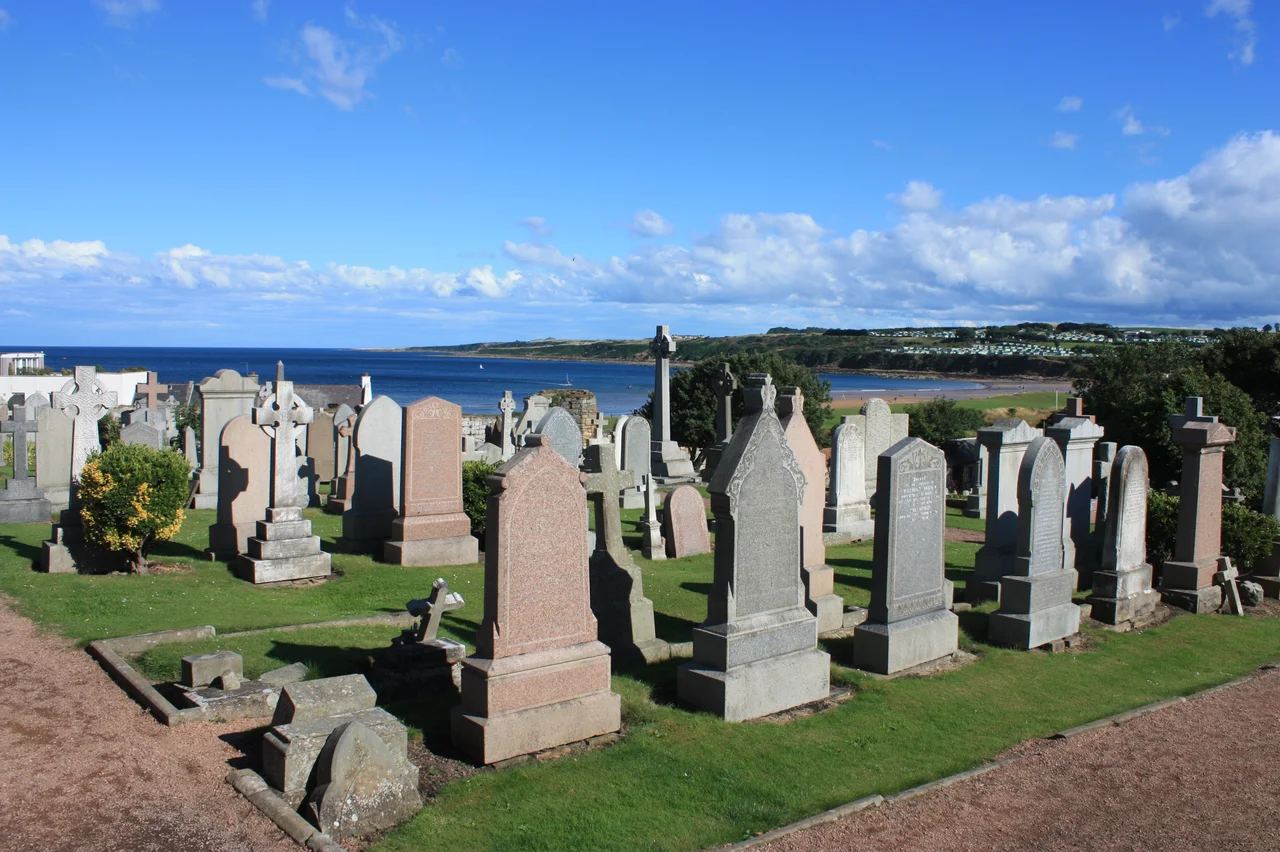

St Andrews Cathedral
On the fifth of July 1318, Robert the Bruce rode into St Andrews Cathedral on his horse. The story, or legend, depending on which historian you ask, has the king of Scotland clattering up the aisle to attend the consecration of the building that had taken 160 years to finish. It was the largest church Scotland had ever built, 119 metres long, the seat of the medieval Catholic church north of the border, the destination of pilgrims who walked here from Spain and Italy to touch the relics of the apostle Andrew. Today it is roofless. The grass between the gables is mown short and the ground plan is cut into the turf. Tom Morris is buried in the graveyard. So is the body of Saint Andrew, or what is left of it.
Built in Stages, Lost to a Storm
Construction began in 1158 under Bishop Arnold. The work outlasted bishops, kings, and architectural fashions. The west end was finished, then blown down in a storm, then rebuilt between 1272 and 1279. The cathedral was finally completed in 1318, with a central tower, six turrets, and an interior long enough to hold any procession the medieval church could imagine. A fire damaged it in 1378. Restoration finished in 1440. The cathedral was served by the Augustinian Canons of St Andrews Cathedral Priory, themselves successors to the older Celtic-Christian Culdees who had kept the apostle's shrine before them. Pilgrims came in their thousands. The cathedral, the priory, the bishop's castle, and the university that grew out of the priory school made St Andrews the most important ecclesiastical town in Scotland.
St Rule's Tower
On the cathedral grounds stands an older, narrower structure: St Rule's Tower, 33 metres high, built in grey sandstone ashlar in the 11th century. It was the tower of the earlier church that the cathedral replaced. The legend says St Rule, also called St Regulus, brought the relics of St Andrew from Patras in Greece to this spot in the 4th century. The truth is murkier, but the tower is real. It served as a landmark and a seamark, visible from miles offshore, drawing pilgrims to the apostle's bones. The original ladders between wooden floors were replaced in the 18th century by a stone spiral stair. You can climb it today. The view at the top takes in the cathedral ruins, the town, the harbour, the West Sands, the Old Course in the distance, and the cold blue plate of the North Sea.
The Day the Mob Came
In June 1559, a mob whose preaching had been provided by John Knox ransacked the cathedral. The interior was destroyed: altars, statues, painted glass, reliquaries, the accumulated devotional craft of four centuries. By 1561 the building had been abandoned. At about the end of the 16th century the central tower collapsed, taking the north wall with it. For two centuries townsfolk quarried the ruins for building stone. Roofs went up around St Andrews using cathedral masonry. Nothing was done to preserve what remained until 1826, when antiquarian sensibility caught up with the loss. Since then, the ruins have been cared for: the ground plan cut into the turf, the surviving gables stabilized, the priory and cemetery laid out for visitors. The east and west gables stand. Most of the south wall of the nave survives. The west wall of the south transept stands. The arcade columns are gone, but you can see where they were. The cathedral now exists chiefly as an outline against the sky.
Who Sleeps Here
The cathedral burial ground reads like a census of important Scottish life. Saint Andrew is buried here, in part: a few bones that survived the iconoclasms. So is Robert Chambers, the publisher and author of the Vestiges of the Natural History of Creation, an evolutionary precursor to Darwin. So are Old Tom Morris and Young Tom Morris, the father and son who shaped early modern golf at St Andrews; Young Tom died at 24 in 1875, broken-hearted by the death of his wife and child, and his grave still draws golfers from every continent. Adam Ferguson, the Enlightenment philosopher, is here. Allan Robertson, who is sometimes called the first professional golfer, lies a few rows over. In the Eastern Cemetery rests Warington Baden-Powell, founder of the Sea Scouts, and the artist Wilhelmina Barns-Graham, and Vice-Admiral Dashwood Fowler Moir who fought at the Battle of Jutland and died protecting an Atlantic convoy in the next war. The cathedral could not survive what was done to it. The people who chose to be buried in its shadow are the cathedral's continued life.
From the Air
Located at 56.34 N, 2.79 W, on the eastern promontory of St Andrews above the harbour, with St Rule's Tower (33 m) as the most prominent landmark. The nearest airport is Dundee (EGPN), about 12 miles northwest. Leuchars Station (EGQL, military) is about 5 miles north. Edinburgh (EGPH) is roughly 45 miles southwest. From the air the cathedral ruins are unmistakable: a long rectangular footprint cut into the turf, the east and west gables still standing, St Rule's Tower rising at the southern edge, and the graveyards extending east toward the cliff. The castle ruins lie about 400 metres northwest. Best viewed at 2,500 feet AGL on Fife coastal routes.
Nearby Stories
- Tantallon Castle 2.2 km away
- Battle of Kinghorn 4 km away
- Lindores Abbey 4.1 km away
- Battle of Dun Nechtain 11 km away
- Eyemouth Disaster 20 km away
- Edradour Distillery 35 km away
- Eyemouth Lifeboat Station 52 km away
- River Dee Ferryboat Disaster 60 km away