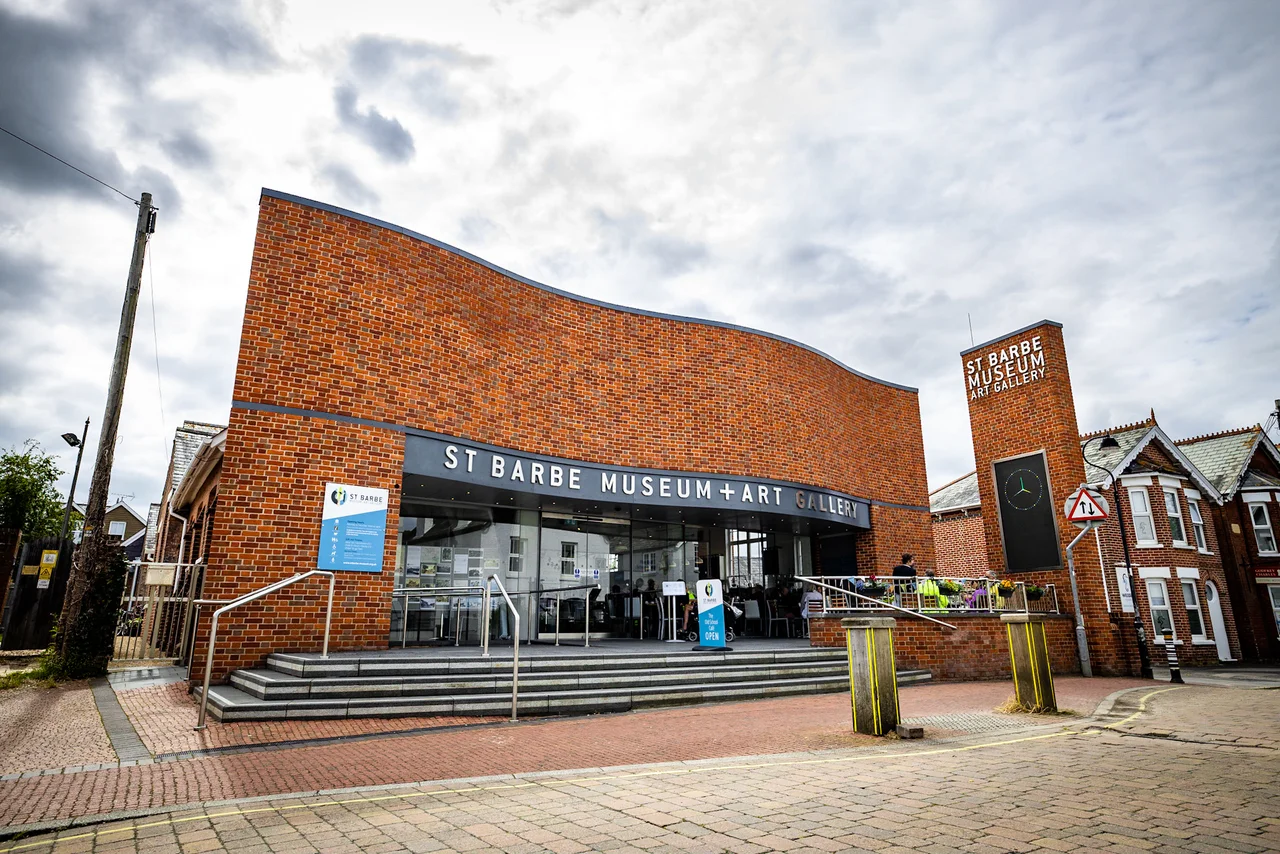

St Barbe Museum & Art Gallery
On the opening day in March 1999, two thousand people walked through the doors of a converted schoolhouse on New Street to see the museum that the town of Lymington had spent more than a decade building for itself. That schoolhouse is still here, slightly enlarged, still independent, still run as a charity. The galleries inside now host loans from the Tate, the British Museum, and the V&A, displayed under the same roof where children once recited their lessons. St Barbe Museum and Art Gallery is a small institution with surprisingly long reach, anchored in a market town at the southern edge of the New Forest.
A Museum the Town Built Itself
The story starts in 1988, with a group called the Friends of Lymington Museum campaigning for the town to have a museum at all. By the following year, they had begun collecting objects. By 1992, they had a trust. The breakthrough came when New Forest District Council handed over the old school building on New Street, and Hampshire County Council helped fund a curator. A modest 'Museum in a Room' opened alongside a shop and visitor centre in 1995. Galleries followed in 1997, and the full museum displays opened in 1999. Few small museums can trace such a clear lineage from volunteer enthusiasm to accredited institution; the building, the collection, and the programme were all assembled by people who simply wanted a museum in their town.
Tate Loans in a Coastal Town
What makes St Barbe punch above its weight is the loan list. The gallery has worked with Tate, the V&A, and the British Museum, and joined a National Maritime Museum touring scheme. The 2015 show 'Shorelines: Artists on the South Coast' drew national attention. The 2018 exhibition 'Dazzle: Disruption and Disguise in War and Art', part-funded by Arts Council England, examined the bewildering geometric ship camouflage of the First World War and earned prime-time TV coverage. A 2017 refurbishment enlarged the gallery so it could host work at this scale. The museum holds full accreditation, achieved in 2013, and has run a continuous exhibition programme since April 1998.
The Living Room of the New Forest
St Barbe is not only a gallery. The New Forest around it spans roughly twenty-two villages along a varied coastal and woodland landscape, and the museum has positioned itself as the area's cultural living room. 'Tea and Memories' invites older residents to handle historical photographs and share what they remember. 'Knit and Natter' is a social knitting group whose work sometimes ends up tied to current exhibitions. Family programming runs through school holidays. The Old School Cafe sits at the front of the foyer, the gift shop just behind, stocked with goods from local makers. Partnerships with Hampshire Cultural Trust, the New Forest National Park Authority, and a clutch of regional arts groups extend the reach beyond the building.
Lymington Outside the Doors
Step outside the museum and Lymington itself is the larger exhibit. Cobbled lanes drop down toward a Georgian quay where yachts crowd the Solent. The town has been a salt-making centre, a smuggling port, and a Royalist stronghold; the museum's collections - several thousand objects strong - sit inside that long history. The exhibition titles tell the story of an institution willing to range widely: 'Erie' (a meditation on a Great Lake), 'Dinosaurs on Your Doorstep' (the local Mesozoic), 'Contemporary Cuts' (printmaking). Few towns of Lymington's size manage to sustain a programme this ambitious; St Barbe does it by leaning on volunteers, lottery support, and the stubborn conviction, dating back to 1988, that a town like this deserves a museum like this.
From the Air
St Barbe Museum sits in central Lymington on the south Hampshire coast at 50.76 N, 1.54 W, on the northern shore of the Solent. The nearest GA airfield is Bournemouth (EGHH), about 15 nm west; Southampton (EGHI) lies 12 nm northeast. From a slow pass at 1,500 to 2,500 feet, look for the Lymington River estuary, the ferry terminal for Yarmouth on the Isle of Wight, and the dense town centre just inland. The New Forest's heaths and woodland fill the northern view; the Isle of Wight rises across the water to the south.
Nearby Stories
- Romsey Abbey 5.8 km away
- Shaftesbury Abbey 7 km away
- The Tank Museum 9.7 km away
- HMS Warrior (1917) 12 km away
- Fishbourne Roman Palace 22 km away
- Farnham 32 km away
- Operation Donnerkeil 58 km away
- D-Day: The Longest Day 145 km away