
St Botolph's Church, Boston
On a clear day, fishermen working the Wash see the tower before they see anything else. It rises 266 feet 9 inches above the dead-flat fen country - taller than the towers of most English cathedrals - and a lookout in Norfolk, twenty-five miles across open water, can spot it on the horizon. The locals call it the Stump, with the kind of dry, perverse affection the English reserve for things they secretly worship. It is not a cathedral. St Botolph's was built as the parish church of a single market town. But Boston in the 14th century was the second-busiest port in England after London, and the merchants who paid for this tower were not interested in modesty.
Why It's Called the Stump
The nickname is older than anyone living can remember, and nobody is sure where it came from. Three theories circulate. One holds that the tower took so long to finish - construction stretched in phases from the early 14th century into the 16th - that the unfinished torso looked like a tree stump in the meantime, and the joke stuck. A second holds that the original design called for a tall spire on top, which would have made the church look something like St James's at Louth a few miles north; when the spire never came, the truncated tower was a stump in the literal sense. The third theory is the most elegant: from the flat fenlands all around, the great tower simply seems to grow out of the earth, the way a stump does after a tree falls, and so generations of farmers and bargemen working the surrounding levels gave it the name as an act of poetic geography. Take your pick. The locals do not particularly care which is true.
Boston Born of Boston
The name Boston, in fact, almost certainly grew out of "Botolph's Town" - St Botolph being the 7th-century Saxon abbot whose followers founded the original settlement. Carry that name forward seven hundred years and you arrive at the Reverend John Cotton, who served as vicar here in the early 17th century. Cotton was a brilliant Puritan preacher who wanted to reform the Church of England from within and lost. In 1633 he sailed for Massachusetts, joined the New England settlers who had already begun to gather there, and was instrumental in founding and naming the city of Boston in the New World after his beloved Lincolnshire parish. The American Boston grew larger than the English one. The Stump quietly remained the original. When the Cotton Chapel inside St Botolph's was restored in 1857, the work was paid for in part by donations from across the Atlantic. The same thing happened during the great 1929-1933 restoration: significant funding came from the citizens of Boston, Massachusetts, who still felt the connection. Boston University once planned a memorial "Boston stump" of its own, in the form of an Alexander Graham Bell tower; the plans were never realised, perhaps fortunately. There is only one Stump.
A Library Above the Porch
Climb the stairs above the south porch and you find one of the strangest things in any English parish church: a working library of over 1,500 books, some of them more than 800 years old. It is raised high above ground level because the fens flood, and the founders knew it. The library was re-established in 1634 by the vicar Anthony Tuckney, and most of the early collection came as gifts, with the donors' names still on the flyleaves. Among the treasures are a 12th-century manuscript of St Augustine's Commentary on Genesis, a 1542 edition of Chaucer, the 1549 first Book of Common Prayer, and a clutch of mid-1540s Erasmus volumes. About 150 books predate 1600. There are even a few incunables - books printed in the very earliest decades of European movable type. Parish records before 1900 were moved to Lincoln in 1988, but everything else stayed. The library remains among the ten largest parish libraries in England. A dedicated cataloguer is slowly working through the shelves, restoring bindings and recording the collection book by book.
Floodlines and Wars
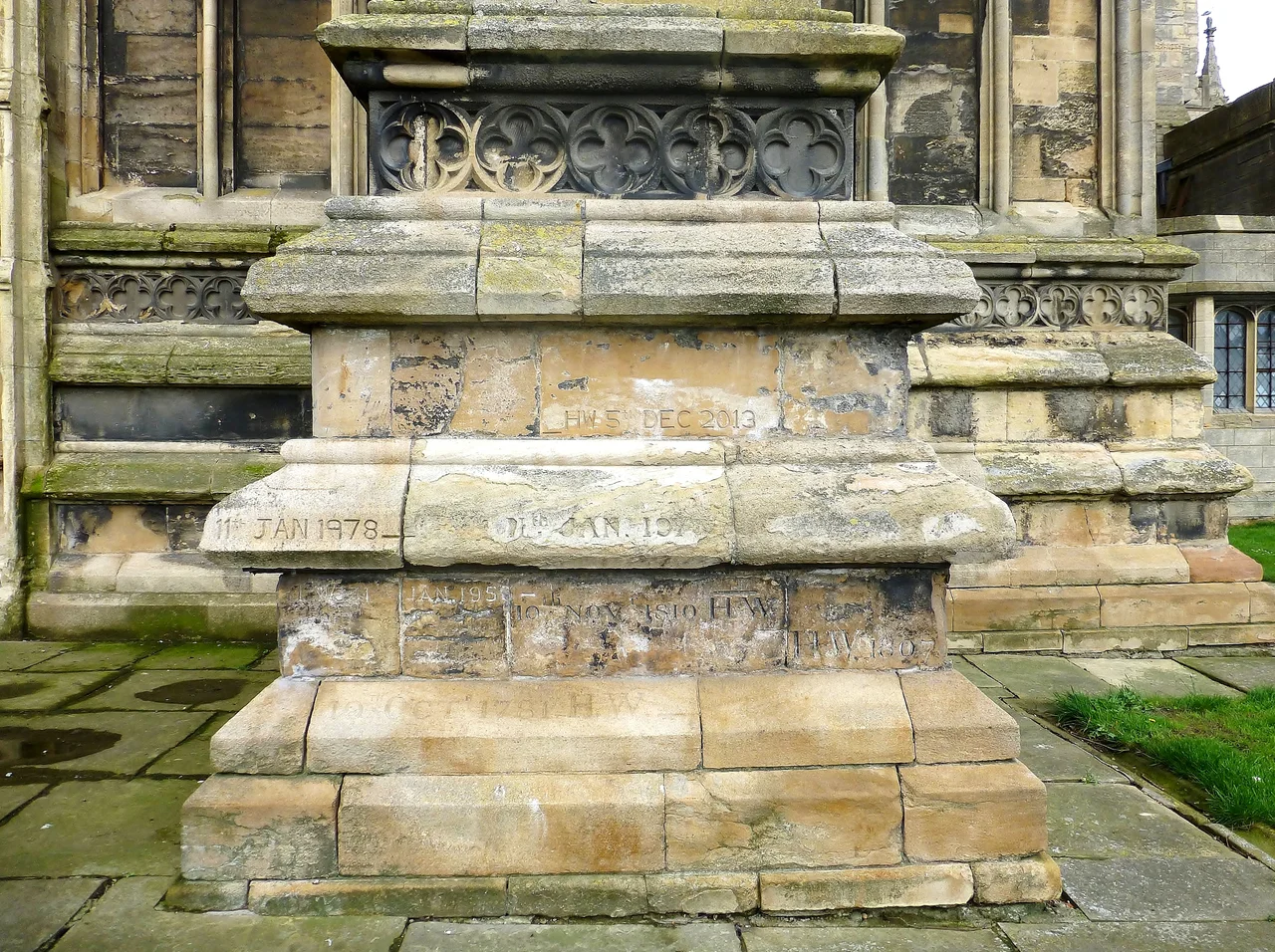
The buttress on the southwest corner of the tower is marked with horizontal lines and dates, each one recording how high the water came in a particular flood. The earliest go back to the 18th century. The most recent is from 5 December 2013, when the North Sea storm surge pushed four feet of water against the church door and two feet inside the nave. Boston sits below the level of high tide; only its drainage engineers stand between the town and the sea. A local folktale explains the steady winds around the Stump differently: the Devil and St Botolph wrestled here, the story goes, and the Devil lost - and is still panting from the effort, his breath becoming the wind that streams past the tower. The church has weathered worse than weather. In 1612 local Puritans damaged it from inside, smashing what they considered idolatrous. Parliamentary troops camped here in 1643 during the Civil War and took out stained glass they found politically offensive. The Reformation reduced the church from its original cathedral-like plan by demolishing the Corpus Christi Chapel and the Charnel House. What remains is the great tower and the long, light-flooded nave - magnificent, and slightly smaller than the medieval builders intended.
A Giant Among Parish Churches
Architectural historian Nikolaus Pevsner called St Botolph's "a giant among English parish churches." Simon Jenkins ranks it in his top eighteen in all of England. The church is a member of the Anglican Major Churches Network - a small group of parish churches that have cathedral-like proportions but never received the cathedral title. The 15-bell carillon, recast and rehung between 1932 and 1951, plays 35 different tunes from a synchronous clock-driven mechanism that was the first of its kind installed in a parish church anywhere in 1933. The three-manual Harrison & Harrison organ has pipes that survive from the 1717 build by Christian Smith. On a still summer evening, when the carillon plays, the sound carries for miles across the fens - exactly as the merchants of medieval Boston intended when they decided that their parish church should rival any cathedral in England.
From the Air
St Botolph's Church stands at 52.9786°N, 0.0252°W in the centre of Boston, Lincolnshire. The 267-foot tower is the most prominent landmark on the south Lincolnshire fenland and is visible on clear days from Norfolk, across the Wash twenty-five miles southeast. The Maud Foster Windmill lies less than two nautical miles north-northeast, and the two together orient any approach to Boston from the air. Recommended viewing altitude is 1,500 to 3,000 feet AGL. The nearest airfield is RAF Coningsby (EGXC) thirteen nautical miles north-northwest, with Humberside Airport (EGNJ) twenty-eight nautical miles north. The Wash provides an unmistakable visual feature to the southeast. The terrain is below sea level in places, with the River Witham winding south through Boston toward the Wash. Coastal haze is frequent on warm afternoons.
Nearby Stories
- Crowland Abbey 6.5 km away
- Oakham Castle and Its Forfeited Horseshoes 7.2 km away
- Murder of Mona Tinsley 10 km away
- Old Hunstanton Lighthouse 11 km away
- Battle of Gainsborough 14 km away
- RAF Downham Market 14 km away
- RAF Binbrook 21 km away
- Silver Pit 42 km away