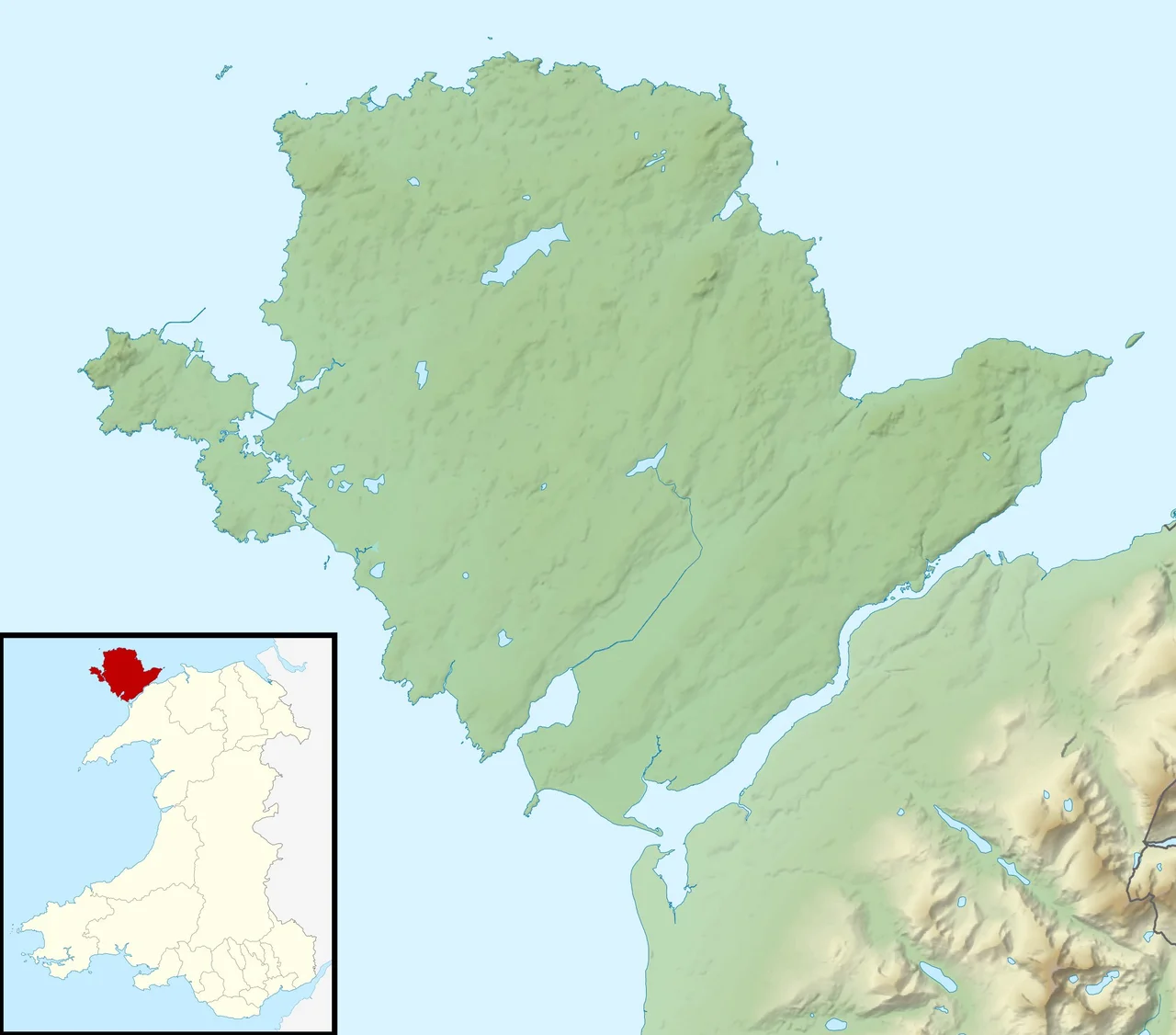

St Gwenfaen's Well
The instruction is exact. Two pebbles, both of white quartz, dropped one at a time into the water of the well. The legend says this offering -- precise, paired, deliberately bright against the dark stone of the chamber -- secures the intercession of Saint Gwenfaen of Rhoscolyn for the trouble of the mind. The well is medieval, possibly older. It lies in a cleft of rock in a small dell on the southwest tip of Holy Island, looking out across the cliffs of Porth Gwalch -- Hawk Bay -- to the Irish Sea. The site is a scheduled monument and a Grade II listed building. Until very recently the offerings still came -- modern pilgrims walking the Anglesey Coastal Path and locals on the long way round, pausing at the chamber and bending to lay quartz in the dark water.
The Saint
Gwenfaen was a sixth-century holy woman, the daughter of Paul Hen of Manaw -- Paul the Elder, sometimes called Old Paulinus -- and the sister of Peulan and Gwyngeneu, both also venerated as saints. The siblings settled on Holy Island, off the west coast of Anglesey, where Celtic Christianity was already flowering in pockets along the Welsh coast. Gwenfaen, the tradition holds, became known for healing the mentally afflicted. The end of her story is a piece of folklore not easily told in modern language: pursued by druids -- the pre-Christian priests of the older religion -- she fled to a sea-stack off the coast, climbed it, and was carried away by angels when the tide came in. Whatever happened, the church a kilometre east of the well was built on the site of her foundation, dated to around 630. The current church goes back to 1875; the dedication is older than the building by twelve hundred years.
The Architecture of the Cure
The well house is dry-stone, 4.5 metres east-to-west by an original 5.5 metres north-to-south. You descend three steps from the east into an outer chamber two metres square, the floor flagged, with four diagonal stone seats in the corners. Beyond that, a narrow opening and more steps lead into the inner well chamber -- 1.2 by 0.6 metres -- with recessed semi-circular stone seats on either side. The well itself sits in an external chamber, also about 1.5 metres square, separated from the inner room by a dry-stone wall. The wall holds a stone slab with circular grooves cut into the top and bottom edges, allowing water to flow between the chambers in a controlled trickle. Another stone slab at the western end has a hole for retaining or releasing water down a 4.6-metre paved channel to a pool 35 metres west of the well. The whole arrangement is small, careful, and quietly ingenious -- a place to sit, descend, breathe the cold air, and place two pebbles in the right water.
Druids and Angels
The story of the chase and the tide raises a question that has no neat answer. By the sixth century, Christianity was already well established in the Brittonic-speaking parts of Britain. The druidic priesthood of the Iron Age had been suppressed centuries earlier -- famously by the Romans, who massacred the druids of Anglesey in AD 60. Whatever Gwenfaen was fleeing, it cannot have been the original druids of Iron Age Anglesey. The story is likely a folk memory of religious tension, shaped over centuries into a clean narrative of saint and persecutors. What it tells us, in the form a sixth-century Welsh community would have used, is that Gwenfaen was a person of extraordinary calm in extraordinary circumstances -- someone you would ask for help when you could not help yourself. The two white pebbles are a way of asking. Quartz, in the folk traditions of these islands, has been associated with healing and clarity for thousands of years.
Still Blessed
The well was designated a Grade II listed building in 1971 and a scheduled monument in 1987. Every year on or near Saint Gwenfaen's day, 4 November, the parishioners of St Gwenfaen's Church walk down to the well after Holy Communion and bless it. The walk takes about twenty minutes from the village along the cliff path. The well sits within the Holy Island Coast Site of Special Scientific Interest and the Anglesey Area of Outstanding Natural Beauty, which means the cleft of rock and the cliffs above stay protected from development. People still leave white quartz pebbles in the water. A coast walker who knows what to do will sometimes carry a pair in their pocket from the beach below. There is no requirement to believe in the saint to make the offering -- though some quiet act of intention is the right way to do it. The well does not need belief. It needs only attention, and the willingness to descend a few steps and sit in the dark with the cold water and the quartz.
From the Air
Located at 53.25N, 4.61W in a cleft of rock above the cliffs of Porth Gwalch on the southwest tip of Holy Island, just under 1 km west of Rhoscolyn village. The site is barely visible from the air -- a small dell in the cliffs rather than a structure. Nearest airport: Valley (EGOV) on the main Anglesey island, about 4 nm northeast. Best viewed at 1,500-2,500 ft AGL flying along the southwest coast of Holy Island. St Gwenfaen's Church on the cliffs above the village is the easier landmark; the well lies down the path from there along the coast.
Nearby Stories
- HMS Conway 3.4 km away
- Tudweiliog 8.5 km away
- East–West Interconnector 12 km away
- Barmouth 24 km away
- German submarine U-1051 25 km away
- HMS Tyler 28 km away
- Greystones 53 km away
- Formby 77 km away