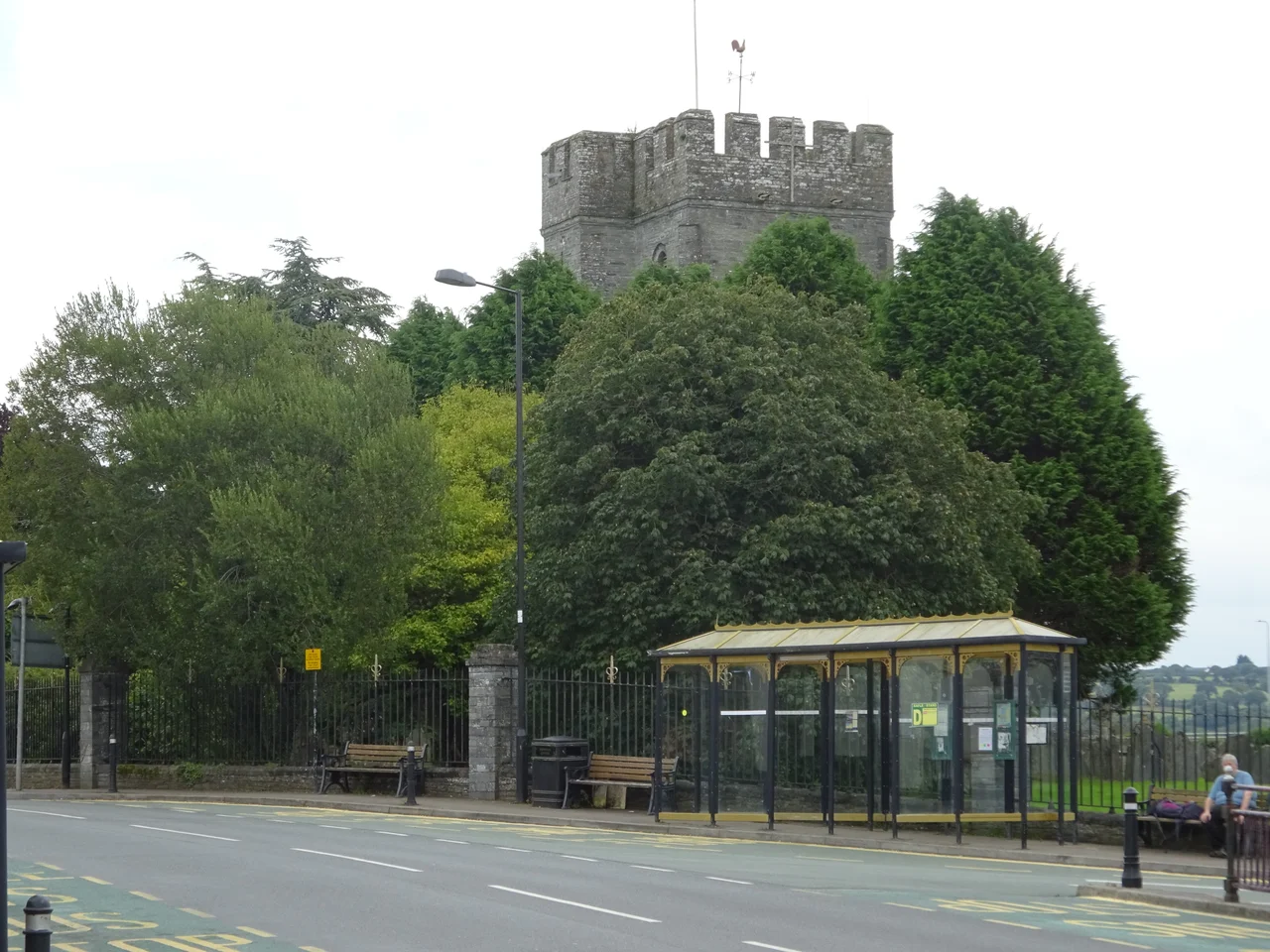

St Mary's Church, Cardigan
Before the Reformation, pilgrims walked here from every corner of Wales. They came for a candle. Inside the priory church on the slope above the Teifi stood a wooden statue of the Virgin Mary holding the infant Christ, and in her hand was a taper that, the chronicles insist, burned without melting. Our Lady of the Taper drew the devout to Cardigan as steadily as Walsingham drew them in England, until Thomas Cromwell's commissioners arrived in 1538, seized the statue, and carried it to London to be burned at Chelsea with other miraculous images. The church that housed it is still here, four centuries later, weathered grey stone above a quiet churchyard, and Cardigan is once again a centre of Marian pilgrimage.
A Benedictine House on the Teifi
Cardigan Priory was founded in the early 12th century as a daughter house of the Benedictine abbey of Chertsey in Surrey, established under the patronage of Norman lords who had pushed their power up the Teifi valley. St Mary's Church served a double role from the start: it was both the priory church for the monks and the parish church for the town. In 1428, when the older Holy Trinity Church of Cardigan vanished from the record, St Mary's formally took over the full parish responsibility, though it continued to belong to the priory until the Dissolution. The 12th-century foundation gave way over time to the present building, largely 14th century in plan but heavily rebuilt later. The blocked-up south doorway is thought to have once opened onto the cloister, and the priory's stones can still be traced in surrounding garden walls and houses, gradually absorbed into the fabric of the town.
The Taper That Would Not Melt
The shrine of Our Lady of the Taper appears in records from the 13th century. According to tradition, the carved wooden statue was found mysteriously washed up on the banks of the Teifi, the candle in her hand burning, and was carried up to the priory church where the flame continued without consuming wax. For three centuries the shrine drew pilgrims; medieval testaments record gifts of money, jewellery, and prayers offered in hope of healing or favour. The statue and her taper were taken to London in 1538 and destroyed. The shrine's lamp was extinguished. The priory itself was dissolved, its lands sold off, its buildings dismantled. St Mary's survived because it was also the parish church and could not be erased without leaving Cardigan with nowhere to worship.
The Tower That Fell
The story of the building is partly a story of slow repair. The porch was rebuilt in 1639, in a period when many Welsh churches were patching up the damage of religious upheaval. In 1705, the tower collapsed. The detail is recorded as plainly as that: a single sentence in the parish accounts and forty years of rebuilding to follow. The new tower was finally completed in 1748, and it still stands. The east window of the chancel shows the Crucifixion flanked by Mary and St John, installed in 1924; fragments of 15th-century glass survive in the upper tracery, small dark medallions that have outlasted both monastery and Reformation.
Our Lady Returns
In 1956, the Catholic Church proclaimed Cardigan a National Shrine to Our Lady of the Taper. A new statue was carved, blessed in Rome by Pope Paul VI in 1970, and installed at the modern Catholic church of Our Lady of the Taper a short walk from St Mary's. Pilgrim Masses are now held there each May, drawing visitors from across Wales and beyond. The Anglican parish church and the Catholic shrine sit a few hundred yards apart in the same small town, the two halves of a story that the Reformation tried to split, slowly being reconciled by time. Dr David Rowlands, an Inspector of Royal Naval Hospitals who died in 1846, is among those commemorated by a memorial tablet inside St Mary's, one of many ordinary remembrances in a church that has seen extraordinary things.
Walking the Grounds
The churchyard slopes down toward the river, gravestones leaning gently into long grass. From the gate you can see across to the wooded ridge above the Teifi and to the restored Cardigan Castle, where in 1176 the Lord Rhys held the first recorded Eisteddfod. The whole town fits inside a half-mile circle: castle, priory church, quay, and bridge, with the parish church looking down on all of it. St Mary's is Grade II* listed, a designation that recognises buildings of particular national importance, and is part of the united benefice of Bro Teifi, which gathers several parishes along the river under shared ministry. A working church, an emptied medieval shrine, a tower that fell and rose again; the building keeps its place at the heart of Cardigan.
From the Air
Located at 52.08 degrees north, 4.66 degrees west on the north slope above the Teifi estuary in Ceredigion. The church tower is a prominent grey landmark against red and slate roofs; the ruined Cardigan Castle stands just to the west on the same ridge. Cruise altitude 2,500-4,000 feet gives a clear view of the river, with St Dogmaels visible on the south bank. Nearest civil airport is Haverfordwest (EGFE); MoD Aberporth range lies northeast, check NOTAMs.
Nearby Stories
- HMS H47 4.6 km away
- National Botanic Garden of Wales 5 km away
- Narberth 6.3 km away
- Aberystwyth Lifeboat Station 9.3 km away
- Skomer 13 km away
- Diamond (1823 ship) 21 km away
- Talley Abbey 22 km away
- HMS Tyler 32 km away