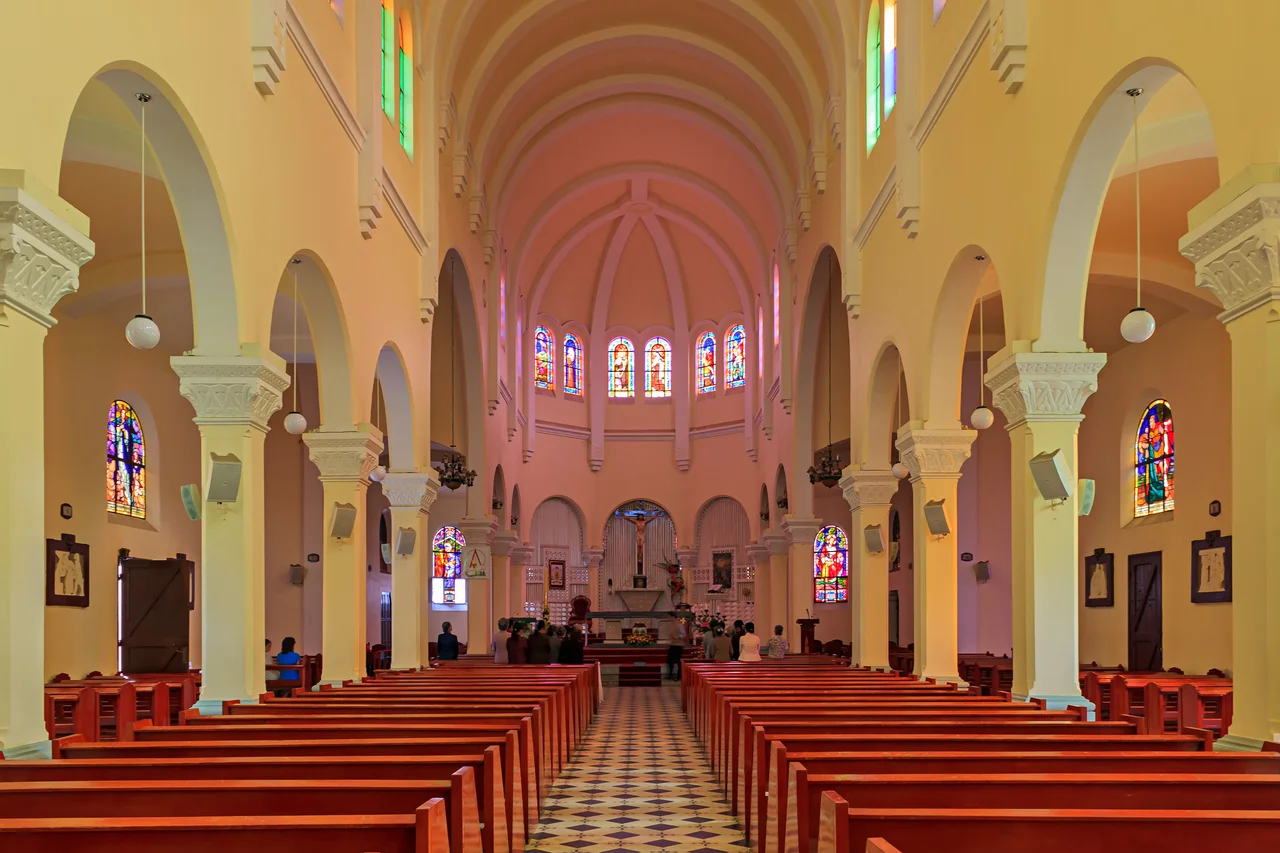

St. Nicholas Cathedral, Da Lat
A brass weathercock has sat at the top of this church's central spire since November 14, 1934 — through the rest of the French colonial period, through World War II and the Japanese occupation, through the long years of conflict that followed, through reunification and everything after. The weathercock is not a conventional choice for a Catholic church; it is more commonly associated with Protestant traditions. But the church that became St. Nicholas Cathedral, Da Lat has always made its own path, beginning existence as a modest parish in 1917, rebuilt in 1920, rebuilt again in 1922, and finally constructed in earnest between 1931 and 1932. Getting the building right took three tries. The weathercock has been watching ever since.
Three Churches, One Site
The first structure on this site was built in 1917, a modest church for the small Catholic community in the young French hill station. It was replaced in 1920 — deemed insufficient for a growing parish — under the direction of Father Frédéric Sidot. That building was itself rebuilt in 1922. The current cathedral, a substantial Romanesque structure in an eclectic style, was constructed between 1931 and 1932. Archbishop Colomban Dreyer, the Apostolic Delegate to Indochina, laid the cornerstone on 19 July 1931. The interior took another decade to complete; the cathedral was finally blessed in February 1942. What began as a colonial parish church had become, over twenty-five years of successive construction, the cathedral it remains today — now serving as the seat of the Roman Catholic Diocese of Đà Lạt, a suffragan diocese of the Archdiocese of Ho Chi Minh City.
The Architecture of the Highlands
The cathedral's Romanesque eclectic style sets it apart from the tropical architectural vernacular of lowland Vietnam. Thick masonry walls, rounded arches, a prominent central bell tower — these were the idioms of European religious architecture translated to a Vietnamese highland town at 1,500 meters elevation. In Da Lat's cool climate, with its European-inflected urban planning and its pine-forested hillsides, the aesthetic is not as jarring as it might be elsewhere in the country. The church sits in the city center, visible from multiple approaches, its spire providing a navigational reference point in a city of moderate scale. Around the church, a European cemetery once occupied the surrounding grounds; it is no longer in use, and the cathedral stands today without that particular reminder of the colonial community it originally served.
War, Interruption, Continuity
The cathedral's interior was not completed until 1942 — the final stages of construction overlapping with the Japanese occupation of Vietnam during World War II. The blessing came in February of that year, in a country already gripped by the conflict between French colonial authority and Japanese imperial power that would reshape Indochina completely. The cathedral absorbed those years and continued. Five masses are held every Sunday. The diocese it serves encompasses the Central Highlands, a geographically and ethnically complex region where Vietnamese, ethnic minority, and French colonial histories have intersected for more than a century. The cathedral's persistence — its willingness to keep being built, to keep functioning — mirrors the stubbornness of religious community under pressure.
What the Weathercock Sees
From the top of the spire, the brass weathercock surveys a city that has changed more than most. Da Lat in the 1930s was a French hill station, carefully planned and racially stratified, its coolness treated as an asset to be rationed to the right people. Today it is a Vietnamese city of some 260,000 people, a center of flower cultivation and agriculture, a tourist destination drawing visitors for its climate and its unusual architecture. The cathedral participates in both versions of the city — first as an emblem of French Catholic presence, now as a living parish embedded in a predominantly Buddhist country. The diocese holds services; the community gathers on Sundays. Whatever the weathercock turns toward in the highland wind, the congregation below continues what the three successive churches on this site began more than a century ago.
From the Air
St. Nicholas Cathedral sits at approximately 11.937°N, 108.438°E in central Da Lat, its central bell tower visible as the most prominent vertical element in the historic district. Xuan Huong Lake lies approximately 500 meters to the north-northeast. The city occupies a plateau at roughly 1,500 meters elevation. Lien Khuong Airport (VVDL) is approximately 27 km to the south-southwest; approach corridors over the plateau offer clear views of the cathedral spire from 2,000–3,500 meters. Cam Ranh International Airport (VVCR) on the coast lies approximately 95 km to the northeast.
Nearby Stories
- Tà Đùng National Park 3.1 km away
- Phan Rang–Tháp Chàm 4.2 km away
- Cam Ranh 18 km away
- Bao Loc 18 km away
- Operation Byrd 23 km away
- Nha Trang Air Base 25 km away
- Bidoup Núi Bà National Park 34 km away
- Duc Lap Camp 43 km away