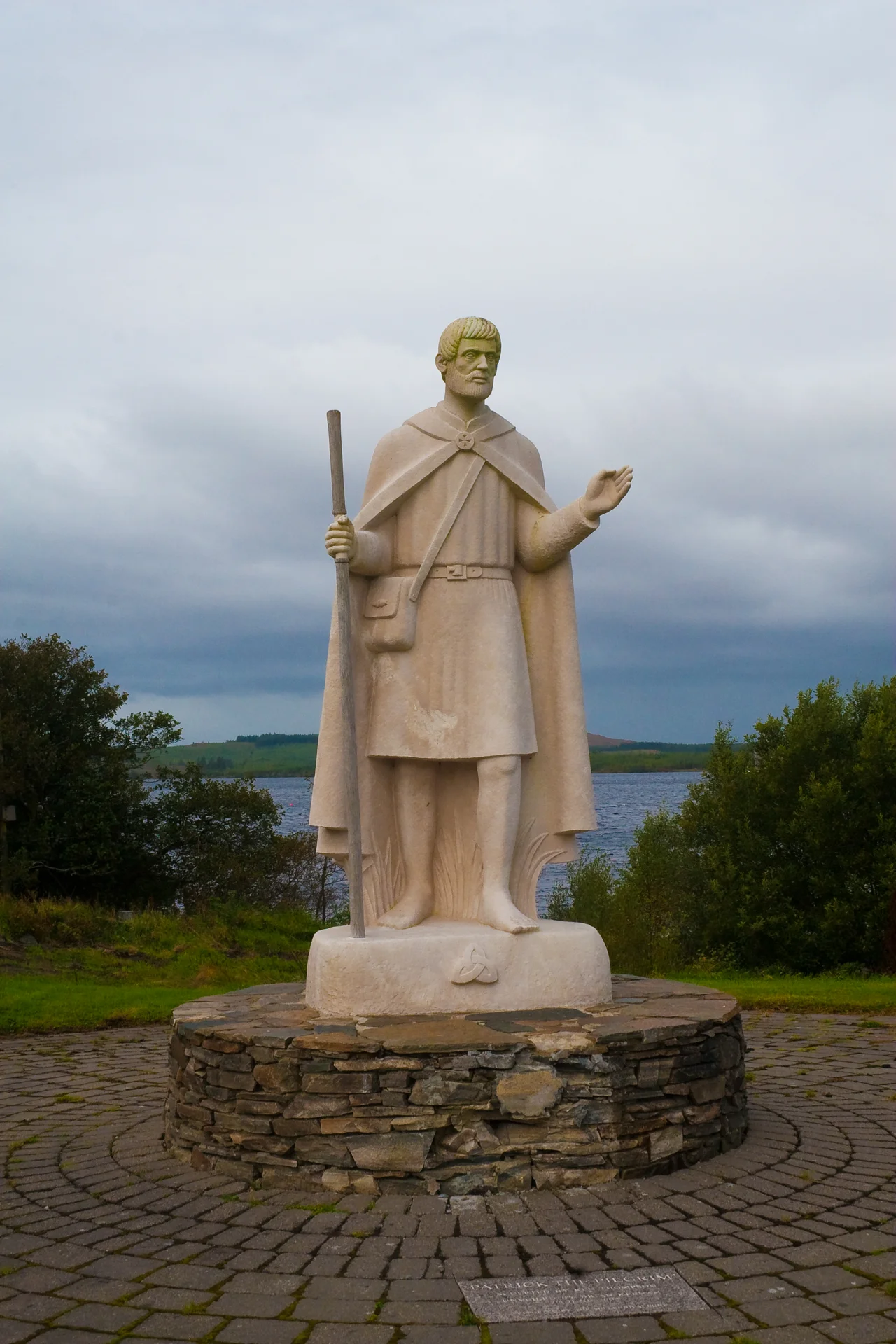

St Patrick's Purgatory
Until 25 October 1632, pilgrims who reached Station Island in Lough Derg were locked in a cave for twenty-four hours. The entrance was about two feet wide and three feet high, with six steps descending into a kneeling-height passage that turned and ended in a small niche. There was nothing inside. No light, no food, no companions. Just stone and silence and the pilgrim's own breath. After fifteen days of fasting and prayer on Saints Island as preparation, after confession and communion and the final rituals, the prior would lock the door. The next morning, if you were still alive, you were brought back to Saints Island for another fifteen days. The cave was sealed in 1632 after the monastery was dissolved. The pilgrimage continued anyway. It has continued, more or less without interruption, for over a thousand years.
A Place on Every Medieval Map
By the late Middle Ages, Station Island was famous across Europe. It appears on Martin Behaim's world map of 1492, the oldest surviving terrestrial globe, where it is the only Irish site Behaim chose to mark. It also appears on the Pinelli-Walckenaer Atlas, an anonymous portolan chart from sometime between 1384 and 1410, where it is named lo Purgatorio. Its earliest map appearance may be on the 1367 portolan chart attributed to Domenico and Francesco Pizzigano. Pilgrims came from all over continental Europe, most arriving by ship at Dublin or Drogheda and then walking northwest across Ireland to Lough Derg. The journey across the Irish countryside took about two weeks, with stops at monasteries along the way: Mellifont, Slane, Donaghmore, Kells, and then on to Enniskillen, which the fifteenth-century Burgundian pilgrim Guillebert de Lannoy called Rousseaumoustier. From Enniskillen, pilgrims took boats up Lough Erne and finally walked overland to Lough Derg.
The Vision Literature
The pilgrimage produced an extraordinary body of medieval literature. The twelfth-century Latin work Tractatus de Purgatorio Sancti Patricii recounted the visions of a knight named Owein who claimed to have descended into the cave and witnessed both purgatory and the earthly paradise. Marie de France translated the Tractatus into French and expanded it into the Legend of the Purgatory of St Patrick. The Spanish national poet Pedro Calderón de la Barca wrote a verse drama about the shrine. Other medieval vision accounts include the Provençal story of George Crissaphan, a Hungarian knight; the French Vision of Louis of France from 1358; the Catalan Vision of Ramón de Perellós from 1397; the English Vision of William Staunton from after 1409; and the Vision of Laurence Rathold de Pasztho from 1411. These texts were among the most widely circulated religious literature of medieval Europe. Dante himself drew on the tradition when he wrote the Divine Comedy.
What the Cave Might Have Been
Modern scholarship has suggested an unexpected possibility about the cave itself. The narrow enclosed space, with banked sides for kneeling, resembles a type of structure called a sweathouse, which was still in use in Ireland into the twentieth century. People entered these small cells to inhale medicinal smoke from burning plants. The Latin word purgatorium originally meant a place of cleansing and purging, much like a modern sauna, and the modern notion of purgatory as a place for punishment in the afterlife only entered common Western theology in the thirteenth century. The cave at Lough Derg may have been used for physical and spiritual healing long before it was specifically associated with St Patrick. Then, in the twelfth century, the legend connecting it to St Patrick's vision crystallised, and the cave became something else: an entrance to the otherworld, where pilgrims could glimpse what awaited them after death.
The False Closure of 1497
Long-standing tradition held that Pope Alexander VI ordered the closure of the pilgrimage in 1497 after a Dutch monk visited Lough Derg, found it disappointing, and travelled to the Vatican to accuse the local bishop and prior of simony. According to research presented by Paolo Taviani at the 31st Irish Conference of Medievalists in 2017, the document recording this closure is a forgery. Taviani argued that the true story is more interesting. In 1497, Cathal Óg Mac Maghnusa, at the time a bishop of the Diocese of Clogher, working with the Guardian of the Franciscan Observant Donegal Abbey, wanted to radically reform the pilgrimage. The medieval promise of a journey to the underworld could no longer be sustained intellectually. To ensure the pilgrimage's survival, the two churchmen turned it into something purely penitential. To overcome opposition to this change, they invented a Papal order. The cave was sealed, the medieval vision tradition was retired, and a more sober devotional practice took its place. The fictitious Papal order has been believed for five centuries.
Pilgrims by the Tens of Thousands
Records of pilgrim numbers begin after 1632, when the original monastic records were destroyed. By 1700, around 5,000 pilgrims completed the pilgrimage each season. The number grew to 15,000 by 1826 and to 30,000 by 1846, just before the Great Famine. The Famine itself, and the social upheaval that followed, brought numbers down. From 1871 to 1903, about 3,000 pilgrims visited annually. From 1908 to 1921, the average was over 8,000. From 1929 to the end of the twentieth century, numbers never fell below 10,000, often double or triple that. In 2011, 8,000 people completed the pilgrimage. The 2020 and 2021 seasons were cancelled because of the COVID-19 pandemic. The site reopened in 2022 with a new Pilgrim Shelter Museum. Notable pilgrims include Mary McAleese, former President of Ireland, and the Nobel laureate Seamus Heaney, whose 1984 collection Station Island took its title from his own experience there.
Three Days on the Island
The modern pilgrimage runs from late May or early June through to 15 August, the feast of the Assumption of Mary. It is open to anyone over fifteen who is in good health and able to walk and kneel unaided. Pilgrims begin fasting at midnight before their arrival. They take a small ferry from the Visitor Centre on the mainland to Station Island, are assigned a dormitory room, and then begin barefoot, walking in an almost continuous cycle of prayer and liturgies at designated stations on the island. These include six beds, the remains of ancient monastic cells named for famous saints. The first night is spent in the island's basilica in prayer. Only on the second night may pilgrims sleep. Each day brings one simple meal of dry toast, oatcakes, and black tea or coffee. On the third morning, the ferry returns the pilgrims to the mainland, where the fast continues until midnight. There are not many places left in modern Europe where this kind of medieval ascetic practice survives intact. There may not be any quite like Lough Derg.
From the Air
Located at 54.61 degrees north, 7.87 degrees west, on Station Island in Lough Derg, County Donegal, Republic of Ireland. Recommended viewing altitude 2,000 to 3,500 feet above terrain. Lough Derg is a 2,200-acre lake with a 13-mile shoreline; Station Island is a small lake-island near its southern shore. The basilica and the cluster of penitential beds are clearly visible from the air. The visitor centre and ferry dock sit on the southern mainland shore. Pettigo, the traditional pilgrim gateway, is six kilometres south. Nearest airports: Donegal (EIDL) to the west, St Angelo (EGAB) to the southeast. Atlantic weather brings frequent rain and low cloud, especially over the higher ground around the lake.
Nearby Stories
- Gweebarra Bay 2.7 km away
- Belcoo 3.4 km away
- The Model, Sligo 5 km away
- Omagh 5.6 km away
- Donemana 5.9 km away
- Killybegs 6.2 km away
- Newmills Corn and Flax Mills 12 km away
- Battle of Clones 18 km away