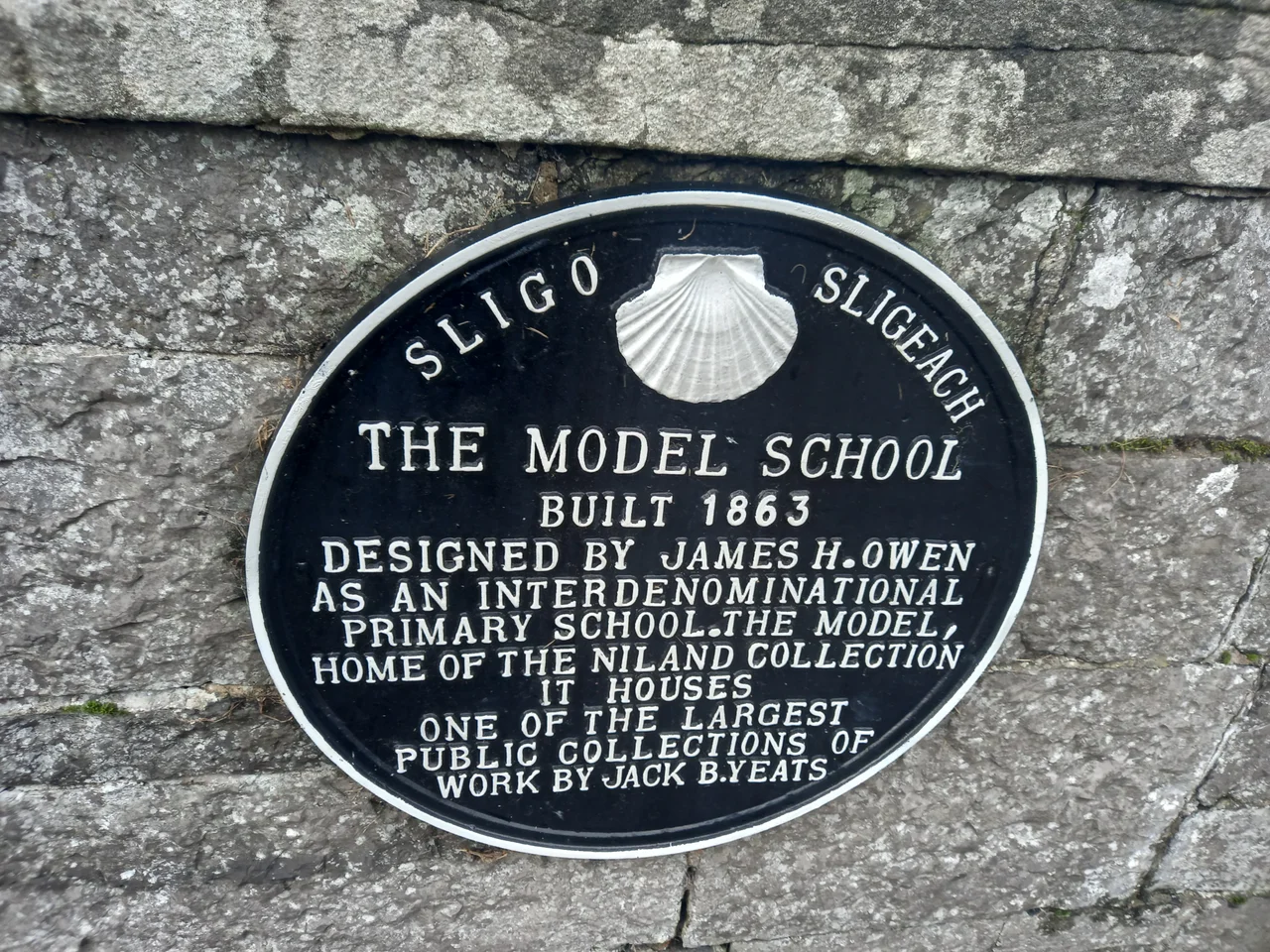

The Model, Sligo
In 1959, Sligo's county librarian Nora Niland needed paintings for the first-ever Yeats Summer School. She borrowed five works by Jack Butler Yeats - three large oils called Communicating with Prisoners, The Funeral of Harry Boland, and The Island Funeral, plus two smaller watercolours, Market Day and The Star Gazer. The summer school ended. The paintings stayed. From that borrowed handful Niland built what is now one of the most important Yeats collections in Ireland, alongside major works by Paul Henry, Louis le Brocquy, George Russell, and Estella Solomons. The collection lives in a converted Victorian schoolhouse on The Mall called, with charming literalism, The Model.
Built to Be a Template
The original building went up in 1862 to a design by James Owen, then working for the Board of Works. It is a two-storey rubble and ashlar stone building in the Italianate Palazzo style, built by local contractors Patrick Keighron & Son for £8,000. "Model" schools were designed - as the name suggests - to function as templates for primary schools throughout Ireland, intended originally to be multi-denominational. In practice, after independence the school became predominantly Protestant, religion having reasserted itself in Irish education under the new Free State. The Model provided primary education up to age 12 until the 1970s, when a new school opened across the road and the old building was abandoned. Sligo County Council bought it in the early 1990s with an idea of making it a museum.
The Niland Collection
Nora Niland's name is now on the gallery as well as on the collection. She was Sligo County librarian and a woman of practical determination. Starting with the five borrowed Yeats works in 1959, she expanded the holding throughout the 1960s into one of the country's most significant collections of Irish modernist art. The Jack Yeats holding is especially important: the painter spent his boyhood summers in Sligo and Rosses Point, and many of the works in the Niland Collection record those experiences and memories directly. To see them in Sligo, where they were imagined, is to see them in something like their natural light. The collection now numbers over 300 works.
Two Refurbishments and a Cultural Quarter
The Model's first refurbishment opened in 2000 after Sligo County Council converted the old schoolhouse for museum use. A second, much larger redevelopment ran from 2008 to 2010 as part of the council's vision for a Sligo Cultural Quarter. The extension increased the building by a third, adding artist studios, a purpose-built performance space, a new northern entrance, a complete gallery circuit, a reception, a bookstore, and a cafe. Funding came from multiple sources - €2.4 million from the BMW Regional Assembly under an EU ERDF scheme, €1.75 million from Arts Council Access 2 funds, €600,000 from Sligo Borough Council. Sligo County Council borrowed €6.4 million in total against the Cultural Quarter project. The Model reopened on 1 May 2010.
Royals, Reconciliation, and an Apology
On 20 May 2015, Prince Charles - now King Charles III - made a speech at The Model during a visit aimed at reconciliation around the legacy of his great-uncle Lord Mountbatten's death. Mountbatten had been killed by an IRA bomb in 1979 at Mullaghmore, twenty-five miles north of Sligo, along with his fourteen-year-old grandson Nicholas Knatchbull, the Dowager Lady Brabourne, and a fifteen-year-old local boy named Paul Maxwell. Charles's visit to The Model was a careful, public attempt at healing - a member of the British royal family standing in a Sligo arts centre, in the county where his great-uncle had been murdered, speaking about forgiveness and forward motion. It was one of the most charged moments in modern Anglo-Irish reconciliation.
Naming Quarrels and Other Distractions
Not every controversy is so heavy. In 2009 the gallery rebranded itself from "Model Arts and Niland Gallery" to "The Model, home of The Niland Collection," which struck some long-time supporters as bureaucratic vandalism. Michael Keohane, former president of the Yeats Summer School, called it a "public disgrace." The critic Bruce Arnold called it "absurd" in the Irish Independent. In 2010 the chef Conrad Gallagher opened a fine-dining restaurant in The Model; by 2011 he had moved to the town centre, and shortly after that Irish Revenue ordered him to wind up the operation. The Model has hosted exhibitions of work by Patti Smith, Andy Warhol, and Gerard Byrne, along with its rotating contemporary programme and the artist studios it rents to local working artists. Through all of it, the Niland Collection waits in its rooms, the Jack Yeats canvases catching the same north light he himself once chased across these same hills.
From the Air
The Model sits at 54.274°N, 8.463°W on The Mall in central Sligo, north of the Garavogue river, in the heart of the Sligo Cultural Quarter. From the air, the Italianate Victorian schoolhouse and its 2010 extension are visible within the dense urban grid, set near Sligo Grammar School and The Mall itself. Sligo Airport (EISG) is 8 km west; Donegal Airport (EIDL) is 50 km northeast. Best viewed at 1,500-2,500 ft AGL over the town centre.
Nearby Stories
- Killala 5.5 km away
- Ballaghaderreen 7.4 km away
- Townlands of Kilcommon 10 km away
- River Shannon 11 km away
- Monastery of Mohill-Manchan 15 km away
- Pettigo 18 km away
- Killybegs 19 km away
- RMS Empress of Britain (1930) 97 km away