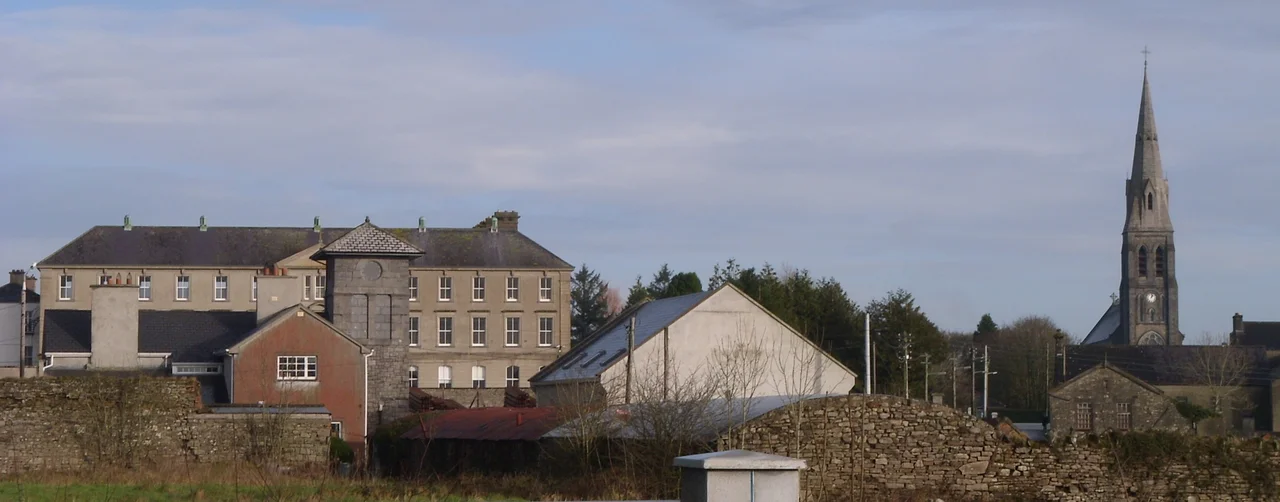

Ballaghaderreen
Until 1899, Ballaghaderreen was in County Mayo. Then the boundary commissioners redrew the map and shifted the town across the line into County Roscommon, where it has sat ever since - though its Gaelic Athletic Association club still plays for Mayo, an administrative anomaly that nobody local has felt much pressure to resolve. The name itself, Bealach an Doirin, is older still: the road of the little oak grove, named for a coach-road through woodland that has long since been felled. In March 2017, the town did something that put it briefly into the national news in a different register: it became an Emergency Reception and Orientation Centre for hundreds of refugees fleeing the Syrian Civil War, and a year later, the community was honoured with a People of the Year Award for how it welcomed them.
The Road, the Cathedral, the County Line
Ballaghaderreen sits in the north-west of County Roscommon, near the borders with Mayo and Sligo, just off the modern N5. In the early 19th century it lay on the new mail coach road from Ballina to Longford, the position that gave the town its commercial importance through the Victorian era. By the mid-1800s, markets were held in Ballaghaderreen on Fridays, with seven fairs spread throughout the year, and the town had a courthouse, a market house and an infantry barracks built to accommodate 94 soldiers. The defining piece of 19th-century architecture, though, was the Cathedral of the Annunciation and St. Nathy, dedicated in 1860 as the cathedral church of the Roman Catholic Diocese of Achonry. For a town this size to host a cathedral is unusual - most Irish diocesan cathedrals sit in larger cities - and the diocesan boundaries of Achonry, drawn long before modern county lines, are part of why the cathedral ended up here.
The Dillon Family
Ballaghaderreen's most famous family was the Dillons. John Blake Dillon was a writer, politician, and one of the founding members of the Young Ireland movement, the romantic nationalist current of the 1840s that briefly attempted insurrection and gave Irish nationalism much of its enduring iconography. His descendants kept up the family tradition: James Dillon went on to become leader of the Fine Gael party and Leader of the Opposition in Dail Eireann in the mid-20th century, a major figure in the development of constitutional Irish politics. Anne Deane, the nationalist, businesswoman and philanthropist, also belonged to the same broader Ballaghaderreen circle. The cluster of national figures from one small Roscommon town in one historical period is a reminder that 19th-century Irish public life often emerged from county-town gentry families whose names recurred in parliament and politics for generations.
Spring 2017
In March 2017, Ballaghaderreen took on a new role almost overnight. The Irish government opened an Emergency Reception and Orientation Centre in the town to accommodate hundreds of refugees from the Syrian Civil War, families and individuals who had been admitted to Ireland under European refugee programmes after fleeing the war that had been tearing Syria apart since 2011. The centre was housed in a hotel that the state had taken over for the purpose. Initial responses in the town were mixed - it was a small place absorbing a sudden, significant new population - but local civic and church groups organised meal-sharing, language exchanges, employment supports and friendship networks with notable energy. In April 2018, the community was honoured at the People of the Year Awards in recognition of how it had welcomed the refugees. The story was not without its tensions, and an Irish Times article from one year on noted that both the community and the refugees themselves felt the state had not followed through with the supports it had promised. But the awarded fact was that the people of Ballaghaderreen had shown up.
A Cathedral Town's Cultural Roll
Garry Hynes, from Ballaghaderreen, became the first woman to win a Tony Award for Best Direction of a Play - a landmark in American theatre and a milestone for Irish stage direction internationally. Matt Molloy, the Irish flute player whose recordings have shaped how generations of musicians approach the instrument, also came from the town. Brian O'Doherty - writer, conceptual artist and art critic - was born here too. Patsy McGarry was a longtime religious affairs journalist with the Irish Times. Pearce Hanley played Australian Rules football professionally in Australia. Maire McDonnell-Garvey was a traditional Irish musician. The town's cultural and intellectual reach is significantly larger than its population would predict, the kind of pattern that is repeated in Irish provincial towns more often than national narratives usually acknowledge.
Off the N5
Ballaghaderreen was previously on the main N5 national primary road linking Longford to Westport, but in September 2014 the road was re-routed to bypass the town to the north. The bypass changed daily life - quieter streets, less through-traffic, fewer overnight stops for long-distance hauliers. The nearest railway stations are now in Castlerea (21 km away) and Boyle (26 km); the Ballaghaderreen branch line that once connected the town directly to the Dublin-Sligo line closed in 1963. Ireland West Airport is 15 kilometres to the west, close enough that the town is on the airport bus routes for arriving passengers and weekend pilgrims. The Cathedral is still there, presiding over the streets. The market is gone, the fairs are gone, the cattle drives are gone. The Tony Award winner, the Chieftains flute player and the Syrian families who came in 2017 are all part of the same continuing story of a town that has reinvented itself, repeatedly, around the road and the railway and the road again.
From the Air
Located at 53.90 degrees north, 8.58 degrees west, in north-west County Roscommon near the Mayo and Sligo borders. Visible just off the N5. Ireland West Airport (EIKN) sits 15 km to the west - Ballaghaderreen is often a recognisable landmark on inbound flights. The Cathedral of the Annunciation stands prominently in the town centre.
Nearby Stories
- Glenamaddy 4.4 km away
- Neale, County Mayo 7.1 km away
- Townlands of Kilcommon 7.6 km away
- Killala 9.6 km away
- Ballysadare 10 km away
- Scramoge Ambush 13 km away
- Glangevlin 14 km away
- Athlone Castle 23 km away