
Killybegs
On a September day in 1588, La Girona limped into Killybegs harbour. She was a Spanish galleass, one of the Armada's largest, and she should not have been on the west coast of Ireland at all. The fleet had been blown north around Scotland by storms after the failed invasion of England, and what remained of it was breaking apart on Atlantic rocks from Sligo to Antrim. La Girona dropped anchor in Killybegs because it was the best deepwater harbour on this whole rugged coast. The local chieftain, MacSweeney Banagh, fed the survivors. Carpenters repaired her shattered rudder. Then she sailed for Scotland with nearly 1,300 people aboard, and wrecked off Lacada Point on the Antrim coast. Nine survived.
Na Cealla Beaga
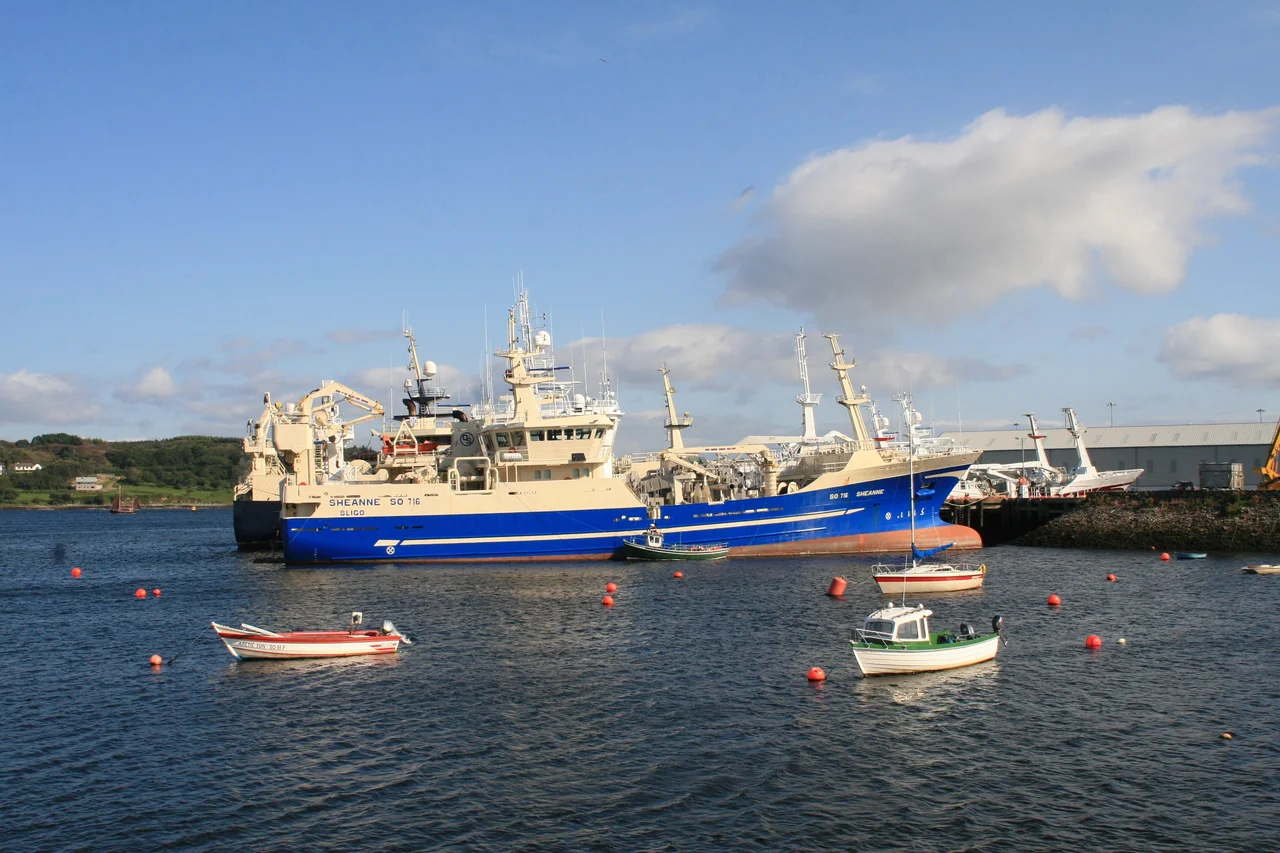
The Irish name means 'the little cells,' a reference to monastic settlements that long predate the town's life as a fishing port. Killybegs sits on the south coast of Donegal, north of Donegal Bay, on what may be the best natural deepwater harbour in Ireland. At low water spring tide, the new pier completed in 2004 still has twelve metres beneath it. That pier cost fifty million euros. The reason it was worth that much is that Killybegs is the centre of the entire Irish pelagic fishing industry, the place where the country's mackerel, herring, scad, and blue whiting are landed, processed, frozen, and shipped to Africa, the Middle East, and Europe in refrigerated freezer ships. All the largest Irish midwater trawlers are based here. The harbour also handles cruise liners, mixed cargo, and, increasingly, the massive components of offshore wind turbines.
MacSweeney and the Galleass
When La Girona arrived, she was already overloaded. Refugees from at least two other Armada wrecks had been gathered aboard, swelling her complement well past her designed capacity. MacSweeney Banagh, the chieftain whose stone slab grave can still be seen at Killybegs's St Mary's Church, took the Spaniards in. The 16th-century carving on the slab shows him chain-mailed, flanked by grappling wrestlers, the kind of warrior who could have handed the Spanish over to the English garrisons for a bounty but chose not to. The repairs went well enough that La Girona made it out of the harbour. She did not make it past Antrim. Most of the bodies were never recovered. The Spanish state, centuries later, salvaged what could be salvaged of her cargo: gold chains, jewels, ducats, the personal possessions of men who had died trying to get home.
Pelagic and Precarious
Fishing has shaped Killybegs for centuries, but the modern industry is recent and fragile. Until 2005, Irish vessels operated under one regulatory regime. Then the Irish Department of the Marine began enforcing EU fishing regulations to the letter, and the rules bit hard. Around the same time, the great mackerel shoals that the Killybegs fleet depended on began to stay longer in Norwegian waters. The combination has meant a slow contraction. Fish factory workers, often the lowest paid people in the industry, were among the hardest hit by the redundancies that followed. The port has diversified, becoming a service hub for offshore oil and gas rigs and the favoured Irish port for importing wind turbines. The freezer ships still leave for Africa. The pelagic trawlers still come back to unload. But the boom years that built the new pier are not what they were.
Storm Bert and Fintra Strand
In November 2024, Storm Bert flooded Bridge Street in the centre of town, the latest in a long series of Atlantic weather events the place has absorbed. Just west of Killybegs, the long curve of Fintra Strand carries a Blue Flag designation, with golden sand, summer lifeguards, and crowds of day-trippers in the high season. Killybegs Rowing Club uses the harbour for training all summer and holds an annual regatta the last weekend of July, racing the Donegal Skiff, the traditional small craft of the county. St Catherine's Vocational School, the non-denominational secondary school, has roughly 385 students from across the area. Tourism College Killybegs, the country's only dedicated tourism institute, joined Atlantic Technological University in 2022. The town is small, around 1,258 people at the last count, but it is not a quiet town.
Faces from the Town
Séamus Coleman, born in Killybegs in 1988, spent seventeen years at Everton and long captained the Republic of Ireland national team. The town has also produced the painter Kevin Sharkey, the poet Noelle Vial (who died in 2003), the Sinn Féin politician Peter J. Ward, and a steady output of Gaelic footballers across decades, including Manus Boyle, Hugh McFadden, Barry McGowan, and Barry Cunningham. In 2011, the French novelist Sorj Chalandon published Retour à Killybegs, whose protagonist Tyrone Meehan is a Killybegs man caught in the moral collapse of an IRA informer's life. The town has carried that kind of weight before. The railway opened in 1893 to connect Killybegs to Donegal town. It closed in 1960. The remains of the terminus at the harbour are still visible. People come and go. The pelagic boats still go out.
From the Air
Located at 54.64°N, 8.44°W on the south coast of County Donegal, north of Donegal Bay. Best viewed at 1,500-3,000 feet to catch the deepwater harbour, the fleet of pelagic trawlers, and Fintra Strand to the west. Nearest airport is Donegal (EIDL), 35 km north; Sligo (EISG) 45 km southeast. The harbour is unmistakable; look for the massive freezer ships and offshore service vessels alongside the fishing fleet.
Nearby Stories
- Rosses Point 3.2 km away
- Gweebarra Bay 11 km away
- Killala 13 km away
- Belcoo 14 km away
- St Patrick's Purgatory 14 km away
- Glenveagh National Park 20 km away
- Ballycastle, County Mayo 36 km away
- RMS Empress of Britain (1930) 65 km away