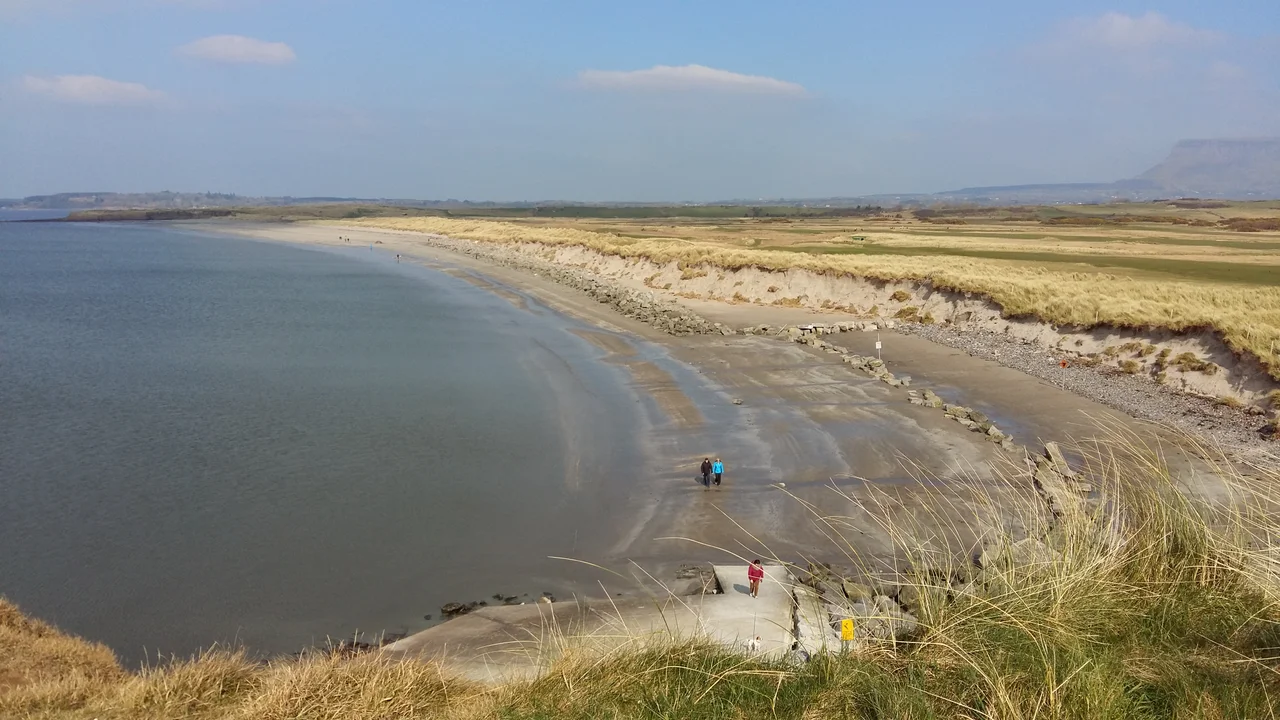

Rosses Point
On a small rock at the mouth of Sligo Bay, a cast-iron sailor has stood since 1821 with his arm flung out, directing ships into the safe channel. Locals call him the Metal Man. Approaching by sea, you line up his lamp with the lighthouse on Oyster Island behind him, then sail in the direction his finger indicates. He has worked this job for two centuries without rest. Behind him, on the spit of land where Sligo Bay meets the open Atlantic, sits the village of Rosses Point - 900 people in 2022, a fishing community turned Victorian holiday resort turned weekend break. The Yeats family used to summer here. The bones of their old house still hold themselves together with ivy.
The Metal Man's Twin
The cast-iron figure on Perch Rock is one of a pair. His identical twin stands on a clifftop above Tramore in County Waterford, on the opposite coast of Ireland. Both were erected in 1821 to mark hazardous approaches, both still serve as navigation aids two hundred years after their installation. The Rosses Point figure has acquired, in local affection, a personality - the locals describe him as distinctly camp, his pointing pose somewhere between authoritative and theatrical. Sail toward where he indicates and you find the deep channel. Sail anywhere else and you find the sandbars that have torn the bottoms out of careless boats since people first put boats into Sligo Bay.
Elsinore and the Yeats Brothers
Elsinore House stands above the strand at Rosses Point, now a ruin held upright largely by ivy. It was where the Pollexfen family - the merchants on William and Jack Yeats's mother's side - took the children on summer holidays. William turned the place and its surroundings into the verse that made him famous. Jack, the painter, turned them into canvases. The two brothers spent decades chasing the light and weather of this small piece of coast in different mediums. William's grave lies five kilometres east at Drumcliffe churchyard, beneath bare Ben Bulben's head, where he wrote himself an epitaph the parish put on the stone exactly as he asked: "Cast a cold eye on life, on death. Horseman, pass by."
Three Beaches and a Spit
The Atlantic-facing coast of the peninsula runs north as a chain of beaches. First Beach is 400 metres of sand with parking, toilets, and summer lifeguards. Bowmore Point caps it, its little cabin painted bright. Beyond, Second Beach stretches a kilometre to Wren Point, where the kite-surfers gather to ride the steady westerlies that pour in off the ocean. Third Beach is the loneliest of the three, north of Wren Point along the spit that reaches toward the outflow of Drumcliffe Bay. Walk it at low tide and you can reach Lower Rosses lighthouse on its trestle tower, perched like a wading bird above the sands. Behind the beach, salt marshes thicken the ground. Across the estuary, the flat-topped wall of Benbulbin watches everything.
Oyster Wars
In 1864, a fleet of "oyster pirates" sailed into Sligo Bay to plunder the local beds. The Royal Irish Constabulary came out in force and the pirates were beaten back that day. It was not enough. Within a decade or two, the Sligo oyster beds were gone, fished out by people who had every legal right to be there. The pirates were merely the front edge of the appetite. Today the bay is quiet and Oyster Island - private property in the permanent channel east of Coney Island - keeps the name of an industry that vanished. Coney Island itself is reached at low tide by walking or driving across Cummeen Strand from Strandhill on the other side, where the rabbits outnumber the residents by a generous margin.
Inishmurray, Unreachable
Six kilometres offshore, north of the bay, the uninhabited island of Inishmurray holds the ruins of an early medieval monastic complex - circular stone enclosure, beehive cells, a scatter of cross-slabs. Monks lived there from the sixth century until Viking raids made it untenable. The last full-time residents left in 1948. Since 2018, the landing point has been declared unsafe and no boat trips can put ashore there. Nobody has the money to repair it. Anglers can still fish its waters; nobody can walk among its ruins. It sits out there, beyond the Metal Man's arm, beyond the lifeboat station's range, slowly returning to weather and gull.
From the Air
Rosses Point sits at 54.309°N, 8.566°W on the north shore of Sligo Bay, on the spit of land between the bay and Drumcliffe Bay. From the air, the Metal Man on Perch Rock, the long Atlantic beach chain, and Coney Island across the estuary are all visible features. Sligo Airport (EISG) is 7 km southwest on the Coolera Peninsula opposite. Benbulbin (526 m) rises 6 km northeast. Best viewed at 1,500-2,500 ft AGL; Atlantic westerlies can be brisk along this coast and produce surf-driven haze over the strand.
Nearby Stories
- Killala 5.5 km away
- Ballaghaderreen 7.4 km away
- Townlands of Kilcommon 10 km away
- River Shannon 11 km away
- Monastery of Mohill-Manchan 15 km away
- Pettigo 18 km away
- Killybegs 19 km away
- RMS Empress of Britain (1930) 97 km away