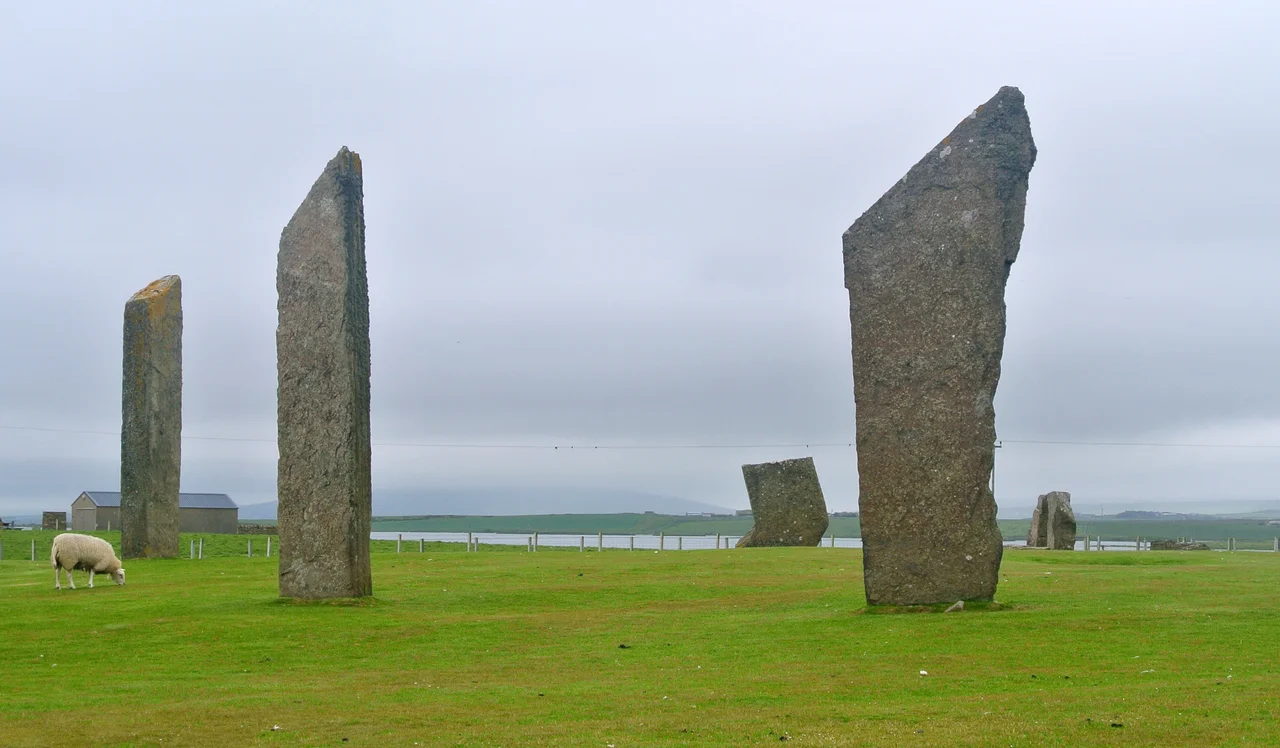

Standing Stones of Stenness
Captain Mackay had only owned the land for a few months when he decided the stones had to go. In December 1814 he took a sledgehammer to the Odin Stone, which had stood north of the henge for five thousand years, and smashed it to pieces. He moved on to the others, destroying one more and toppling a third before the outraged people of Orkney managed to stop him. The Standing Stones of Stenness had survived the Stone Age, the Vikings, the Reformation, and several centuries of weather. They very nearly did not survive a single irritated landowner from the Scottish mainland with a grudge against the locals who kept walking across his fields.
Possibly the Oldest Henge in Britain
Radiocarbon dating places the start of construction at the Stenness site around 3100 BCE. That date makes it possibly the oldest henge in the British Isles, predating Avebury, predating Stonehenge in its earliest form, predating most of the great Neolithic ceremonial monuments of Europe. The original layout was an ellipse of up to twelve thin slab-like stones, set on a levelled platform thirty metres across, surrounded by a ditch cut as much as two metres deep into the underlying rock. Only four stones remain standing. The tallest reaches six metres. The henge's single entrance causeway, on the north side, faces toward the Barnhouse Settlement on the shore of the Loch of Harray. Whoever planned this place wanted the people of Barnhouse to see it as they approached.
Stone Headland
The name comes from Old Norse: stein-nes, stone headland, pronounced stane-is in the Orcadian dialect. The Vikings who named the place had inherited the stones from people they did not know, on a landscape they were colonising as their own. The position is on a narrow promontory at the south bank of a stream that joins the sea loch Stenness with the freshwater Harray, a few hundred metres from where the Ness of Brodgar would later be excavated. Maeshowe is a short walk to the east. The Ring of Brodgar is across the bridge to the northwest. Every direction you look, there is another Neolithic monument. This was clearly the spiritual centre of a culture spread across an entire archipelago.
The Hearth at the Centre
In the middle of the original stone circle, archaeologists found a square stone setting that they describe as a hearth, similar to one excavated at the nearby Barnhouse Settlement. Cremated bone, charcoal, and pottery fragments were recovered from it. The presence of a hearth in the centre of what was a ceremonial monument is striking. It suggests the rituals practised here involved fire, food, and possibly the cremation of the dead. The pottery links Stenness directly to Skara Brae and Maeshowe, placing all four sites within a shared cultural network. Animal bones came out of the ditch, hinting at feasting and offering. People did things here that mattered enough to leave traces of food, fire, and bone behind.
The Odin Stone and the Vow
Even in the eighteenth century, the local traditions associated with Stenness were astonishingly persistent. Walter Scott visited in 1814 and recorded the customs. The Odin Stone, a single megalith standing north of the henge, had a hole bored through it at about waist height. Local people made what was called the Vow of Odin by clasping hands through that hole, an oath considered binding for all the kinds of promises that mattered most: marriage, contracts, reconciliations. The tradition had survived the conversion to Christianity by nine centuries. It survived Walter Scott's visit by less than a year. Captain Mackay destroyed the Odin Stone in December 1814, and one of the most extraordinary survivals of pre-Christian European ritual practice ended with the swing of a hammer.
What You See Now
The toppled stone was re-erected in 1906, along with some inaccurate reconstruction inside the circle that later excavators identified as a dolmen-like structure of dubious authenticity. That structure was taken down again in the 1970s, leaving the four original surviving megaliths and the Watch Stone, which stands outside the henge near the modern bridge. Historic Environment Scotland manages the site as a scheduled monument, and the henge is part of the Heart of Neolithic Orkney World Heritage Site inscribed by UNESCO in December 1999. The site sits open to the weather, with sheep grazing among the stones. You can walk between them, touch them, and stand where Neolithic people stood five thousand years ago. The Odin Stone, you cannot touch. There is only a small marker showing where it used to be.
From the Air
The Standing Stones of Stenness sit at 58.994°N, 3.208°W on the isthmus between the Loch of Stenness and the Loch of Harray. Kirkwall Airport (EGPA) is 12 km east-northeast, with paved facilities and limited instrument approaches. From 2,000 to 3,000 ft AGL, the two lochs form a distinctive figure-eight, and the four surviving megaliths appear as small dots clustered near the southern bridge. The Ring of Brodgar is visible to the northwest on the opposite side of the bridge. Westerly winds frequently exceed 30 kt. Best photographed in late-afternoon or early-morning light, when shadows from the tall stones throw distinctive markers across the grass.
Nearby Stories
- Castle of Mey 9.7 km away
- Copinsay 12 km away
- HMS Sword Dance (1918) 27 km away
- Strathnaver Museum 28 km away
- HMS King Edward VII 35 km away
- Fair Isle 74 km away
- Jarlshof 135 km away
- The Laki Eruption: The Volcano That Changed World History 926 km away