_-_SLV_H99.220-2989.jpg)
Star of India
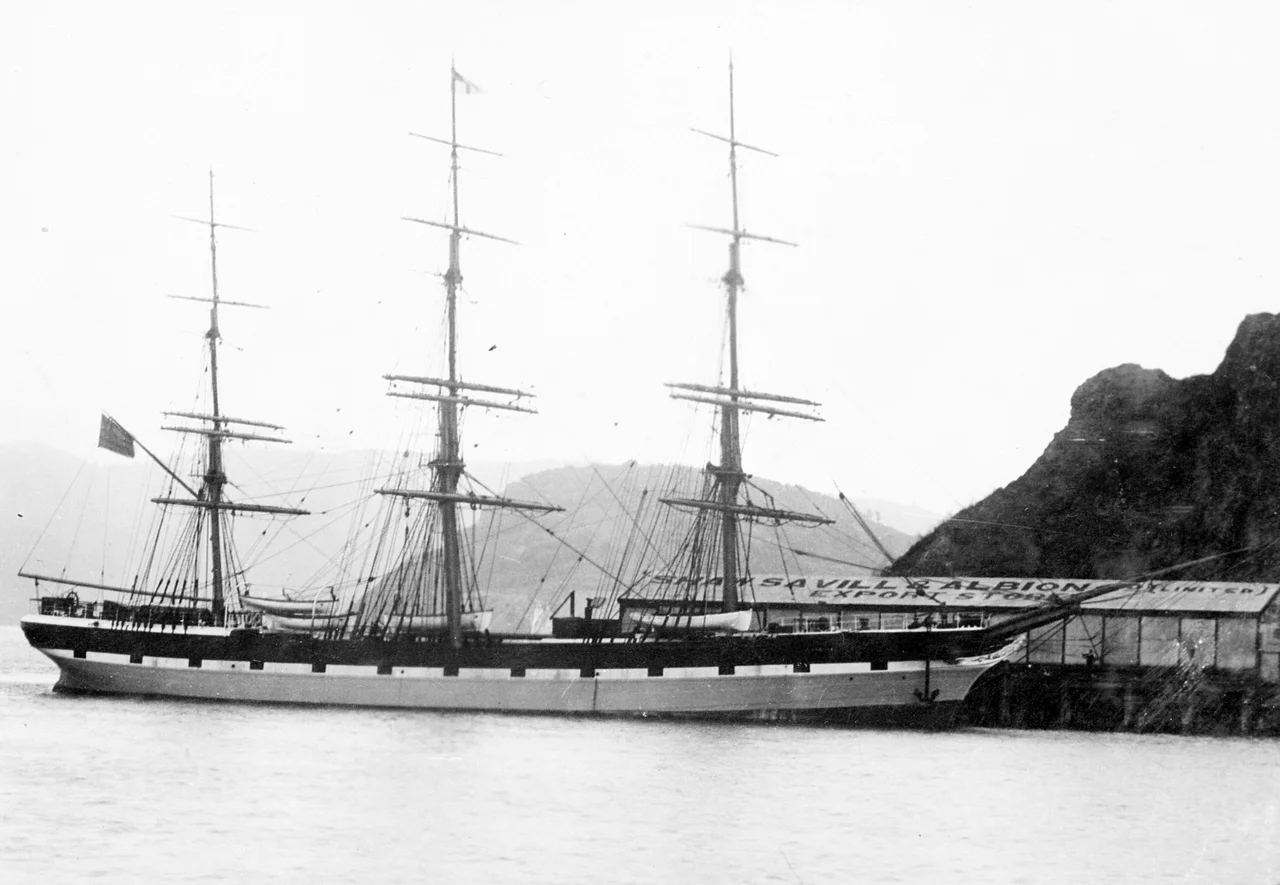
She departed Liverpool for Calcutta on January 9, 1864, under the name Euterpe — after the Greek muse of music — and within days, chaos. A collision with an unlit Spanish brig off the coast of Wales damaged her rigging. Her crew mutinied, refusing to continue. She turned back to Anglesey for repairs, and seventeen of the crew were confined to Beaumaris Gaol at hard labor. This was her first voyage. The ship that would eventually be called Star of India was not easily discouraged.
Around the World, Twenty-One Times
After her disastrous start, Euterpe settled into a long career in the New Zealand emigrant trade. Between 1871 and 1897, she made 21 round-the-world voyages, each time sailing eastward around the globe before returning to England — the fastest passage taking 100 days, the longest 143. Passengers gave birth aboard her; children were named for her and for the captains who carried them to Dunedin and Auckland. In 1865, she had to cut away her own masts in a gale in the Bay of Bengal off Madras and limp to Trincomalee for repairs. Her captain on that first voyage died during the return journey to England and was buried at sea. The ship survived everything.
From Euterpe to Star of India
In 1901, the Alaska Packers' Association of San Francisco purchased Euterpe and re-rigged her as a barque — converting her square-rigged aftermost mast to fore-and-aft, making her easier to handle with smaller crews. Starting in 1902, she carried fishermen, cannery workers, coal, and canning supplies each spring from Oakland to the Nushagak canneries in the Bering Sea, then returned in autumn with holds full of canned salmon. In 1906, the Association renamed her Star of India to match the rest of their fleet. She made 22 Alaskan voyages before being laid up in 1923. Steam had defeated sail.
Rescue and Return
In 1926, the Zoological Society of San Diego bought Star of India with plans to make her the centerpiece of a museum and aquarium. The Great Depression and World War II cancelled those plans. She sat in San Diego harbor, slowly decaying, for decades. In 1957, restoration efforts began — slowly at first. A breakthrough came when Alan Villiers, a windjammer captain and author, saw her deteriorating condition during a lecture tour and publicized the situation. A citizen group formed in 1959, calling themselves the Star of India Auxiliary. Money and effort accumulated. On July 4, 1976, Star of India sailed again for the first time in half a century. She has sailed at least once a year ever since.
The World's Oldest Active Sailing Ship
Star of India is the oldest ship in the world that still sails regularly, and the oldest iron-hulled merchant ship still afloat. Her hull, cabins, and equipment are nearly 100% original — not a reconstruction or replica, but the actual ship launched in Ramsey, Isle of Man, in November 1863. She is docked at the Maritime Museum of San Diego, just south of San Diego International Airport on North Harbor Drive, and the museum uses her for school tours and overnight living-history programs for thousands of children each year. More than 6,000 children visit annually. She also has a reputation for being haunted. Multiple paranormal television programs have investigated the claim. The ship has survived everything for 160 years; ghosts seem plausible.
From the Air
Located at 32.720°N, 117.174°W along the North Embarcadero in downtown San Diego, immediately south of San Diego International Airport (KSAN). The tall masts of Star of India and the Maritime Museum fleet are visible from the runway threshold. Best viewed at 500-1,500 feet on final approach to KSAN from the northwest.
Nearby Stories
- Laguna Fire 0.9 km away
- San Diego Botanic Garden 3.3 km away
- Santa Ysabel Asistencia 10 km away
- Valle de Las Palmas 19 km away
- Tijuana: The Border City That Became Its Own Third Country 20 km away
- Laguna Art Museum 55 km away
- San Clemente Island 69 km away
- USS Higbee 206 km away