
Stonehaven
The Highland Boundary Fault runs diagonally across Scotland from Helensburgh in the west to Stonehaven in the east, and what it does at Stonehaven is to bend the geology of the country around the back of the town. Stand on the headland south of the harbour, look inland, and the difference is visible: behind you, the bright red Old Red Sandstone of the lowlands; in front of you, the granite Grampian highlands rising in dark layers. It is, geologically and culturally, the line where lowland Scotland ends. Stonehaven could call itself the most northerly lowland town. Most days, it doesn't bother — it has other things to do.
A Harbour and Two Rivers
The Carron Water and the Cowie Water meet the sea here, in a deeply indented bay sheltered between Downie Point to the south and Garron Point to the north. The harbour, two basins of working stone, was rebuilt in the 1820s by the engineer Robert Stevenson — grandfather of the author Robert Louis Stevenson — and became, briefly, an important centre of the 19th-century herring trade. At the peak in 1894, Stonehaven boats landed about fifteen million herring in a single year and the industry employed twelve hundred and eighty people. Overfishing collapsed the catch within a generation; by 1939 only a remnant fleet remained. The harbour still works, though now for smaller boats and seafood that mostly stays local. On the north quay, the 16th-century Tolbooth in red sandstone has been variously a courthouse, a prison, and now a small museum, open Saturdays and Sundays from noon.
The Hogmanay Fireballs
On the night of 31 December each year — except during world wars and the 2021 COVID year — volunteers walk down Stonehaven's High Street swinging fireballs. The fireballs are homemade: balls of wire stuffed with burning rags, tar, paper, and old timber, attached to a chain and a handle. The walkers swing them in slow circles above their heads as they progress through the crowd, sparks scattering, faces lit orange. At the end of the route, the fireballs are thrown into the harbour, hissing into the water. The earliest newspaper reports of the ceremony go back to 1911; its origins are older but uncertain. Some say it is a fire-purification rite carried over from pre-Christian solstice traditions. Others say it is simply what Stonehaven has always done because Stonehaven has always done it. STV used to broadcast it as part of national Hogmanay coverage.
Dunnottar, the Crown Jewels, and the Covenanters
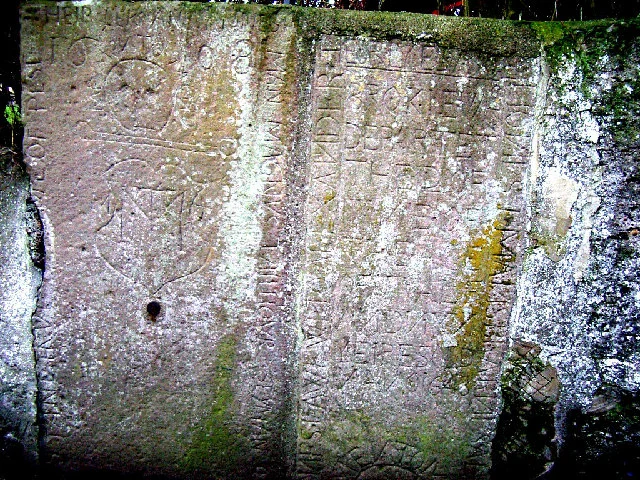
South of town, on a flat-topped sea-stack joined to the mainland by a narrow neck, stands Dunnottar Castle — one of the most cinematic ruins in Scotland. It was held by the Keith family for centuries. In 1296 Edward I of England took it; in 1297 William Wallace burned the church inside with the entire English garrison still in it. In 1650 Oliver Cromwell laid siege to the castle, eight months long, looking for the Honours of Scotland — the Scottish Crown Jewels. Just before the castle fell, the jewels were smuggled out and hidden in Kinneff Old Church down the coast, where they stayed undetected for eleven years. The Covenanters' Stone in the churchyard at Dunnottar Parish Church marks something darker: in 1685, 170 anti-royalist prisoners — men and women — were held in Dunnottar's vaults. Many died of disease or fell from the cliffs trying to escape. Most of the survivors were transported to the American colonies, where many landed in New Jersey.
The Deep-Fried Mars Bar and the Oldest Land Animal
Two improbable things both call Stonehaven home. The deep-fried Mars Bar — that legendary, almost mythological Scottish snack — is widely traced to the Haven Fish Bar in Stonehaven in the 1990s; the present-day Carron fish and chip shop on Allardice Street still sells around a hundred and fifty of them a week, mostly to tourists. The other improbable resident is much older. In 2004, a Stonehaven bus driver named Mike Newman, walking on Cowie Beach, found a small fossil. It turned out to be Pneumodesmus newmani, a primitive millipede about 428 million years old, with the earliest known spiracles — the breathing holes that suggest an animal had moved out of the sea and onto dry land. For a while it was considered the oldest evidence of land-dwelling animal life on Earth. The fossil lives now in the National Museum of Scotland in Edinburgh. Stonehaven's oldest resident, and its strangest snack, both came from the same stretch of beach within a few hundred metres of each other.
What Else There Is
The open-air swimming pool, Olympic-sized and heated and filled with filtered seawater, has been one of Stonehaven's pride pieces since the 1930s. The Folk Festival in July, the Highland Games at the same time, the Feein' Market on the first Saturday of June that recreates a 19th-century hiring fair, the RW Thomson Classic Car Rally celebrating the local inventor of the pneumatic tyre — the town's calendar is fuller than its population of around 11,600 might suggest. Robert Burns came through in 1787 to meet relatives. Mary, Queen of Scots passed through. William Wallace came down to burn an English garrison alive. Most days now, none of that history is visible. Most days, it is just a small fishing port on a beautiful curve of coast, with the cliffs of Dunnottar in one direction and the granite of Aberdeen in the other.
From the Air
Stonehaven lies at approximately 56.96°N, 2.21°W, on the northeast coast of Scotland about 15 nautical miles south of Aberdeen. Recommended viewing altitude is 2,500–5,000 feet AGL. The town is unmistakable: a sheltered bay between two headlands, a fishing harbour, and Dunnottar Castle on its cliff-top peninsula a mile south. EGPD (Aberdeen International) is the controlling airfield; Stonehaven is on the A90 corridor and the Dundee–Aberdeen rail line. The Highland Boundary Fault makes landfall immediately north of town — visible in the rapid transition from rolling lowland farms to higher Grampian terrain.
Nearby Stories
- Battle of Inverurie (1308) 3.9 km away
- Tomnaverie Stone Circle 9 km away
- Montrose Air Station Museum 12 km away
- Restenneth Priory 14 km away
- Auchindoun Castle 21 km away
- German submarine U-58 (1938) 104 km away
- Longstone Lighthouse 126 km away
- Farne Islands 158 km away