.jpg)
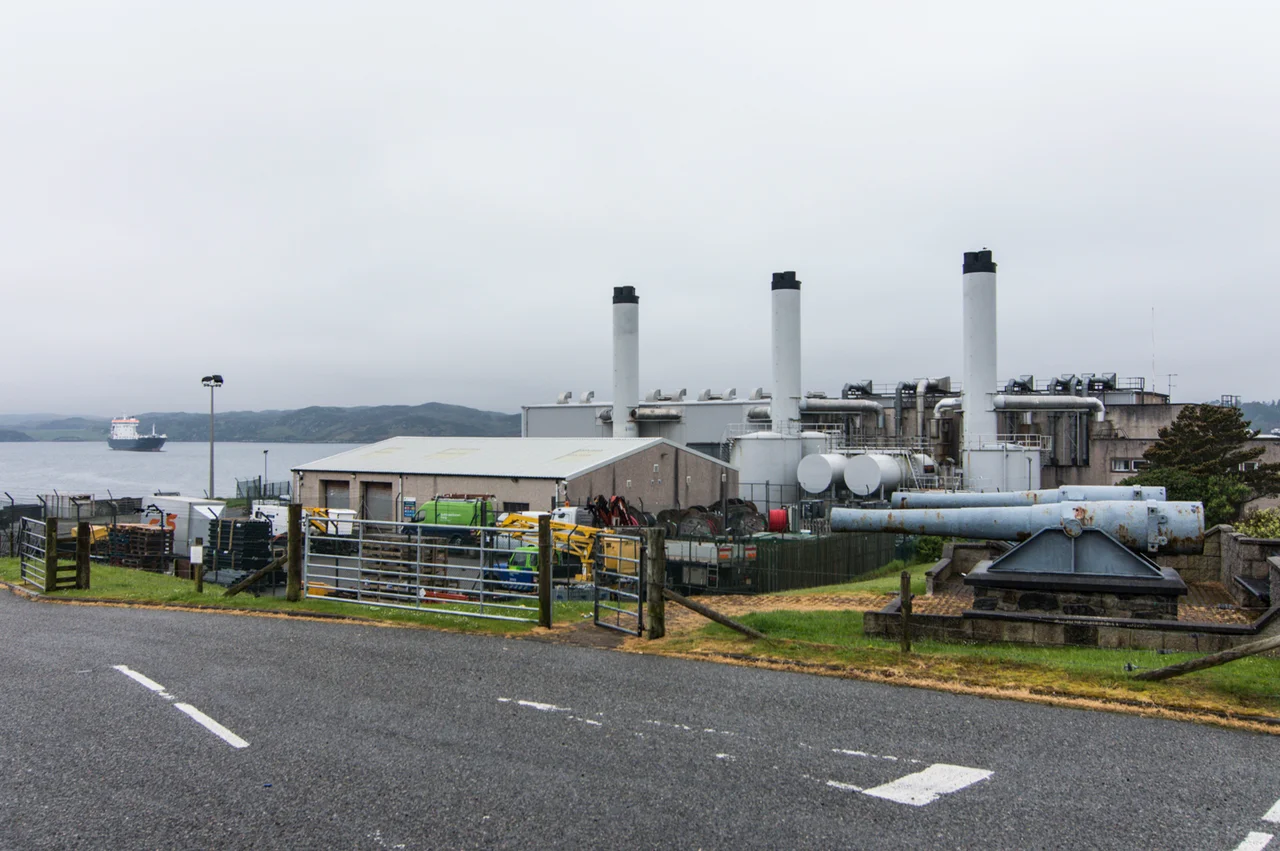
Stornoway Power Station
There is no engine number 4, and there is no engine number 7. The other eight Mirrlees Blackstone diesels at Battery Point, brought online in numerical order whenever Lewis demands more electricity than a single submarine cable can deliver, are numbered 1, 2, 3, 5, 6, 8, 9, and 10. Engineers learn quickly not to ask why. On a winter evening when the wind is up and Stornoway's lights are on, somewhere inside these long grey sheds at the entrance to the harbour, one of those engines is almost certainly running.
Built for an Island Off the Grid
Battery Point Power Station was commissioned in 1954 to supply power to a place the mainland grid had not yet reached. For decades the Western Isles ran their own electrical network, independent of Scotland's, with diesel generators in Stornoway and smaller stations at Arnish, Loch Carnan on South Uist, and Ardveenish on Barra holding the lines together. The station has a total rated output of 25.5 megawatts split across its eight medium-speed compression-ignition engines, which burn low-sulphur marine-grade diesel. The plant is owned and operated today by Scottish and Southern Electricity Networks, and it sits literally next to the old gun emplacement that gave the point its name, two centuries of energy infrastructure layered against one ragged stretch of Hebridean shoreline.
The Cable from Fort Augustus
Everything changed in 1990, when a 33-kilovolt submarine interconnector cable was laid to link Lewis through Harris and Skye to the 132 kilovolt mainland circuit running up from Fort Augustus. The diesels at Battery Point dropped from primary generation to a peaking and backup role. Now they fire up principally on winter nights when Lewis demand exceeds the cable's roughly 22-megawatt capacity, typically for about three hours each evening, five nights a week between November and March, an operating pattern engineers call 'peak lopping.' During cable-maintenance windows in summer the engines run continuously for a fortnight at a time. And when the cable simply fails, they carry the entire island. In November 2018, a landslip damaged the overhead transmission network on the mainland and the Western Isles were left wholly dependent on their four standalone diesel stations.
Old Engines, New Lessons
The engineering philosophy at Battery Point is straightforward: the newer engines (3, 9, and 10) come online first, with engine 8 next, then 5 and 6, then the original engines 1 and 2 as last resort. In 2017, with SSE's consent from the Scottish Environment Protection Agency, ABB Group refurbished the engine turbochargers, breathing new life into hardware that had been spinning since the Eisenhower administration. The site has acquired a strange dignity, becoming both a working power station and a kind of accidental industrial museum, with the start-up of engine number 6 immortalised on a YouTube video that has earned its own small cult following among diesel enthusiasts.
Wind, Cable, and the Future
What changed Lewis next was wind. As wind farms rose across the moors of Harris and Lewis, the operating logic of Battery Point shifted again: site operations are now largely dictated by how much wind energy is feeding the local grid. The proposed Western Isles HVDC connection, a 450-megawatt link between Beauly on the mainland and Lewis, was designed primarily to export wind power, but would also provide a redundant circuit reducing the islands' need for diesel altogether. Ofgem gave provisional support in 2019. The diesels keep working because nobody yet trusts the wires alone. On a calm night with the cable healthy and the wind low, the stacks at Battery Point stand silent against the lights of Stornoway, waiting to be told that the mainland has gone dark.
From the Air
Stornoway Power Station sits at 58.20 N, 6.37 W on Battery Point at the southwest entrance to Stornoway Harbour, about 1.5 nm southwest of EGPO Stornoway Airport (ICAO EGPO, IATA SYY). Distinctive features from the air: three exhaust stacks grouped together, the old gun battery just outside the perimeter, and the harbour breakwater extending east. Visible on left base for runway 06 at EGPO. Nearest alternates: Benbecula (EGPL) 65 nm south, Inverness (EGPE) 90 nm east-southeast.
Nearby Stories
- German submarine U-905 13 km away
- Loch Seaforth 13 km away
- Rua Reidh Lighthouse 19 km away
- The Minch 25 km away
- The Flannan Isles Mystery: The Lighthouse Keepers Who Vanished 33 km away
- Sollas 44 km away
- Sandwood Bay 84 km away
- The Laki Eruption: The Volcano That Changed World History 856 km away