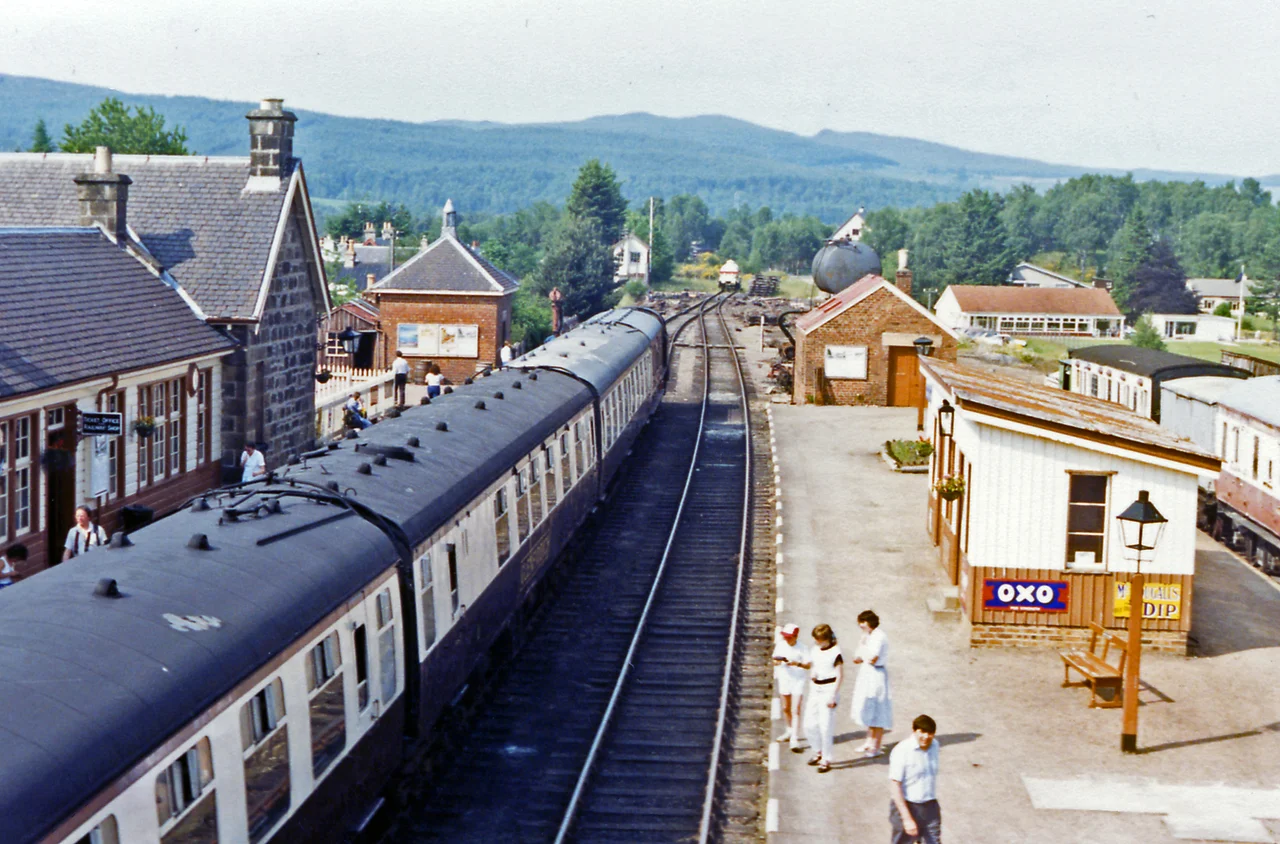

Strathspey Railway (preserved)
The whistle carries a long way in the Spey valley. It rises from the platform at Aviemore, drifts north along the line of the old Highland Railway through Boat of Garten, and dies somewhere over the heather of Granish Moor where the train chuffs in slow rhythm past the Cairngorm Brewery and out across country that for a few minutes will look, sound, and smell exactly like 1960. The Strathspey Railway runs ten miles of preserved track between Aviemore and Broomhill, and almost everything about it is deliberately, lovingly old. The locomotives are old. The signal boxes are old, worked by levers and mechanical semaphores. The carriages are old. Even the way the volunteers operate the line - with electric key tokens on one section and the older staff-and-ticket system on the other - is the way Britain ran its rural railways before the cuts. The cuts came in 1965, when the line from Aviemore to Forres was closed under the Beeching axe. By the late 1970s, a band of enthusiasts had bought back what they could and started running trains again.
The First Steam
On 22 July 1978, an LMS Class 2MT locomotive numbered 46464 - 'The Carmyllie Pilot' - hauled the first preserved passenger service on the line. The train left Aviemore Speyside station, ran the short distance to Boat of Garten, and brought half a century of British railway preservation history to the Spey valley. Locomotive 46464 was built at Crewe Works in 1950, one of a class of small mixed-traffic 2-6-0 engines designed by H.G. Ivatt for the London, Midland and Scottish Railway. By 1978 it was rare and irreplaceable. The Strathspey Railway has since acquired a working fleet that includes sister engine 46512 (built at Swindon in 1952), the unique Caledonian Railway 0-6-0 number 828 (built in 1899 and one of only two surviving Caledonian engines in working order), and the Andrew Barclay industrial saddle tank 'Braeriach', built in Kilmarnock in 1935. The four-road locomotive shed at Aviemore was built by the Highland Railway in 1898 to serve trains heading for Perth, Inverness, and Forres. It still does.
Working the Line
The line uses British Railways mechanical semaphore signalling - the arms-and-wires system that has almost vanished from the modern railway. Signals are pulled by levers in two physical signal boxes at Boat of Garten, one at the north end and one at the south. The single-track section from Boat of Garten South to Aviemore Speyside is controlled by Electric Key Token; the section from Boat of Garten North to Broomhill is still worked by Staff and Ticket, the older system that depends on a physical token carried with the train. Train crews coal their locomotives at a facility built in 2014 on the site of the former Aviemore Speyside station. Spey Lodge, a hostel built by the LMS during the Second World War to accommodate engine crews working away from home, now does the same job for volunteers. The level crossing at Dalfaber was added in the 1980s when housing arrived on the line's edge. Almost everything else is original or deliberately reconstructed in period style.
Boat of Garten
Halfway along the line, the train pulls into Boat of Garten. The station building dates from 1904 - a category B listed structure designed by William Roberts, with its original booking hall, ticket office, and waiting room still in use. The waiting room has an open fire. A coffee shop now occupies the old gas house on platform 1. The station was originally the junction where the Highland Railway main line from Perth to Forres met the Great North of Scotland Railway branch to Craigellachie; the GNSR's branch was the original Strathspey Railway, a name the preserved line now carries. The yard behind the station stores the majority of the railway's out-of-service rolling stock, and a new covered shed built in 2018-2019 keeps the wooden carriages out of the weather. Boat of Garten is also the only place on the line with a water column. When a locomotive needs to drink, this is where it stops. The village outside is known to ornithologists as the Osprey Village - Loch Garten and its famous nest sit just a short walk away.
Glenbogle and Beyond
The northern terminus, Broomhill, sits in countryside roughly halfway between Nethy Bridge and Dulnain Bridge. The replica station building stands on the foundations of the original. Viewers of the BBC drama Monarch of the Glen, which ran from 2000 to 2005, will recognise it as Glenbogle, the fictional Highland railway station that featured throughout the series. The volunteers' ambition stretches farther: a full extension to Grantown-on-Spey along the original Highland Railway alignment to Dava and Forres. The Scottish Executive committed in 2006 to re-aligning the A95 at Gaich to allow the railway to pass underneath, and donated trackwork from the relaid Stirling-to-Alloa line is waiting in storage. Network Rail donated the steelwork of the former Merry Street Bridge in Motherwell; in February 2014, with Colas Rail providing one of the few cranes in Britain capable of the lift, the bridge was installed over the River Dulnain and track was laid across it. The full extension would cost more than £13 million and depends on Scottish Government statutory orders that have not yet arrived. For now, the train chuffs out beyond Broomhill into the fields, the locomotive changes ends on the passing loop, and it returns south.
From the Air
The Strathspey Railway runs between 57.21°N, 3.83°W (Aviemore) and approximately 57.30°N, 3.66°W (Broomhill), roughly 10 nautical miles southeast of Inverness Airport (EGPE). The line follows the Spey valley on a northeasterly heading, paralleling the A95 road and the Speyside Way long-distance footpath. Recommended viewing altitude is 2,000-3,500 ft AGL to track the line through the trees; the easiest visual reference is the broad U-shape of the Spey valley, with the Cairngorm massif (peak 1,245 m at Cairn Gorm) to the southeast and rolling Monadhliath foothills to the northwest. Look for steam: an active train shows a clear plume that is visible for several miles in still air. EGPE provides full instrument approaches. Aviemore has no airfield. The line is best viewed in autumn, when low sun lights the steam from behind and the deciduous trees along the route turn gold.
Nearby Stories
- Dalwhinnie distillery 1.9 km away
- Battle of Mons Graupius 11 km away
- Black Isle 12 km away
- Battle of Auldearn 13 km away
- Keith, Moray 14 km away
- Kildrummy Castle 16 km away
- Boleskine House 16 km away
- Siege of Blair Castle 22 km away