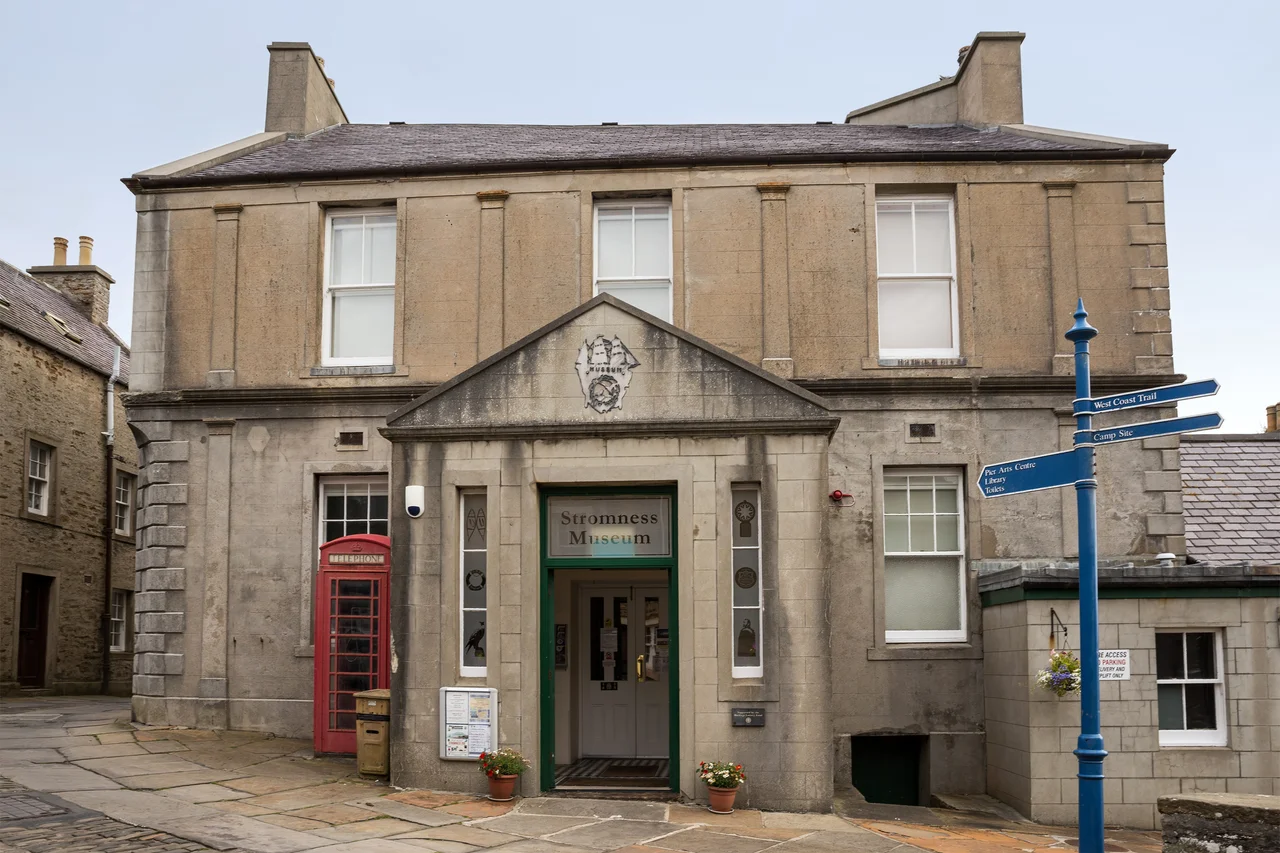

Stromness Museum
Curators were going through what they thought was the last unopened box in the Skara Brae collection in 2016 when they pulled out a small whalebone figurine. It had been catalogued sometime in the nineteenth century, then misplaced, then forgotten. The carving turned out to be five thousand years old, one of the earliest known representations of the human form from Neolithic Britain. It had been sitting in a drawer at the Stromness Museum the entire time. Small museums often have this problem: they are full of things their predecessors collected for reasons nobody now remembers, and occasionally one of those things turns out to be priceless.
A Town Hall That Became a Museum
The building was built as a town hall. Stromness grew quickly in the early nineteenth century on the back of the herring fishery and the Hudson's Bay Company trade, and by 1856 the population had reached the point where the area was created a police burgh. The new burgh council commissioned a neoclassical town hall, built in dressed ashlar stone and completed in 1858. The council occupied the ground floor. The Orkney Natural History Society, founded in 1837 by Stromness merchants and gentlemen-naturalists, took the first floor and opened a museum there in the same year the building was finished. In the 1920s the burgh council moved out and the society took over the whole building. It has been a museum ever since.
The Arctic Collection
Stromness was for two centuries the last British port that Hudson's Bay Company ships called at before crossing the Atlantic. Generations of Orcadian men joined the company as labourers, clerks, and traders, and many of them spent their working lives in what is now northern Canada. John Rae, born on the Hall of Clestrain just outside Stromness, was the explorer who eventually established the fate of the Franklin expedition. The museum's Arctic collection reflects this connection: an Arctic medal awarded to Sir John Franklin himself, ethnographic items collected by Orcadians working for the Company, and one of only two surviving examples of the Halkett boat, a folding inflatable craft invented by a Royal Navy lieutenant in the 1840s for Arctic exploration.
Cook Came Here Twice
Captain James Cook's third voyage, the one that took him to Hawaii where he was killed, ended in Stromness in 1780 when HMS Resolution and HMS Discovery sheltered in the harbour on their long limp home from the Pacific. Some of what the crew brought back with them stayed in the town, scattered through private collections and eventually finding its way into the museum. There are objects associated with Cook's third voyage in the Stromness Museum collection today, more than two centuries after his crew tied up at the local pier. The town's other connection to Pacific exploration came through Jack Renton, a Stromness man who survived eight years as a captive on the Solomon Islands in the 1860s before being rescued. His ethnographic collection is also on display.
Fragments from Scapa Flow
Stromness sits on the western edge of Scapa Flow, the great natural anchorage where the interned German High Seas Fleet was scuttled in 1919 and where HMS Royal Oak was torpedoed by U-47 in 1939. The museum's naval history collection reflects this geography. There are artefacts recovered from the scuttling of the German fleet, fragments of ships that ended up on the seabed a few miles offshore. There is a dumaresq, a mechanical fire-control computer, recovered from HMS Vanguard, the British dreadnought that exploded in Scapa Flow in 1917 when her magazine cooked off, killing all but two of her thousand-strong crew. The Vanguard relics had been in the museum's collection for decades before researchers identified what they were.
Shabti and Whalebone
In 2020, researchers from the National Museum of Scotland visiting Stromness identified two Egyptian faience shabti dating from 1145 to 986 BC in the collection. Nobody in Stromness had known what they were. Shabti are small funerary figurines, placed in Egyptian tombs to act as servants for the dead in the afterlife. How they reached an Orkney museum is unclear, but Orcadians travelled widely and collected widely, and the British nineteenth century was a great moment for the casual export of Egyptian antiquities. Combined with the whalebone Skara Brae figurine rediscovered four years earlier, the museum's collection includes one of the oldest known human representations from Neolithic Britain and figurines that once accompanied Egyptian dead into eternity. Not bad for a building originally meant to house council meetings.
From the Air
Stromness Museum sits at 58.958°N, 3.301°W in the heart of the town of Stromness on the southwest coast of the Orkney Mainland. Kirkwall Airport (EGPA) is 15 km east-northeast, with paved facilities and limited instrument approaches. From 2,000 ft AGL Stromness is recognisable as a long narrow town strung along the harbour at the head of Hamnavoe, with the dark hills of Hoy rising across the channel to the south. The museum building itself is a small neoclassical structure on Alfred Street near the southern end of town. Westerly winds funnel down the channel between Mainland and Hoy and can produce significant turbulence. Best viewed in late-morning light from the east.
Nearby Stories
- Castle of Mey 9.7 km away
- Copinsay 12 km away
- HMS Sword Dance (1918) 27 km away
- Strathnaver Museum 28 km away
- HMS King Edward VII 35 km away
- Fair Isle 74 km away
- Jarlshof 135 km away
- The Laki Eruption: The Volcano That Changed World History 926 km away