.jpg)
Studley Royal Park
By 1726, approximately a hundred men were at work digging canals and shaping ponds in a Yorkshire valley that had already been a landscape garden for nearly a hundred and fifty years. Christopher Saxton's 1577 map of Yorkshire shows the enclosed park as it existed under earlier owners. The Aislabie family - first John, disgraced by the South Sea Bubble and exiled from London politics, then his son William - turned that valley into something unprecedented: a designed water garden built around the ruins of a Cistercian abbey dissolved by Henry VIII. The result, now jointly listed by UNESCO with Fountains Abbey, is the most fully realised example of the English water garden style still surviving anywhere in the country.
Politics of a Garden
John Aislabie was Chancellor of the Exchequer when the South Sea Bubble collapsed in 1720. Censured, expelled from Parliament, banned from public office, he came home to Studley with nothing left to do except remake the landscape. The political wound is everywhere in the design. The Moon Pond, the crescent ponds flanking it, the half-moon pond beyond - they are exercises in geometric perfectionism by a man who had lost the chance to perfect anything else. Each pond is grade II* listed today, stone-walled and clay-lined, surveyed in 1730 in essentially the form they hold now. The grade I-listed canal runs five hundred metres, ten metres wide, with gritstone walls and a puddled clay base; near the weir called Drum Falls it angles deliberately, breaking the straight line where the cascade demands movement. Drum Falls itself drops in four stepped courses flanked by fishing pavilions with Venetian windows and pyramidal roofs.
The Borrowed Ruin
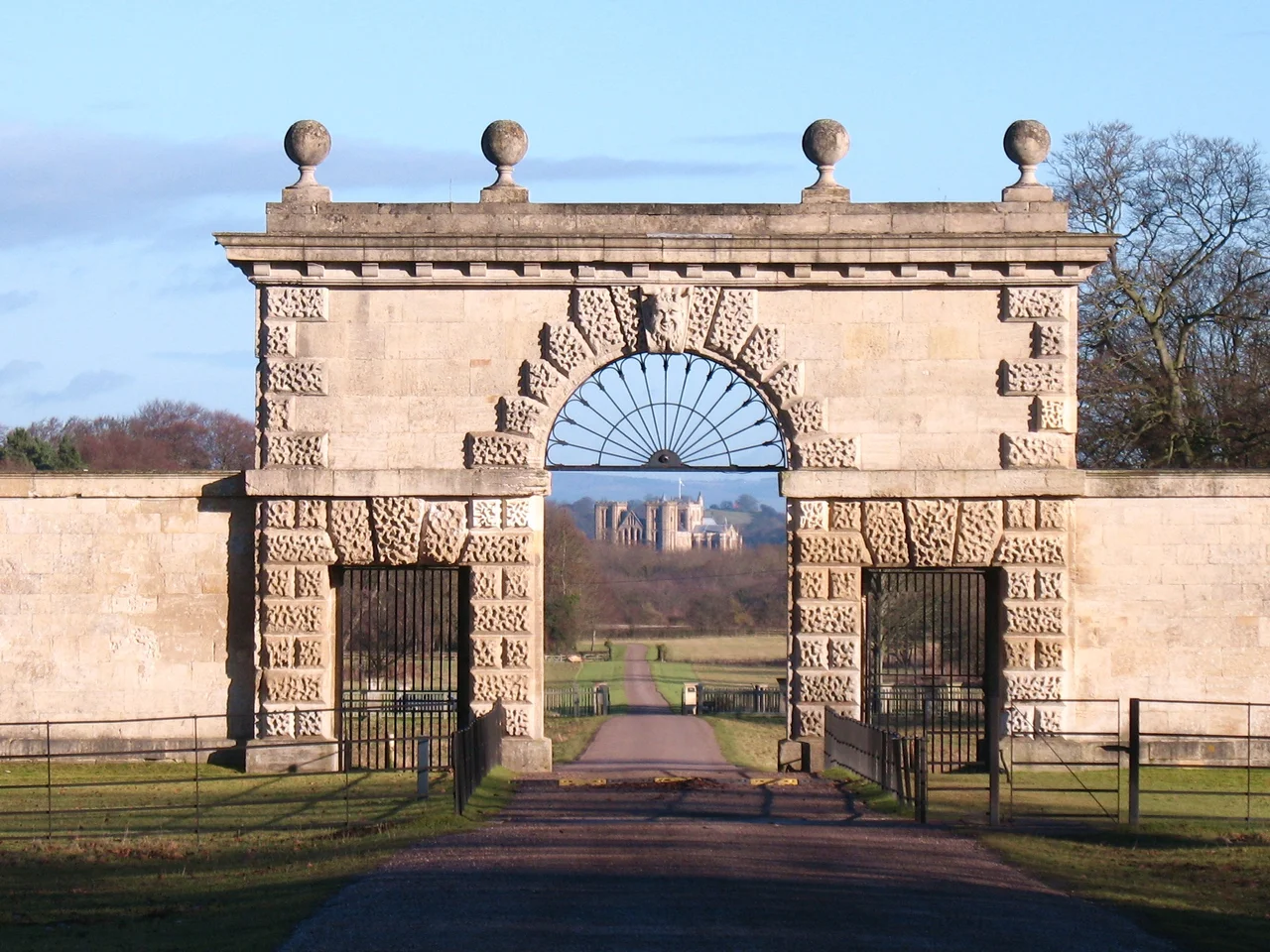
What sets Studley apart from every other Georgian water garden is the ruin at the end of the walk. Fountains Abbey, founded in 1132 by Cistercian monks and dissolved by Henry VIII in 1539, sits on the western side of the estate. The Aislabies acquired Fountains in 1767 and incorporated the abbey as the designed climax of the visitor's path - a deliberate gothic surprise after the formal pools and follies. The family had been letting visitors view the ruins as early as 1655, more than a century before the abbey became theirs to frame. The combination is what made the UNESCO listing inevitable: a designed landscape that uses an authentic medieval ruin not as a folly but as its final reveal. Walk the cascade, round the Half-Moon Pond, follow the river path through the Skell valley, and the abbey appears - real twelfth-century stone, where the picturesque convention would put a fake.
The Burges Church
Above the park stands St Mary's Church, an 1870s commission by the family of the 1st Marquess of Ripon. The reason is harrowing: their son Frederick Grantham Vyner had been kidnapped and killed in Greece in 1870, one of four hostages taken by brigands near Marathon in what became known as the Dilessi murders. The architect chosen for the memorial was William Burges - one of the most inventive of the Victorian gothic revivalists, secured through his friendship with Vyner's Oxford contemporary the Marquess of Bute. Burges worked on it from 1871 until consecration in 1878. Nikolaus Pevsner called the result a Victorian shrine, a dream of Early English glory. The stained glass and the saturated interior are among the finest things Burges ever did - his ecclesiastical masterpiece, by general consent. Both marquesses and their wives are buried inside.
What Remains, What Changes
The Vyner family sold the estate after the Second World War; the upkeep had become impossible. The National Trust took over the water garden in 1983 and joined it with Fountains under joint management. St Mary's is owned by the State and managed by the Trust under local agreement. Ted Cullinan designed the new visitor centre in 1992, set north-west of the abbey above the valley floor so as not to disturb sightlines. The deer park survives intact; in 1738 John Clerk watched the bucks move together so that they resembled a moving forest, and the herd is still there. Modern interventions are kept light: Mat Collishaw's installations in the Temple of Piety in 2016, Steve Messam's site-specific exhibition in 2021, Joe Cornish's photographs across the estate in 2022. The garden absorbs them, then returns to itself.
From the Air
Studley Royal Park is centred at 54.12 degrees north, 1.57 degrees west, two miles southwest of Ripon in North Yorkshire. The estate covers roughly 800 acres in the Skell valley. From altitude, look for the linear cascade of canal and ponds running northeast-southwest, with Fountains Abbey ruins at the western end. Best viewed at 3,000-4,500 feet AGL. Leeds Bradford (EGNM) is approximately 25 nautical miles south. Teesside (EGNV) lies about 30 nautical miles north. The Yorkshire Dales rise to the west; the Vale of York extends east.
Nearby Stories
- Elland Road 1.4 km away
- Gordale Scar 2.6 km away
- Sheriff Hutton Castle 5.1 km away
- Selby Rail Crash 6.6 km away
- Battle of Catraeth 7.5 km away
- Rosedale Abbey 12 km away
- Murder of Sophie Lancaster 12 km away
- Hawes Junction Rail Crash 14 km away